
Server-Side Tracking: 7 Powerful Reasons Modern Marketing Needs Better Conversion Data
Digital advertising depends on data.
Businesses use conversion data to understand which campaigns generate leads, which audiences perform best, which ads drive purchases, and where marketing budgets should be increased or reduced.
But modern tracking has become more complicated.
Browser privacy changes, cookie restrictions, ad blockers, consent requirements, and technical limitations can reduce the amount of conversion data captured through traditional browser-based tracking.
That is why Server-Side Tracking has become increasingly important for performance-focused businesses.
Server-Side Tracking creates a more controlled way to collect and send important website or app events to analytics and advertising platforms. Instead of depending entirely on a visitor’s browser to transmit every event, important data can also be processed through a server environment.
The result can be stronger conversion tracking, better marketing data accuracy, more dependable ad tracking, and greater control over first-party tracking.
Before increasing advertising budgets, businesses need to trust the information they are using to make decisions.
This guide explains 7 powerful reasons why modern marketing needs better conversion data and where Server-Side Tracking fits into a stronger measurement strategy.
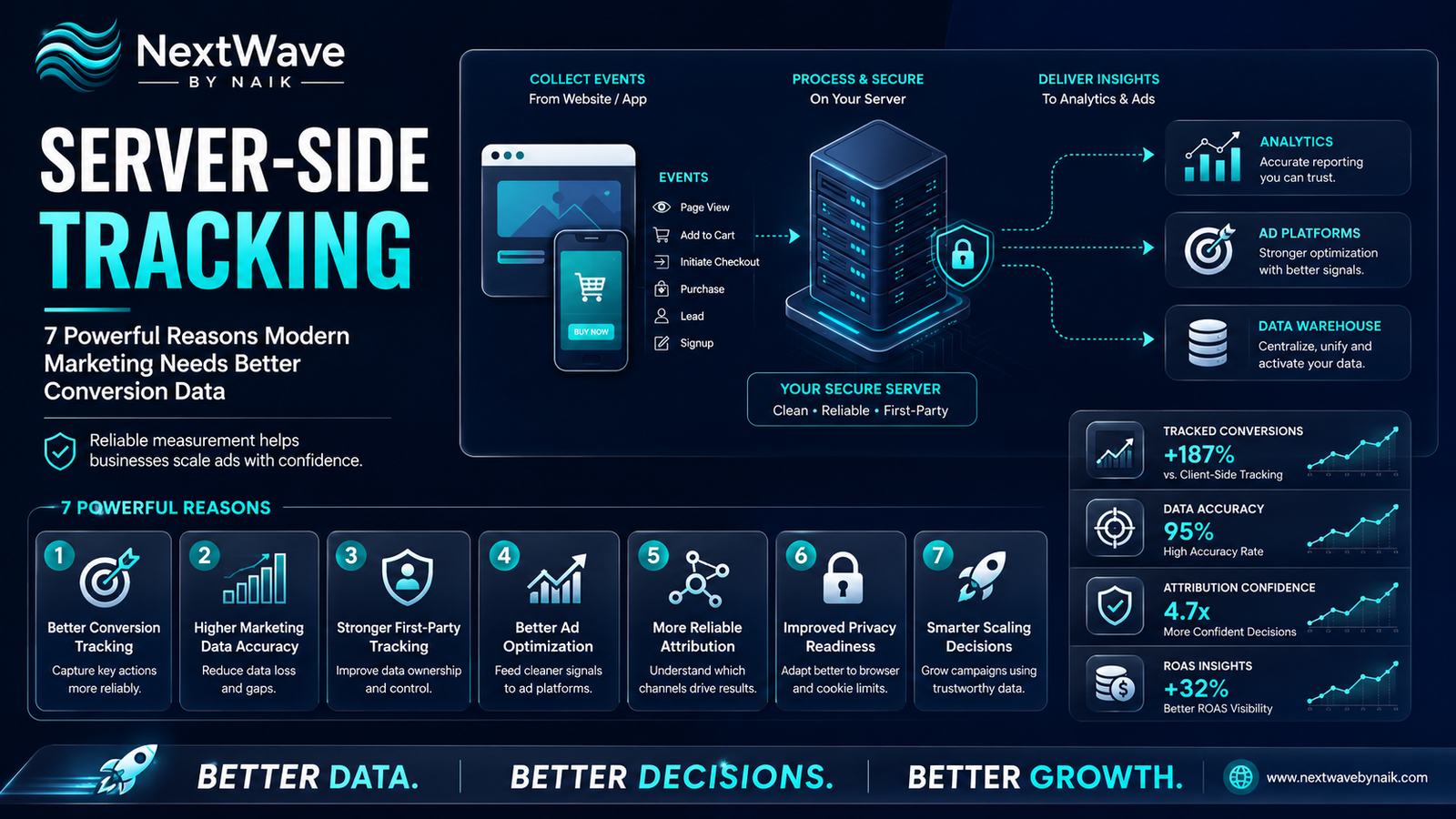
What Is Server-Side Tracking?
Server-Side Tracking is a method of collecting and processing website or application events through a server before sending relevant information to analytics, advertising, CRM, or other marketing platforms.
Traditional browser-side tracking often works like this:
Visitor → Browser → Tracking Script → Analytics or Ad Platform
With server-side measurement, part of the process can become:
Visitor → Website/App → Server → Analytics or Ad Platform
This gives businesses more control over how events are processed and where information is sent.
Common events may include:
- Page views
- Form submissions
- Lead generation
- Add-to-cart actions
- Checkout initiation
- Purchases
- Sign-ups
- Appointment bookings
- Subscription events
The goal is not to collect unlimited information.
Good implementation should focus on relevant business events while respecting consent, privacy requirements, and platform policies.
Why Conversion Data Matters Before Scaling Advertising
Imagine a business spending ₹50,000 per month on paid advertising.
The tracking system reports:
- Campaign A: 15 conversions
- Campaign B: 28 conversions
- Campaign C: 9 conversions
Based on this information, the business may increase Campaign B’s budget.
But what happens if a significant number of Campaign A’s conversions were never recorded?
The optimization decision could be wrong.
Now imagine increasing the advertising budget from ₹50,000 to ₹2,00,000 using incomplete information.
The financial impact becomes much larger.
Reliable conversion tracking therefore matters before a company scales.
Advertising platforms optimize based on the signals they receive. Marketing teams also make strategic decisions using the same information.
Poor data can lead to:
- Wrong campaign decisions
- Misleading ROAS calculations
- Incorrect audience optimization
- Missed conversions
- Unreliable attribution
- Wasted advertising spend
Better measurement creates a stronger foundation for performance marketing.
7 Powerful Reasons Server-Side Tracking Matters
1. More Reliable Conversion Tracking
One of the biggest reasons businesses explore Server-Side Tracking is measurement reliability.
Traditional client-side tracking depends heavily on the user’s browser.
That means event collection may be affected by:
- Browser settings
- Tracking prevention
- Script-blocking extensions
- Cookie restrictions
- Network interruptions
- JavaScript failures
If an important purchase or lead event does not reach the analytics or advertising platform, the business may underestimate campaign performance.
Server-Side Tracking can provide an additional measurement layer for important events.
For example, an e-commerce business may track:
- Product view
- Add to cart
- Checkout
- Purchase
When the purchase is confirmed on the business’s backend, the server can help communicate that event to connected systems.
This makes conversion tracking more dependable for business-critical actions.
2. Better Marketing Data Accuracy
Marketing decisions are only as good as the information behind them.
Suppose an advertising dashboard reports:
- 80 leads
while the CRM contains:
- 112 genuine leads
That difference creates a serious measurement gap.
Marketing teams may incorrectly believe:
- The campaign is performing poorly
- A channel should be paused
- Cost per lead is too high
- A different audience is more effective
Improving marketing data accuracy helps reduce these gaps.
With a carefully designed Server-Side Tracking system, businesses can align:
- Website events
- CRM data
- Ad-platform conversions
- Analytics data
- Purchase records
The goal should be consistent measurement across systems.
A more accurate data foundation helps teams make better decisions about budgets, targeting, creative strategy, and sales follow-up.
3. Stronger First-Party Tracking
Modern businesses increasingly need better control over their own customer interactions.
First-party tracking focuses on data generated through direct relationships between the business and its customers.
Examples may include:
- Website interactions
- Form submissions
- Purchases
- Account registrations
- Customer preferences
- CRM activity
With Server-Side Tracking, businesses can process relevant first-party events within systems they control before sending permitted information to external tools.
This can improve:
- Data governance
- Measurement consistency
- Platform integration
- Customer journey analysis
It also encourages businesses to build measurement strategies around their own digital infrastructure rather than depending entirely on third-party browser mechanisms.
4. Better Advertising Optimization Signals
Advertising platforms depend on conversion signals to optimize campaigns.
Imagine an advertising platform receives only 60% of the genuine purchase events from a campaign.
Its optimization system is learning from incomplete information.
That can affect:
- Audience optimization
- Automated bidding
- Campaign learning
- Conversion modelling
- Budget allocation
Better ad tracking gives platforms stronger signals about which visitors are completing valuable actions.
For example, suppose two audience segments each generate 20 real purchases.
But the tracking system records:
Audience A → 18 purchases
Audience B → 9 purchases
The platform may incorrectly favour Audience A, even though both produced equal results.
More complete event signals can support better campaign optimization.
However, Server-Side Tracking cannot repair a poor advertising strategy.
It improves measurement. The offer, creative, audience, landing page, and sales process still need to perform.
5. More Reliable Marketing Attribution
Marketing attribution tries to answer:
Which marketing activities contributed to this conversion?
A customer journey may look like:
Instagram Ad
↓
Website Visit
↓
Google Search
↓
Return Visit
↓
WhatsApp Enquiry
↓
Sales Call
↓
Purchase
If important touchpoints or conversion events are missing, attribution becomes less reliable.
A stronger Server-Side Tracking setup can help businesses connect important events more consistently across their measurement stack.
This supports better analysis of:
- Campaign source
- Landing pages
- Lead events
- Purchases
- Revenue
- Customer acquisition
Reliable attribution matters because businesses need to know where to invest their next marketing rupee.
Without accurate measurement, attribution reports may look precise while still being incomplete.
6. Greater Control Over Data Processing
Traditional tracking often sends browser-generated information directly to several external platforms.
Server-side architecture can create an additional processing layer.
This gives businesses more control over:
- Which events are sent
- Which fields are included
- Where data is routed
- How events are formatted
- How systems communicate
This can support cleaner measurement architecture.
For example:
Website
↓
Server environment
↓
Analytics
↓
Advertising platform
↓
Data warehouse / CRM
Instead of adding multiple independent scripts and tags directly to the visitor’s browser, businesses can centralize parts of the measurement process.
However, control also creates responsibility.
Businesses still need to follow:
- Applicable privacy laws
- User consent requirements
- Advertising platform policies
- Internal data governance standards
Server-Side Tracking should be designed as a responsible measurement system, not as a way to bypass user privacy choices.
7. More Confident Advertising Scalability
This is where measurement connects directly with business growth.
Before scaling advertising, businesses need answers to questions such as:
- Which campaigns generate qualified leads?
- Which campaigns generate revenue?
- Which channels produce repeat customers?
- What is the real cost per acquisition?
- Which audiences convert?
- Which ads generate profitable purchases?
If the underlying data is unreliable, scaling becomes risky.
Strong Server-Side Tracking can provide greater confidence in the events being used for these calculations.
Consider two scenarios.
Scenario A: Weak Measurement
Reported ad spend: ₹1,00,000
Reported revenue: ₹2,00,000
Reported ROAS: 2x
But 25% of purchases are missing from tracking.
Actual revenue may be significantly higher.
Scenario B: Better Measurement
Advertising data is compared with backend orders and CRM results.
The company receives a more complete picture of campaign performance.
Now budget decisions are based on stronger evidence.
This is one of the most important reasons businesses should improve tracking before aggressively scaling campaigns.
Client-Side Tracking vs Server-Side Tracking
It is important to understand that Server-Side Tracking does not necessarily mean removing all browser tracking.
Many implementations use both.
Client-Side Tracking
Events are primarily collected and sent from the user’s browser.
Advantages:
- Easier implementation
- Useful for page interactions
- Supports front-end behaviour tracking
- Widely supported
Limitations:
- Can be affected by browser restrictions
- Can be blocked
- Depends on front-end scripts
- May experience data loss
Server-Side Tracking
Events are processed or sent through the server.
Advantages:
- Greater control
- Stronger first-party measurement architecture
- Useful for confirmed backend events
- Can improve measurement reliability
Limitations:
- More technical to implement
- Requires proper event validation
- Needs ongoing monitoring
- Privacy and consent still apply
The best approach often depends on the business, platform, and measurement requirements.
Which Events Should Businesses Track?
Not every website interaction needs to become a major conversion signal.
Focus on events connected to meaningful business outcomes.
Lead Generation Businesses
Track:
- Contact form completed
- Consultation booked
- WhatsApp enquiry
- Phone lead
- Qualified lead
- Sales opportunity
E-Commerce Businesses
Track:
- Product view
- Add to cart
- Checkout
- Purchase
- Refund
- Repeat purchase
Education Businesses
Track:
- Course enquiry
- Application start
- Application completed
- Counselling booking
- Enrollment
Service Businesses
Track:
- Quote request
- Appointment booking
- Service enquiry
- Consultation
- Confirmed customer
Good conversion tracking starts with clearly defining what actually matters to the business.
Server-Side Tracking and CRM Integration
One of the strongest measurement improvements can happen when marketing data is connected with sales outcomes.
Consider this journey:
Ad Click
↓
Website Form
↓
CRM Lead
↓
Sales Call
↓
Qualified Opportunity
↓
Customer
Most advertising systems easily measure the initial form submission.
But a form submission is not necessarily a good lead.
If the CRM records which leads become actual customers, businesses can evaluate advertising using deeper outcomes.
This creates a better feedback loop between:
- Marketing
- Sales
- CRM
- Advertising platforms
Server-Side Tracking can form part of this broader measurement architecture.
The ultimate objective is not merely to count leads.
It is to understand which marketing efforts generate meaningful business results.
Common Server-Side Tracking Mistakes
Tracking Everything Without a Strategy
More events do not automatically produce better insights.
Track meaningful actions.
Sending Duplicate Conversions
If the same conversion is sent from both browser and server without proper deduplication, reports may become inflated.
Ignoring CRM Data
Lead quantity alone does not show lead quality.
Poor Event Naming
Events should be clearly and consistently defined.
No Testing Before Launch
Always test whether events are firing correctly.
Assuming Server-Side Tracking Guarantees Perfect Data
No measurement system is perfect.
Server-side architecture can improve reliability, but implementation quality still matters.
Ignoring Privacy Requirements
Better tracking must still respect consent and applicable regulations.
Server-Side Tracking Implementation Checklist
Before implementing Server-Side Tracking, businesses should define:
- Primary conversion goals
- Important website events
- CRM outcomes
- Analytics requirements
- Advertising platforms
- Consent requirements
- Event naming standards
- Deduplication strategy
- Testing process
- Data validation process
After implementation, regularly compare:
- Website conversions
- Analytics conversions
- Advertising conversions
- CRM leads
- Sales results
- Backend revenue
Major differences may indicate tracking issues.
Why Marketing Data Accuracy Matters for ROAS
Return on ad spend is commonly calculated as:
Revenue attributed to advertising ÷ Advertising spend
But the calculation is only useful if the revenue data is reasonably complete.
If conversion events are missing, ROAS may appear lower than reality.
If conversions are duplicated, ROAS may appear artificially high.
That means marketing data accuracy directly affects performance reporting.
Businesses should therefore avoid scaling campaigns based only on dashboard numbers without checking those numbers against actual sales or backend data.
Better Tracking Does Not Replace Better Marketing
It is important to keep expectations realistic.
Server-Side Tracking can improve the quality of measurement.
It cannot fix:
- A weak offer
- Poor advertising creative
- Incorrect targeting
- Slow landing pages
- Confusing forms
- Bad sales follow-up
- Poor customer experience
Think of tracking as the measurement system.
Better measurement helps you see what is happening.
You still need a strong strategy to improve the results.
When Should a Business Consider Server-Side Tracking?
It may be worth considering when:
- Advertising spend is increasing
- Important conversions appear to be missing
- CRM numbers differ significantly from ad dashboards
- Multiple advertising platforms are used
- E-commerce revenue attribution matters
- Lead quality needs to be connected with campaigns
- First-party data strategy is becoming more important
- The business requires stronger measurement infrastructure
Small businesses with very simple marketing systems may not need complex tracking immediately.
But as advertising becomes more sophisticated, measurement architecture becomes more important.
Conclusion
Modern performance marketing depends on reliable information.
Businesses cannot confidently scale advertising if they do not understand which campaigns, audiences, and channels are actually generating results.
Server-Side Tracking can strengthen the measurement foundation by improving conversion tracking, supporting better marketing data accuracy, creating stronger ad tracking signals, and giving businesses greater control over first-party tracking.
The goal is not to collect more data simply because it is possible.
The goal is to collect the right data accurately enough to make better business decisions.
Before increasing ad spend, confirm that your tracking system can answer the most important question:
Which marketing activities are actually producing valuable business outcomes?
Better data leads to better decisions.
And better decisions make advertising growth much easier to manage.
Ready to turn blogging into a powerful SEO growth engine for your business?
At NextWave By Naik, we specialize in creating data-driven blogging strategies that improve rankings, attract organic traffic, and build long-term authority. From keyword research to content creation and optimization, we handle everything—so you can focus on growing your business.