
What Is Search Intent Mapping?
Search intent mapping means assigning keywords to website pages based on the reason behind the search.
In simple terms:
Keyword → Search Intent → Content Type → Website Page
For example:
| Keyword | Intent | Best Page Type |
|---|---|---|
| What is SEO? | Informational | Blog/Guide |
| Best SEO tools | Commercial | Comparison/Listicle |
| SEO agency in Bangalore | Commercial/Transactional | Service Page |
| Buy SEO software | Transactional | Product/Pricing Page |
| OpenAI login | Navigational | Login/Home Page |
The goal is to make sure your content satisfies the searcher’s expectations.
When your page matches the intent behind a query, you have a better opportunity to improve rankings, engagement, conversions, and the overall user experience.
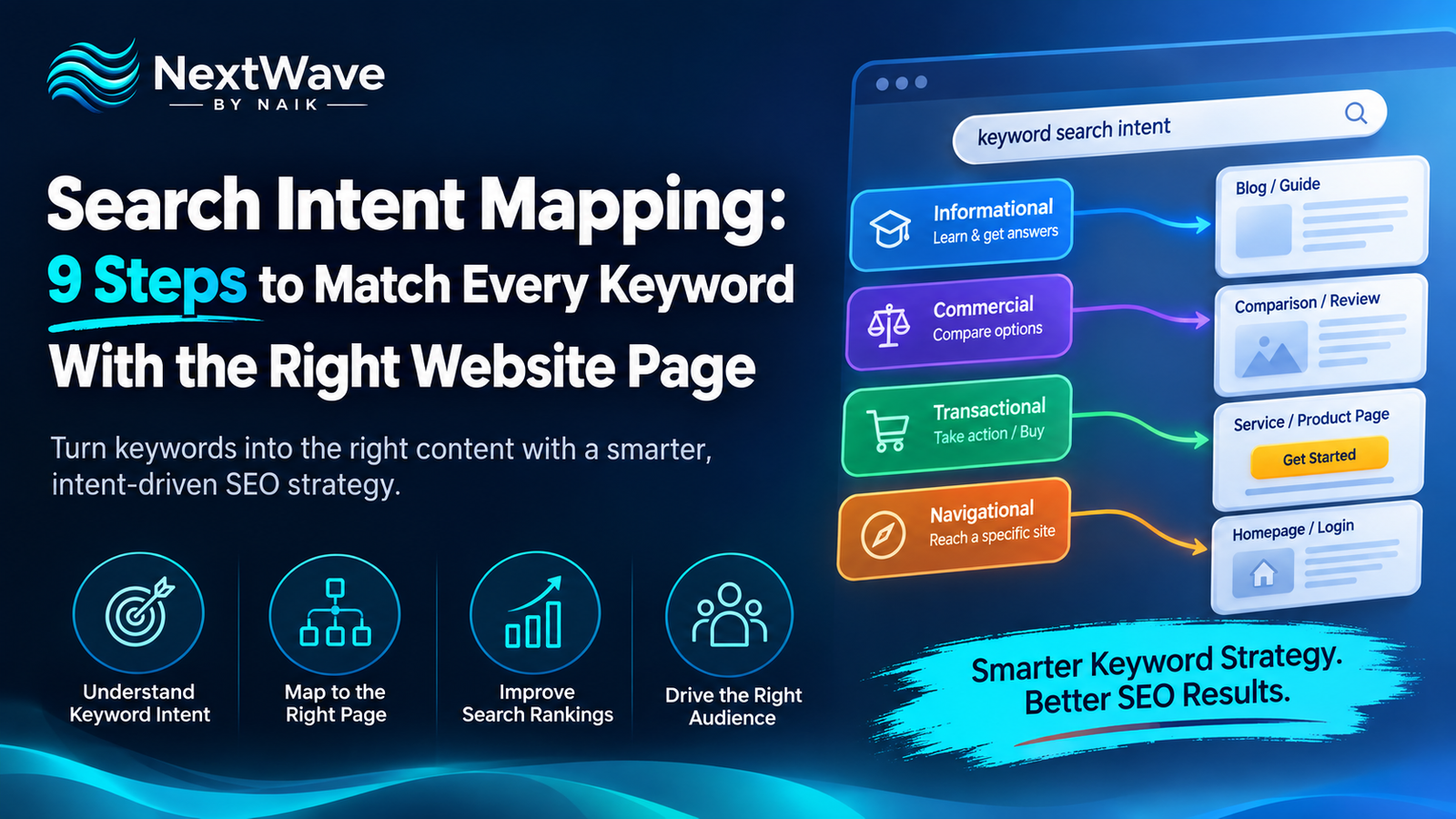
The 4 Main Types of Search Intent
Before mapping keywords, you need to understand the major categories of keyword search intent.
1. Informational Intent
The searcher wants to learn something or find an answer.
Examples:
- What is search intent?
- How does SEO work?
- How to do keyword research
- What is technical SEO?
- SEO tips for beginners
Best content types:
- Blog posts
- How-to guides
- Tutorials
- Educational articles
- Glossaries
- FAQs
The goal is to educate and answer the user’s question.
2. Commercial Investigation Intent
The searcher is researching options before making a decision.
Examples:
- Best SEO agencies in India
- SEO software comparison
- Ahrefs vs Semrush
- Best website development company
- SEO services pricing
The user may not be ready to purchase immediately, but they are evaluating solutions.
Best content types:
- Comparison pages
- Product reviews
- Service comparison pages
- “Best” listicles
- Case studies
- Buying guides
The goal is to help the user evaluate their options.
3. Transactional Intent
The searcher is ready to take action.
Examples:
- Buy SEO software
- Hire SEO agency
- Website development services
- SEO audit service
- Book SEO consultation
Best page types:
- Service pages
- Product pages
- Pricing pages
- Booking pages
- Landing pages
The goal is to make the desired action easy to complete.
4. Navigational Intent
The searcher is trying to reach a particular website, brand, product, or page.
Examples:
- Google Search Console
- HubSpot login
- Amazon
- Nike official website
- Semrush pricing
Best page types:
- Homepage
- Login page
- Brand page
- Product page
- Specific destination page
The goal is to help users reach the destination they are looking for.
9 Steps for Effective Search Intent Mapping
Step 1: Build a Complete Keyword List
Start by collecting all the keywords relevant to your business, products, services, and audience.
Don’t focus only on high-volume keywords. Include:
- Primary keywords
- Long-tail keywords
- Question keywords
- Location-based keywords
- Comparison keywords
- Brand keywords
- Product and service keywords
For example, an SEO agency might collect:
- SEO services
- What is SEO?
- How does SEO work?
- Best SEO agency
- SEO agency in Bangalore
- SEO audit service
- SEO pricing
- SEO tools
- SEO consultant
A comprehensive keyword list gives you the foundation for your SEO keyword mapping process.
Step 2: Identify the Search Intent Behind Each Keyword
Next, determine what the user is actually trying to accomplish.
Ask:
“What does someone expect to find after searching this keyword?”
For example:
Keyword: “what is keyword research?”
Likely intent: Informational.
The searcher wants an explanation, not a sales page.
Keyword: “best SEO agency in Bangalore”
Likely intent: Commercial investigation.
The searcher is comparing potential providers.
Keyword: “hire SEO agency Bangalore”
Likely intent: Transactional.
The searcher is looking for a service and may be ready to contact a provider.
Understanding content intent prevents you from creating pages that don’t align with what users expect.
Step 3: Analyze the Search Results
One of the best ways to understand intent is to examine the current search results.
Search your target keyword and look at the pages appearing on the first page.
Ask:
- Are most results blog posts?
- Are they service pages?
- Are they product pages?
- Are they comparison articles?
- Are they category pages?
- Are they landing pages?
- Are Google features such as featured snippets dominating the results?
Google’s results provide useful clues about what type of content it considers relevant for that query.
For example, if the first page for a keyword is dominated by detailed guides, creating a thin service page may not be the best approach.
Step 4: Group Keywords by Intent
Once you’ve identified intent, organize related keywords into groups.
For example:
Informational Cluster
- What is SEO?
- How does SEO work?
- Why is SEO important?
- SEO basics
Target page: SEO guide
Commercial Cluster
- Best SEO agency
- Top SEO companies
- SEO agency reviews
- SEO company comparison
Target page: SEO agency comparison or commercial guide
Transactional Cluster
- Hire SEO agency
- SEO services
- SEO consultant
- SEO audit service
Target page: SEO services page
This prevents keyword cannibalization and gives your website a clearer content structure.
Step 5: Match Each Keyword Group to the Right Page Type
Now connect each keyword cluster to an appropriate website page.
A simple framework is:
| Search Intent | Keyword Example | Recommended Page |
| Informational | What is SEO? | Blog |
| Informational | How to improve SEO | Guide |
| Commercial | Best SEO agencies | Comparison |
| Commercial | SEO agency reviews | Review/Comparison |
| Transactional | SEO services | Service Page |
| Transactional | Hire SEO consultant | Landing Page |
| Navigational | Company Name | Homepage |
| Navigational | Company Name pricing | Pricing Page |
This is the core of effective SEO keyword mapping.
Step 6: Map Keywords to Existing Pages First
Before creating a new page, check whether your website already has a page that satisfies the keyword’s intent.
You may discover that:
- An existing blog already targets the keyword.
- A service page is already relevant.
- Two pages are targeting the same keyword.
- An old page needs to be improved instead of creating a new one.
Creating a new page for every keyword can create unnecessary duplication.
Instead, ask:
“Do I already have the right page for this search intent?”
If yes, optimize that page.
If no, create a new page.
Step 7: Identify Keyword Cannibalization
Keyword cannibalization happens when multiple pages on your website compete for the same or very similar search queries.
For example, imagine you have:
/seo-services/seo-agency/seo-company/best-seo-services
If all four pages target almost identical keywords and intent, search engines may have difficulty determining which page should rank.
Search intent mapping helps identify these overlaps.
You may decide to:
- Merge pages
- Redirect an outdated page
- Change the focus of one page
- Build clearer topic clusters
- Differentiate the search intent of each page
The objective is not to create as many pages as possible. It’s to create the right page for each meaningful search intent.
Step 8: Optimize the Page Around Its Intent
Once a keyword is mapped to a page, optimize the page according to what the searcher needs.
For an informational page, focus on:
- Clear explanations
- Examples
- Step-by-step instructions
- FAQs
- Supporting research
- Internal links
For a commercial page, focus on:
- Comparisons
- Benefits
- Features
- Reviews
- Case studies
- Pros and cons
For a transactional page, focus on:
- Clear value proposition
- Services or products
- Benefits
- Trust signals
- Testimonials
- FAQs
- Strong calls to action
The keyword should be naturally incorporated into the content. Don’t force the exact keyword repeatedly.
Step 9: Review and Update Your Keyword Map Regularly
Search intent can change over time.
SERPs evolve, competitors publish new content, and user behavior changes.
Review your keyword map periodically and check:
- Has the dominant search intent changed?
- Is another page ranking better?
- Is your page still satisfying the query?
- Are multiple pages competing?
- Are there new keyword variations?
- Does the content need updating?
- Is the page generating the desired conversions?
A keyword map shouldn’t be a one-time spreadsheet. It should become part of your ongoing keyword strategy.
Search Intent Mapping Example
Let’s take the keyword “SEO services” and see how intent can influence the page you create.
A user searching for “SEO services” is likely looking for companies or providers offering SEO.
Therefore, a dedicated service page is generally more appropriate than a purely educational blog post.
Your page could include:
- What your SEO service includes
- Technical SEO
- On-page SEO
- Off-page SEO
- Local SEO
- Reporting and analytics
- Expected process
- Case studies
- FAQs
- Contact or consultation CTA
Now compare that with:
“What is SEO?”
The user is looking for education.
A long-form guide would be more appropriate, covering:
- SEO definition
- How search engines work
- Main SEO types
- How SEO affects rankings
- Examples
- Beginner tips
The keywords may belong to the same broad topic, but their search intent is completely different.
Create a Simple Keyword Mapping Framework
You can maintain your SEO keyword map using a spreadsheet with columns such as:
| Keyword | Search Intent | Keyword Type | Target URL | Content Type | Status |
| What is SEO? | Informational | Primary | /what-is-seo | Blog | Published |
| SEO services | Transactional | Primary | /seo-services | Service | Published |
| Best SEO agency | Commercial | Secondary | /best-seo-agencies | Comparison | Planned |
| SEO agency Bangalore | Commercial/Transactional | Local | /seo-agency-bangalore | Service | Published |
This makes it much easier to see gaps, overlaps, and opportunities across your website.
Common Search Intent Mapping Mistakes
Targeting Every Keyword With a Blog
Not every keyword needs a blog post.
Some keywords deserve:
- Service pages
- Product pages
- Category pages
- Comparison pages
- Landing pages
Always start with intent rather than content format.
Ignoring the SERPs
Your assumptions about a keyword may be wrong.
Always examine the pages currently ranking before deciding what to create.
Creating Multiple Pages for Similar Keywords
This can create cannibalization and dilute your authority.
Group keywords with similar intent when one page can satisfy them effectively.
Focusing Only on Search Volume
A keyword with 10,000 monthly searches isn’t automatically more valuable than one with 500.
A lower-volume transactional keyword can potentially generate more business than a high-volume informational keyword.
Forgetting the User’s Next Step
Good content should satisfy the current intent while naturally guiding the user toward the next relevant action.
For example:
Informational article → Related guide → Service page → Contact
This creates a logical journey from learning to conversion.
Why Search Intent Mapping Matters for SEO
Search intent mapping helps create a website where every important keyword has a clear destination.
Instead of randomly publishing content around keywords, you build a structured system:
Keyword → Intent → Page → User Journey → Business Goal
This can help you:
- Improve content relevance
- Reduce keyword cannibalization
- Build stronger topic clusters
- Improve internal linking
- Create better user experiences
- Align content with different stages of the buying journey
- Identify content gaps
- Strengthen your overall SEO strategy
Most importantly, it shifts your approach from “How many keywords can we rank for?” to “What is the best page to satisfy each search?”
Conclusion
Effective SEO isn’t simply about finding keywords and placing them into content.
It’s about understanding why someone searched for that keyword and giving them the right experience.
With search intent mapping, you can separate keywords into informational, commercial, transactional, and navigational categories and assign each one to the most appropriate website page.
Follow these nine steps:
- Build your keyword list.
- Identify the search intent.
- Analyze the search results.
- Group keywords by intent.
- Match keywords to the right page type.
- Map keywords to existing pages first.
- Identify keyword cannibalization.
- Optimize pages around intent.
- Review and update your keyword map regularly.
When every important keyword has a clear purpose and destination, your website becomes easier for both search engines and users to understand.
And that’s the foundation of a stronger, more organized keyword strategy.
Ready to turn blogging into a powerful SEO growth engine for your business?
At NextWave By Naik, we specialize in creating data-driven blogging strategies that improve rankings, attract organic traffic, and build long-term authority. From keyword research to content creation and optimization, we handle everything—so you can focus on growing your business.