
Retargeting Audience Exclusions: How to Stop Paying to Reach the Wrong People
Retargeting is one of the most powerful tools in digital advertising.
Someone visits your website. They view a product. They add something to their cart. Maybe they even start filling out a form.
Then they leave.
Retargeting allows you to bring those users back with relevant advertising.
But there is a problem.
If your audience exclusions aren’t properly configured, you may end up paying to advertise to people who shouldn’t be seeing your ads at all.
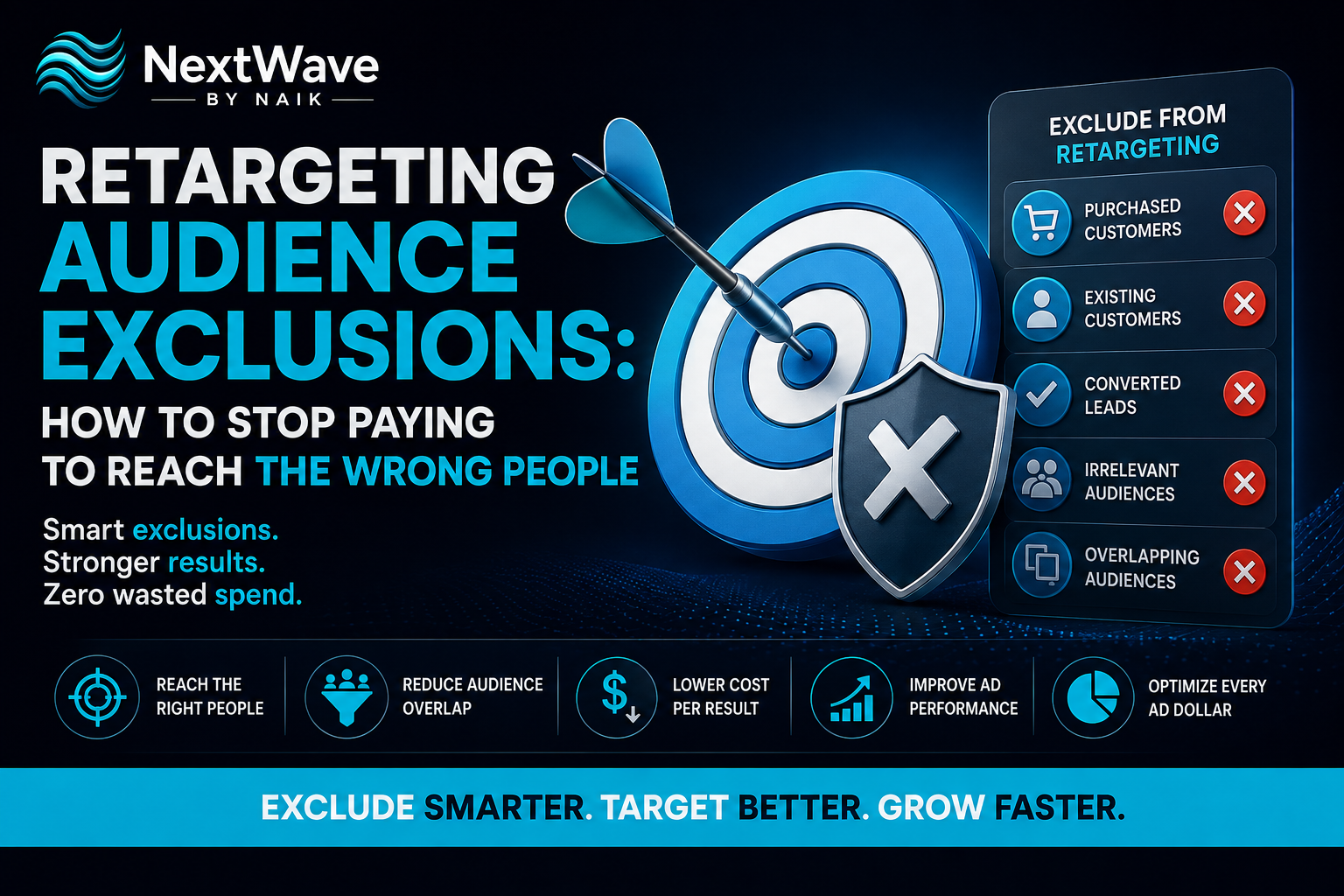
That could include existing customers, people who already converted, users who have become irrelevant to the campaign, or audiences already being targeted by another campaign.
This is where Retargeting Audience Exclusions become important.
A well-planned exclusion strategy can reduce audience overlap, improve remarketing optimization and help you spend your advertising budget more efficiently.
What Are Retargeting Audience Exclusions?
Retargeting Audience Exclusions are rules used to prevent specific groups of people from being included in a retargeting campaign.
Instead of simply asking:
“Who should see this ad?”
you also ask:
“Who should not see this ad?”
For example, suppose you’re running a campaign targeting people who visited your product page during the last 30 days.
You may want to exclude:
- People who already purchased
- Existing customers
- Employees
- Users who completed a lead form
- People who requested a consultation
- Users targeted by another campaign
- Irrelevant website visitors
This creates a more controlled retargeting strategy.
Why Audience Exclusions Matter
Without exclusions, your campaigns can become inefficient.
Imagine someone purchases your product today.
If they’re still included in a 30-day product retargeting audience, they could continue seeing:
“Complete your purchase today!”
That message is no longer relevant.
The customer has already purchased.
You are essentially spending money trying to convince someone to do something they’ve already done.
Effective exclusions help ensure that your advertising reflects where the user is in the customer journey.
9 Powerful Ways to Use Retargeting Audience Exclusions
1. Exclude People Who Already Converted
This is one of the most important exclusions for most retargeting campaigns.
If your campaign is designed to generate purchases, leads or registrations, consider excluding people who have already completed that action.
For an ecommerce campaign, this could mean excluding:
Purchasers → From product retargeting
For a lead-generation campaign:
Lead submitters → From lead-generation retargeting
For a consultation campaign:
Booked users → From booking campaigns
This prevents your advertising from continuing to push users toward an action they’ve already completed.
2. Exclude Existing Customers From Acquisition Campaigns
Existing customers and new prospects often need completely different messages.
A new customer may need:
“Discover our best-selling products.”
An existing customer may be better suited to:
“Your next order is waiting.”
If you’re running a campaign designed specifically to acquire new customers, excluding existing customers can make your paid advertising audiences more relevant.
You can then create a separate customer campaign focused on:
- Cross-selling
- Upselling
- Repeat purchases
- New product launches
- Loyalty offers
- Customer education
This creates a more sophisticated retargeting strategy.
3. Exclude Irrelevant Website Visitors
Not every website visitor is a valuable retargeting prospect.
Someone may have:
- Visited the careers page
- Read a blog article
- Viewed your privacy policy
- Visited a support page
- Landed on your website accidentally
- Spent very little time on the site
Retargeting all of these users equally can dilute your audience.
Instead, consider creating audiences based on higher-intent actions.
For example:
Lower Intent:
Website visitors
Higher Intent:
Product viewers
Very High Intent:
Add-to-cart users
This helps you focus your budget on people who demonstrate stronger commercial intent.
4. Exclude Overlapping Audiences
Audience overlap is another common problem.
Imagine you have three retargeting campaigns:
Campaign A: Website visitors – 30 days
Campaign B: Product viewers – 30 days
Campaign C: Add-to-cart users – 30 days
There is a strong possibility that users in Campaign C are also included in Campaign B and Campaign A.
Without a clear exclusion hierarchy, multiple campaigns may compete for similar users.
A better structure could be:
Campaign A: Website visitors
→ Exclude product viewers
Campaign B: Product viewers
→ Exclude add-to-cart users
Campaign C: Add-to-cart users
→ Exclude purchasers
Now each audience has a clearer position within the funnel.
5. Exclude Recent Converters From Old Retargeting Windows
Retargeting audiences often use time windows such as:
- 7 days
- 14 days
- 30 days
- 60 days
- 90 days
- 180 days
But a user who converted yesterday shouldn’t necessarily remain in every retargeting audience simply because they visited your website within the previous 30 days.
For example:
30-day website visitors
Exclude:
Purchasers from the last 30 days
This simple setup can prevent your retargeting ads from following customers after they’ve already converted.
6. Create Sequential Retargeting Audiences
Instead of treating every retargeting user the same, think about the customer journey.
A simple structure could be:
Stage 1 — Website Visitor
Message:
“Explore what we offer.”
Stage 2 — Product Viewer
Message:
“Take a closer look at the product.”
Stage 3 — Add to Cart
Message:
“Ready to complete your order?”
Stage 4 — Purchaser
Remove from acquisition retargeting.
Then move the customer into a separate campaign.
This creates a more logical remarketing optimization system.
7. Exclude Audiences That No Longer Match the Offer
Audience relevance can change quickly.
Suppose you’re promoting:
20% off this weekend
Someone sees the ad and purchases.
Another person sees the campaign but becomes interested in a different product.
Another user may no longer be eligible for the promotion.
Your audience strategy should account for these changes.
Whenever your offer, product availability or campaign objective changes, review your exclusions.
This is particularly important for:
- Limited-time promotions
- Seasonal campaigns
- Product launches
- Event registrations
- Free trials
- Lead magnets
- Special discounts
Good audience management isn’t something you set once and forget.
8. Exclude Low-Value or Unqualified Audiences
Not every person who interacts with your brand is equally valuable.
Depending on your business, you may identify audiences that consistently produce poor-quality results.
Examples could include users who:
- Never engage meaningfully
- Don’t meet your target criteria
- Only consume free content
- Are outside your service area
- Are not eligible for your offer
- Repeatedly interact without converting
Instead of continuing to spend heavily on these audiences, consider whether they belong in your retargeting campaigns at all.
However, exclusions should be based on real performance data, not assumptions.
The goal is not to make your audience as small as possible.
The goal is to make it more relevant.
9. Build an Exclusion Hierarchy
The most effective retargeting systems often use a clear hierarchy.
For example:
Prospects
↓
Website Visitors
↓
Product Viewers
↓
Add-to-Cart Users
↓
Purchasers
Each stage becomes more valuable and more specific.
Your exclusions can then prevent users from appearing in lower-intent campaigns once they move further down the funnel.
For example:
Website Visitor Campaign
Exclude:
- Product viewers
- Add-to-cart users
- Purchasers
Product Viewer Campaign
Exclude:
- Add-to-cart users
- Purchasers
Add-to-Cart Campaign
Exclude:
- Purchasers
This creates a much cleaner funnel.
A Simple Retargeting Exclusion Matrix
Here’s a practical framework you can use:
| Campaign | Target Audience | Exclude |
|---|---|---|
| Website Retargeting | Website visitors | Purchasers, leads |
| Product Retargeting | Product viewers | Add-to-cart users, purchasers |
| Cart Retargeting | Add-to-cart users | Purchasers |
| Lead Retargeting | Form viewers | Completed leads |
| Offer Campaign | Interested users | Converted users |
| Customer Campaign | Existing customers | Non-customers |
Your exact structure should depend on your business model, conversion cycle and campaign objectives.
How to Organize Retargeting Exclusions for Better Campaign Control
Creating exclusions is only the first step. The next step is organizing them logically so each campaign has a clear purpose.
Start by identifying the primary action you want from each audience. For example, a website visitor campaign may focus on bringing users back to your site, while an add-to-cart campaign should focus on completing the purchase.
Then create exclusions based on where users are in the customer journey.
A simple structure could be:
Website Visitors → Exclude Product Viewers
Product Viewers → Exclude Add-to-Cart Users
Add-to-Cart Users → Exclude Purchasers
Purchasers → Move to Customer Campaigns
This structure prevents users from being repeatedly exposed to campaigns that are less relevant to their current stage.
It also makes campaign reporting easier because each audience has a clearer role.
Another important consideration is exclusion timing. A recent purchaser may need to be excluded immediately from a conversion campaign, while an older customer might become eligible for a cross-sell or new-product campaign later.
Review these rules regularly as your offers, customer journey and campaign objectives change.
The better your exclusion structure, the easier it becomes to control your paid advertising audiences and spend your budget where it has the greatest potential.
How Exclusions Reduce Wasted Ad Spend
The purpose of exclusions isn’t simply to make audiences smaller.
It is to make your budget more purposeful.
Consider a simplified example.
Suppose you have 100,000 people in a broad retargeting audience.
After analysis, you discover:
- 15,000 already purchased
- 10,000 are existing customers
- 20,000 belong to another high-intent audience
- 5,000 are irrelevant visitors
Your original audience contains a large amount of unnecessary overlap.
Exclusions can help separate these groups so your campaign focuses more closely on the people it was designed to reach.
That can improve budget efficiency and make performance data easier to interpret.
Retargeting Exclusions vs. Audience Expansion
These strategies solve different problems.
Audience Expansion
Focuses on finding more people who may be interested.
Audience Exclusions
Focuses on removing people who shouldn’t be targeted.
If you’re already experiencing significant audience overlap or repeatedly advertising to converted customers, adding more people isn’t necessarily the answer.
Sometimes the better move is simply:
Remove the wrong people first.
How to Audit Your Retargeting Strategy
A regular audience audit can help identify wasted targeting.
Ask these questions:
1. Are purchasers still seeing acquisition ads?
If yes, review your conversion exclusions.
2. Are multiple retargeting campaigns targeting the same people?
If yes, build a clearer exclusion hierarchy.
3. Are irrelevant website visitors included?
If yes, create more specific audience definitions.
4. Are old audiences still relevant?
Review your audience windows.
5. Are users receiving the correct message?
Match creative and offer to the user’s funnel stage.
6. Are your campaigns competing for the same audience?
Review campaign structures and exclusions.
7. Are your exclusions updated when campaigns change?
Make audience management part of your regular optimization process.
Common Retargeting Exclusion Mistakes
Excluding Too Little
If everyone remains in every audience, your campaigns can become unnecessarily repetitive.
Excluding Too Much
Overly aggressive exclusions can make audiences too small and remove potentially valuable users.
Forgetting Existing Customers
Customers shouldn’t always be treated like prospects.
Using the Same Message Everywhere
A first-time visitor and an add-to-cart user have different levels of intent.
Never Reviewing Audience Windows
A 7-day audience and a 180-day audience represent very different levels of freshness.
Ignoring Conversion Data
Exclusions should be informed by actual campaign and customer behavior.
A Better Retargeting Strategy
A strong retargeting system follows a simple principle:
Right person → Right message → Right stage → Right time
For example:
New visitor
→ Educational message
Product viewer
→ Product benefits
Add-to-cart user
→ Purchase-focused message
Existing customer
→ Cross-sell or loyalty message
Recent purchaser
→ Exclude from acquisition retargeting
This approach makes your advertising more relevant and reduces unnecessary repetition.
Conclusion
Retargeting is powerful because it allows you to reconnect with people who have already shown interest.
But without the right exclusions, that advantage can quickly turn into wasted ad spend.
Retargeting Audience Exclusions help you:
- Reduce audience overlap
- Avoid repeatedly targeting converted users
- Improve campaign relevance
- Separate funnel stages
- Protect your advertising budget
- Improve remarketing optimization
- Create cleaner performance data
- Deliver more relevant messages
The goal isn’t simply to reach more people.
It’s to stop paying for people you no longer need to reach.
A smarter retargeting strategy combines precise audience definitions, thoughtful exclusions, relevant creative and continuous optimization.
Reach the right people. Exclude the wrong ones. Make every ad count.
Ready to turn blogging into a powerful SEO growth engine for your business?
At NextWave By Naik, we specialize in creating data-driven blogging strategies that improve rankings, attract organic traffic, and build long-term authority. From keyword research to content creation and optimization, we handle everything—so you can focus on growing your business.