
Micro-Conversions: How Small Website Actions Predict Bigger Sales
Most website visitors do not arrive and immediately make a purchase, book a consultation, or submit a detailed enquiry.
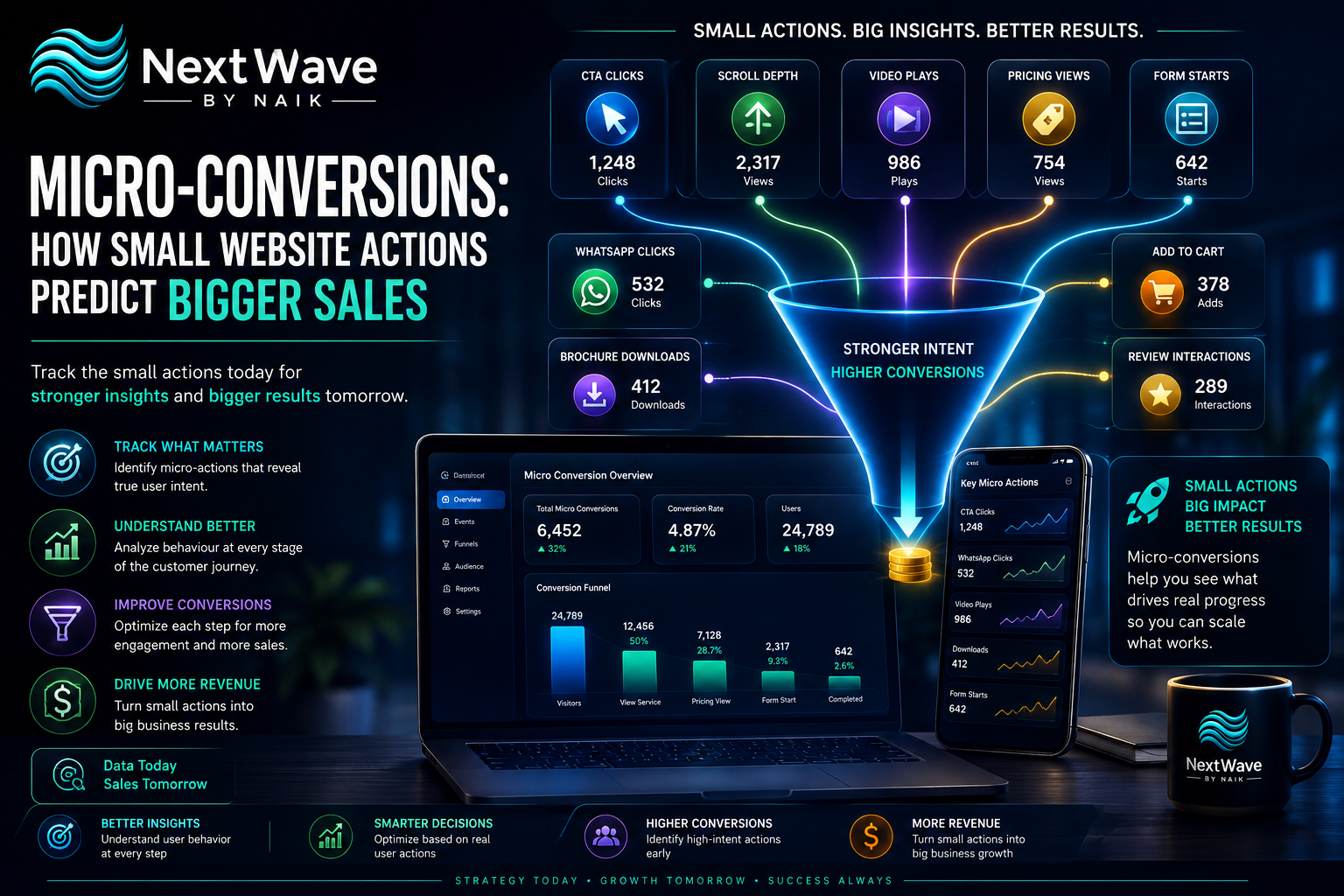
Before completing a major conversion, they usually take several smaller actions. They may scroll through a service page, watch a product video, open a pricing section, click a WhatsApp button, read customer reviews, download a brochure, or begin filling out a form.
These actions are known as micro-conversions.
Understanding and improving these behaviours through Micro Conversion Optimization can help businesses identify buyer intent much earlier in the customer journey.
Instead of measuring success only through final purchases or completed forms, businesses can analyze the small signals that show whether visitors are becoming more interested, more informed, and more likely to convert.
A strong Micro Conversion Optimization strategy connects these smaller actions with larger business goals. This provides better insight into website micro conversions, user intent signals, and overall conversion funnel optimization.
What Is Micro Conversion Optimization?
Micro Conversion Optimization is the process of identifying, measuring, and improving smaller website actions that move a visitor toward a major conversion.
A major conversion, sometimes called a macro-conversion, could be:
- Making a purchase
- Booking an appointment
- Requesting a quotation
- Completing a lead form
- Subscribing to a paid service
- Registering for a course
- Scheduling a consultation
Micro-conversions happen before these larger actions.
Examples include:
- Clicking “View Pricing”
- Watching a demonstration video
- Adding a product to a wishlist
- Clicking WhatsApp
- Opening an FAQ
- Reading customer reviews
- Downloading a brochure
- Adding a product to the cart
- Starting a contact form
- Using a website calculator
- Clicking a phone number
- Viewing multiple service pages
Individually, these activities may appear small. Together, they can reveal how close a visitor is to becoming a customer.
Why Micro-Conversions Matter
A website may receive 5,000 visitors and generate only 50 direct enquiries.
If the business only tracks those 50 enquiries, it knows very little about what happened with the other 4,950 visitors.
However, those visitors may have:
- Viewed pricing
- Read testimonials
- Watched videos
- Added products to carts
- Clicked contact buttons
- Started forms
- Returned several times
These are valuable user intent signals.
Micro Conversion Optimization allows businesses to understand what happens between the first website visit and the final conversion.
This can reveal where visitors are progressing and where they are getting stuck.
Micro-Conversions vs Macro-Conversions
Understanding the difference is important for effective measurement.
Macro-Conversions
These are the primary business outcomes.
Examples:
- Completed sale
- Qualified enquiry
- Appointment booking
- Subscription
- Registration
- Payment
Micro-Conversions
These are smaller actions that indicate movement toward the primary outcome.
Examples:
- Product-page view
- CTA click
- Video completion
- Pricing-page visit
- Cart addition
- Form start
- Review interaction
The goal of Micro Conversion Optimization is not to replace macro-conversion tracking.
Instead, it helps businesses understand the steps that lead to those major outcomes.
Two Types of Website Micro Conversions
Most website micro conversions can be grouped into two categories.
Process Milestones
These are actions that directly move a visitor through the conversion process.
Examples include:
- Adding an item to the cart
- Starting checkout
- Selecting a pricing plan
- Starting a lead form
- Choosing an appointment slot
These actions show clear progress.
Secondary Actions
These indicate interest but may not directly start the transaction.
Examples include:
- Watching a video
- Reading testimonials
- Downloading a PDF
- Subscribing to updates
- Sharing content
- Opening an FAQ
- Viewing the About page
Both types can provide valuable information about visitor behaviour.
12 Website Micro-Conversions Worth Tracking
1. Call-to-Action Clicks
One of the easiest micro-conversions to monitor is CTA interaction.
Examples include:
- Get a Quote
- View Pricing
- Book Now
- Contact Us
- Learn More
- Shop Now
A visitor clicking one of these buttons demonstrates stronger intent than someone simply viewing the page.
If a page receives thousands of visits but very few CTA clicks, the problem could involve:
- Weak copy
- Poor button placement
- Unclear value proposition
- Low trust
- Wrong audience
Tracking CTA activity makes Micro Conversion Optimization more actionable.
2. WhatsApp Clicks
For many businesses, clicking WhatsApp is a powerful intent signal.
Even when a visitor does not send a message immediately, the click suggests that they are considering direct communication.
Track:
- WhatsApp button clicks
- Page where the click happened
- Campaign source
- Device type
- Leads generated after the click
Comparing these data points can show which pages produce stronger enquiry intent.
3. Pricing-Page Visits
People who view pricing information are often further down the buying journey.
A visitor who moves from:
Blog → Service Page → Pricing Page
may be more valuable than someone who only reads one blog article.
Pricing-page visits can therefore become useful user intent signals.
Businesses can also analyse what visitors do after viewing pricing.
Do they:
- Contact sales?
- Leave the website?
- Read reviews?
- Compare packages?
- Return later?
This information can reveal pricing-related friction.
4. Form Starts
Completed forms are macro-conversions in many businesses.
But form starts are equally interesting.
Suppose 200 people begin a form but only 60 complete it.
The issue may not be lead generation—it may be the form itself.
Possible problems include:
- Too many fields
- Sensitive questions too early
- Poor mobile usability
- Technical errors
- Unclear expectations
- Weak privacy reassurance
Tracking form starts and completions helps identify these problems.
5. Form Field Completion
You can go deeper by analysing where visitors abandon a form.
For example:
Name → completed
Phone → completed
Email → completed
Company details → completed
Budget → abandoned
A pattern like this may indicate that the budget question creates unnecessary friction.
This is a practical example of conversion funnel optimization.
6. Video Engagement
Video engagement can reveal how interested visitors are in a product or service.
Track actions such as:
- Video started
- 25% watched
- 50% watched
- 75% watched
- Video completed
Someone who watches a full product demonstration may have significantly stronger intent than someone who leaves after several seconds.
Video engagement can be particularly useful on:
- Product pages
- Service pages
- Case studies
- Landing pages
- Course pages
7. Customer Review Interactions
Customers often check reviews immediately before making a decision.
Track whether users:
- Scroll to testimonials
- Expand review sections
- Open case studies
- Click customer stories
- Watch testimonial videos
If visitors repeatedly interact with these sections before converting, social proof is playing an important role in the sales journey.
This insight can help you place reviews more strategically.
8. Downloads
Downloads often indicate deeper interest.
Examples include:
- Brochures
- Price lists
- Product catalogues
- Case studies
- Checklists
- Company profiles
- Technical specifications
A visitor downloading a company profile may be demonstrating stronger buying intent than someone casually browsing the homepage.
Downloads should therefore be included in your Micro Conversion Optimization tracking.
9. Add-to-Cart Actions
For e-commerce businesses, an add-to-cart event is one of the strongest micro-conversions.
If customers frequently add products but fail to purchase, investigate:
- Shipping fees
- Checkout complexity
- Payment options
- Delivery times
- Coupon problems
- Account-creation requirements
High cart additions with low purchases point toward a checkout issue rather than a product-discovery issue.
10. Internal Search Activity
Visitors using a website search bar are actively trying to find something.
Track:
- Search terms
- Products searched
- Services searched
- Searches returning no results
Internal search data can reveal exactly what customers want.
If dozens of visitors search for a service you offer but cannot easily locate, website navigation needs improvement.
11. Repeat Website Visits
Not every customer converts during the first visit.
Some may return:
- Later the same day
- Several days later
- After receiving an email
- After seeing another advertisement
- After comparing competitors
Repeat visits can indicate increasing interest.
Combining returning-visitor behaviour with other website micro conversions provides a clearer picture of buying intent.
12. Scroll Depth
Scroll depth measures how far visitors move through a page.
Common tracking levels include:
- 25%
- 50%
- 75%
- 90%
If most users leave before reaching your testimonials or CTA, those important elements may be positioned too far down the page.
However, scroll depth should not be evaluated alone.
A visitor may find what they need immediately without scrolling very far.
Combine scroll data with other user intent signals for a better interpretation.
How Micro-Conversions Predict Bigger Sales
A single action rarely proves purchase intent.
But combinations of actions can become powerful indicators.
Consider two visitors.
Visitor A
- Reads one blog article
- Leaves after 30 seconds
Visitor B
- Reads the blog
- Visits the service page
- Checks pricing
- Reads two testimonials
- Downloads a brochure
- Clicks WhatsApp
Visitor B clearly demonstrates stronger commercial intent.
This is where Micro Conversion Optimization becomes valuable.
Businesses can identify behavioural patterns associated with customers who eventually convert.
These patterns can then be used to improve:
- Lead scoring
- Remarketing
- Website personalization
- Sales follow-ups
- Landing pages
- Content strategy
Build a Micro-Conversion Funnel
Instead of treating every visitor equally, map a progression.
For example:
Awareness
Blog visit or landing-page view
↓
Interest
Scrolls 50% or watches a video
↓
Consideration
Views service or product page
↓
Evaluation
Checks pricing, testimonials, or FAQs
↓
Intent
Clicks WhatsApp or starts a form
↓
Conversion
Sends enquiry or completes purchase
This structure turns individual activities into a meaningful conversion funnel optimization system.
Use Micro-Conversions for Lead Scoring
Businesses with many enquiries can use behaviour to identify higher-quality prospects.
For example:
| Action | Example Intent Score |
|---|---|
| Blog visit | 1 |
| Service-page visit | 2 |
| Case-study view | 3 |
| Pricing-page visit | 4 |
| Video completion | 4 |
| Brochure download | 5 |
| WhatsApp click | 6 |
| Form start | 7 |
These numbers are only examples. Each company should build scores based on its own customer behaviour.
A lead who triggers several high-intent actions may deserve faster sales follow-up.
Use Micro-Conversions to Improve Remarketing
Not every visitor should see the same advertisement.
A person who only viewed a blog is at a different stage from someone who started checkout.
Businesses can create audiences based on behavioural signals.
For example:
Low Intent
Visited one educational article.
Show:
- Helpful content
- Awareness ads
- Educational videos
Medium Intent
Visited product or service pages.
Show:
- Benefits
- Testimonials
- Case studies
High Intent
Viewed pricing, started checkout, or clicked WhatsApp.
Show:
- Strong offer
- Consultation CTA
- Customer proof
- Reminder campaign
This makes remarketing more relevant.
Optimize Pages Based on Micro-Conversion Data
The purpose of tracking is not simply collecting numbers.
Use the data to improve the website.
Low CTA Click Rate
Try:
- Stronger CTA copy
- Better button placement
- Clearer benefits
- More visible buttons
High Form Starts but Low Completions
Try:
- Fewer fields
- Better mobile layout
- Clear privacy reassurance
- Multi-step forms
High Pricing Views but Few Enquiries
Review:
- Pricing clarity
- Value explanation
- Competitor positioning
- Trust elements
High Cart Adds but Low Purchases
Investigate:
- Shipping charges
- Payment failures
- Checkout speed
- Hidden fees
This is where Micro Conversion Optimization directly supports revenue improvement.
Do Not Optimize Every Micro-Conversion Equally
More clicks are not automatically better.
Suppose a business redesigns a website and doubles “View Pricing” clicks but final enquiries decline.
The micro-conversion improved, but the business outcome became worse.
Always connect smaller actions with major conversions.
Ask:
Do people who perform this action become customers more often?
If the answer is yes, the micro-conversion is meaningful.
If not, it may simply be a vanity metric.
Tools for Tracking Website Micro Conversions
Businesses can track micro-conversions using tools such as:
- Web analytics platforms
- Tag management systems
- Heatmap software
- Session recordings
- CRM systems
- E-commerce analytics
- Advertising conversion tracking
Important events may include:
- Button clicks
- Form starts
- Downloads
- Video engagement
- Cart actions
- Scroll milestones
- Outbound clicks
Create clear event names so reports remain understandable.
For example:
whatsapp_click
is better than:
event_001
Clean tracking makes future analysis easier.
Micro Conversion Optimization for E-Commerce
E-commerce websites can monitor:
- Product views
- Image gallery interactions
- Size-guide opens
- Wishlist additions
- Review interactions
- Add-to-cart actions
- Coupon attempts
- Checkout starts
- Payment selections
If customers repeatedly abandon the same stage, investigate it.
For example:
Product View → Add Cart = strong
Add Cart → Checkout = strong
Checkout → Payment = weak
This suggests the biggest problem exists during payment or checkout rather than product discovery.
Micro Conversion Optimization for Service Businesses
Service businesses may track:
- Service-page visits
- Pricing clicks
- Portfolio views
- Case-study reads
- Phone clicks
- WhatsApp clicks
- Calendar opens
- Consultation form starts
- Brochure downloads
These actions help reveal which visitors are approaching the enquiry stage.
Sales and marketing teams can use this data to improve their lead journey strategy.
Common Micro-Conversion Tracking Mistakes
Tracking Too Many Events
Not every click deserves a report.
Focus on actions connected to customer progress.
Measuring Actions Without Context
A scroll or button click alone may not mean much.
Combine events to understand intent.
Ignoring Final Conversion
Every micro-conversion should eventually be evaluated against a business result.
Not Testing Mobile Separately
Mobile visitors may behave very differently from desktop visitors.
Poor Event Naming
Unclear tracking names make reporting difficult.
Treating Every Visitor the Same
Different behaviour indicates different levels of intent.
Micro Conversion Optimization Checklist
Before implementing your tracking system, confirm that you have identified:
- Primary business conversions
- Important website micro conversions
- CTA clicks
- Pricing-page views
- WhatsApp interactions
- Phone clicks
- Video engagement
- Review interactions
- Downloads
- Form starts
- Form completions
- Cart additions
- Checkout starts
- Internal searches
- Returning visitors
- Funnel drop-off points
Then connect each important event with the final outcome.
The objective is not to track everything.
The objective is to discover which small actions actually predict bigger business results.
Conclusion
A sale rarely begins with a “Buy Now” click.
It often begins with a visitor reading a review, watching a video, comparing pricing, exploring a service page, downloading information, or opening WhatsApp.
These small behaviours provide important clues about customer intent.
Micro Conversion Optimization helps businesses transform those clues into measurable insights. By tracking meaningful website micro conversions, identifying valuable user intent signals, and improving each stage of conversion funnel optimization, businesses can better understand why visitors convert—or why they leave.
The key is to connect every small action with a larger business objective.
When businesses understand the steps customers take before buying, they can improve the journey before the final conversion even happens.