
Introduction
Running Google Ads is not simply about deciding how much money to spend. The real challenge is determining where your advertising budget should go and how much each campaign actually deserves.
A common mistake businesses make is dividing their budget equally across awareness, lead generation, and conversion campaigns. While this approach may appear balanced, it does not necessarily produce balanced results.
Effective Google Ads Budget Allocation requires a strategy based on business objectives, campaign performance, audience intent, conversion data, and expected return.
Instead of giving every campaign the same amount of money, businesses should identify which campaigns contribute most effectively to their goals and allocate their budget accordingly.
In this guide, we will explore how to build a smarter Google Ads budget strategy, plan your PPC spending, and improve your Google Ads ROI.
What Is Google Ads Budget Allocation?
Google Ads Budget Allocation is the process of distributing your available advertising budget across different campaigns, objectives, audiences, keywords, and stages of the customer journey.
A typical Google Ads account may include campaigns for:
- Brand awareness
- Website traffic
- Lead generation
- Product sales
- Local searches
- Remarketing
- High-intent keywords
- Existing customer engagement
Each campaign can serve a different purpose. Therefore, every campaign does not need to receive an equal share of your budget.
The right allocation depends on what your business is trying to achieve.
If the main objective is immediate sales, conversion-focused campaigns may deserve a larger share. If the business is entering a new market, awareness may require additional investment. If lead generation is the primary business objective, campaigns producing qualified inquiries may become the biggest priority.
The key is to make your advertising budget work toward measurable business outcomes.
Why You Should Not Split Your Google Ads Budget Equally
Suppose a business has a monthly Google Ads budget of ₹1,00,000.
An equal approach would mean:
- ₹33,333 for awareness
- ₹33,333 for leads
- ₹33,333 for conversions
This looks balanced, but it ignores campaign performance.
Imagine the conversion campaign is consistently generating profitable customers while the awareness campaign is generating impressions but very few measurable actions. Giving both campaigns the same budget could mean that valuable opportunities are being underfunded while lower-intent activity receives more money than necessary.
This is why PPC budget planning should focus on performance rather than symmetry.
A better approach is to start with a reasonable allocation, collect performance data, and then adjust the budget based on what the campaigns are actually delivering.
How to Allocate Your Google Ads Budget
There is no single percentage that works for every business. However, a performance-oriented framework can provide a useful starting point.
1. Allocate a Smaller Share to Awareness
Awareness campaigns are designed to introduce your brand, products, or services to potential customers.
They can be valuable for businesses that are:
- Launching a new product
- Entering a new market
- Building brand recognition
- Expanding their audience
- Supporting long-term customer acquisition
However, awareness usually targets users earlier in the buying journey.
Businesses focused on immediate leads or sales may therefore start with a smaller portion of their budget, such as 10–20%, and increase it when awareness activity demonstrates value.
The exact amount should depend on your industry, customer journey, competition, and marketing objectives.
2. Invest More in Lead Generation
Lead-generation campaigns are particularly important for service businesses, B2B companies, agencies, education providers, real estate companies, and other businesses that rely on inquiries.
These campaigns may target searches such as:
- Digital marketing agency
- Website development company
- SEO services near me
- PPC management services
- Business consultation services
These searches can indicate stronger commercial intent because the user is actively looking for a solution.
If qualified leads are the primary business objective, allocating approximately 30–40% of the budget to lead-generation campaigns can be a reasonable starting point.
However, don’t evaluate these campaigns only by the number of leads.
Lead quality matters.
A campaign generating 100 low-quality leads may be less valuable than another campaign generating 30 highly qualified prospects.
3. Prioritize Conversion-Focused Campaigns
Conversion campaigns often deserve the largest portion of the budget when they consistently produce measurable business results.
These campaigns can target users who are ready to:
- Purchase a product
- Request a quote
- Book a service
- Schedule a consultation
- Submit an inquiry
- Call a business
- Complete a transaction
For businesses focused on immediate revenue, allocating around 40–60% toward high-intent conversion activity may be a useful starting framework.
Again, this is not a fixed rule.
If conversion campaigns consistently generate profitable customers, increasing their budget may make sense. If they have poor conversion rates or expensive acquisition costs, the priority may need to be optimization rather than simply increasing spending.
Example of a Smarter Google Ads Budget Strategy
Consider a company with a monthly advertising budget of ₹1,00,000.
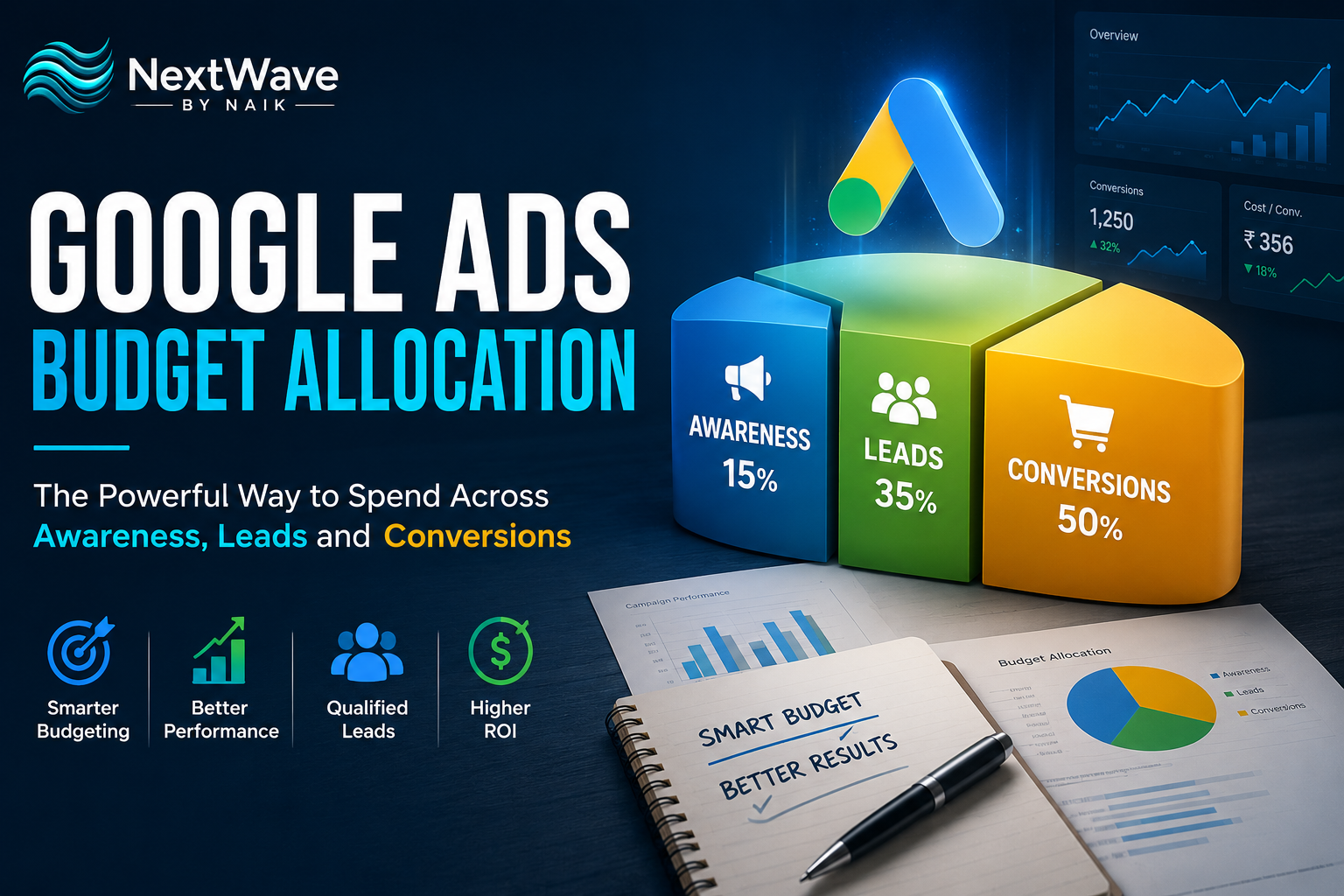
Instead of dividing the money equally, it could start with:
| Objective | Allocation | Monthly Budget |
|---|---|---|
| Awareness | 15% | ₹15,000 |
| Lead Generation | 35% | ₹35,000 |
| Conversions | 50% | ₹50,000 |
This structure puts more money toward campaigns closer to the point of conversion.
However, the allocation should not remain unchanged forever.
After collecting sufficient performance data, the business may discover that awareness is contributing strongly to branded searches and conversions. It could then increase the awareness budget.
Alternatively, if a lead-generation campaign is producing expensive and unqualified inquiries, some of its budget could be shifted toward better-performing campaigns.
That is the foundation of effective Google Ads Budget Allocation.
Use Performance Data for PPC Budget Planning
Your PPC budget planning should be based on data rather than assumptions.
Important metrics include:
Cost Per Click
CPC shows how much you are paying for individual clicks. A high CPC does not automatically mean a campaign is unsuccessful.
If expensive clicks generate valuable customers, the campaign may still deliver excellent returns.
Conversion Rate
Conversion rate measures how effectively clicks turn into desired actions.
A campaign with a strong conversion rate may deserve additional budget if the resulting conversions are valuable.
Cost Per Lead
For lead-generation campaigns, track the cost of acquiring each lead.
However, a low cost per lead should not automatically trigger more spending. Check whether those leads actually become qualified opportunities.
Customer Acquisition Cost
Customer acquisition cost provides a more meaningful view of advertising efficiency because it connects spending to actual customers.
Google Ads ROI
Ultimately, businesses need to understand whether their advertising spend contributes to revenue and profit.
A campaign generating fewer conversions can sometimes produce better Google Ads ROI if those customers have a higher lifetime or transaction value.
Don’t Optimize Only for the Number of Conversions
More conversions do not always mean better performance.
For example:
Campaign A
- 100 conversions
- ₹800 cost per conversion
Campaign B
- 50 conversions
- ₹400 cost per conversion
At first glance, Campaign A appears stronger because it produces twice as many conversions.
But if Campaign A’s customers generate only ₹500 in average revenue while Campaign B’s customers generate ₹3,000, Campaign B could be far more valuable.
This is why budget decisions should connect advertising data with actual business results.
The goal is not simply to generate the highest number of clicks or conversions.
The goal is to generate profitable outcomes.
Review and Reallocate Your Budget Regularly
Your Google Ads performance can change because of:
- Seasonal demand
- Competitor activity
- Changes in search behavior
- New products
- Promotional offers
- Keyword competition
- Landing-page improvements
- Changes in conversion rates
Because of these factors, your Google Ads budget strategy should remain flexible.
Review campaigns regularly and ask:
- Which campaigns are generating the most qualified traffic?
- Which campaigns are producing the best conversion rates?
- Which campaigns are generating profitable customers?
- Which campaigns are spending without producing meaningful results?
- Are there campaigns limited by budget that could benefit from additional investment?
These questions help identify where your next advertising dollar should go.
When Should You Increase Your Campaign Budget?
Increasing a campaign’s budget may make sense when:
- The campaign consistently generates qualified conversions.
- Acquisition costs remain sustainable.
- The campaign produces valuable customers.
- Conversion rates are strong.
- Search demand is available.
- The campaign is regularly limited by budget.
However, don’t increase spending simply because a campaign receives many clicks.
A campaign should demonstrate a reasonable relationship between additional spending and additional business value.
When Should You Reduce Your Budget?
You may want to reduce spending when a campaign:
- Produces irrelevant traffic
- Generates poor-quality leads
- Has consistently high acquisition costs
- Has a weak conversion rate
- Targets low-intent searches
- Consumes a significant portion of the budget without meaningful results
Reducing budget does not always mean stopping the campaign.
Sometimes the problem can be fixed through better keyword targeting, negative keywords, improved ad copy, stronger landing pages, better audience targeting, or improved conversion tracking.
How Better Budget Allocation Can Improve Google Ads ROI
Improving Google Ads ROI is not always about reducing costs.
Sometimes the biggest opportunity comes from reallocating existing money.
For example, if one campaign consistently generates qualified customers while another campaign spends heavily with limited results, moving part of the budget toward the stronger campaign can improve overall efficiency.
Businesses can also improve ROI by:
- Focusing on high-intent keywords
- Improving landing pages
- Testing different ad messages
- Using negative keywords
- Tracking qualified leads
- Reviewing search terms
- Separating campaign objectives
- Measuring revenue rather than clicks alone
This approach helps ensure that your advertising budget supports your broader business strategy.
Conclusion
Effective Google Ads Budget Allocation is not about giving every campaign an equal amount of money.
It is about understanding the role of each campaign and investing according to business objectives, customer intent, performance, and profitability.
Awareness campaigns can help build demand. Lead-generation campaigns can attract potential customers. Conversion campaigns can capture users who are ready to take action.
The right balance will vary from business to business.
Instead of automatically splitting your budget equally, start with a practical allocation, measure the results, and continuously shift investment toward the campaigns producing the strongest business outcomes.
A smarter Google Ads budget strategy allows businesses to make better use of their advertising budget, improve campaign efficiency, generate higher-quality leads, and work toward stronger Google Ads ROI.
The goal is not to spend your Google Ads budget equally. The goal is to spend it where it can create the greatest business value.
Ready to turn blogging into a powerful SEO growth engine for your business?
At NextWave By Naik, we specialize in creating data-driven blogging strategies that improve rankings, attract organic traffic, and build long-term authority. From keyword research to content creation and optimization, we handle everything—so you can focus on growing your business.