
FAQ Content Strategy: 9 Powerful Ways to Structure Answers for Search Engines and AI Discovery
People increasingly search by asking complete questions rather than typing short keywords.
They may ask:
- “How much does SEO cost for a small business?”
- “How long does website development take?”
- “What is the difference between SEO and Google Ads?”
- “Which digital marketing strategy is best for a local business?”
These questions can appear across traditional search, voice assistants, AI-powered search experiences and conversational platforms.
For businesses, this creates an important content opportunity: answer the questions customers are actually asking in a clear, structured and useful way.
This is where an effective FAQ Content Strategy becomes valuable.
Instead of creating FAQs simply to add more keywords to a page, businesses can use question-and-answer content to address genuine customer intent, remove buying barriers and make important information easier for both people and search systems to understand.
A well-planned approach can support answer engine optimization, FAQ SEO, AI search optimization and conversational search visibility.
What Is an FAQ Content Strategy?
An FAQ Content Strategy is a structured approach to identifying genuine customer questions and creating concise, useful answers around them.
A good FAQ strategy considers:
- What customers ask before buying
- Questions people search online
- Questions sales teams receive repeatedly
- Product or service objections
- Questions about pricing, process and timelines
- Questions that appear during customer support
- Related questions around a topic
The objective isn’t to create the longest possible FAQ section.
It is to provide the right answer to the right question in the clearest possible format.
Why FAQs Matter in Modern Search
Traditional search often starts with a keyword.
Conversational search can start with a complete question.
For example:
Traditional query:
SEO agency Bangalore
Conversational query:
What should a small business look for when choosing an SEO agency in Bangalore?
The second query contains much more context.
A useful FAQ strategy helps businesses address these detailed questions directly.
However, appearing in AI-generated answers or search features is never guaranteed simply because a page contains FAQs. Search systems evaluate many signals, including relevance, quality, authority and context.
The goal should therefore be useful answer content, not trying to manipulate AI systems.
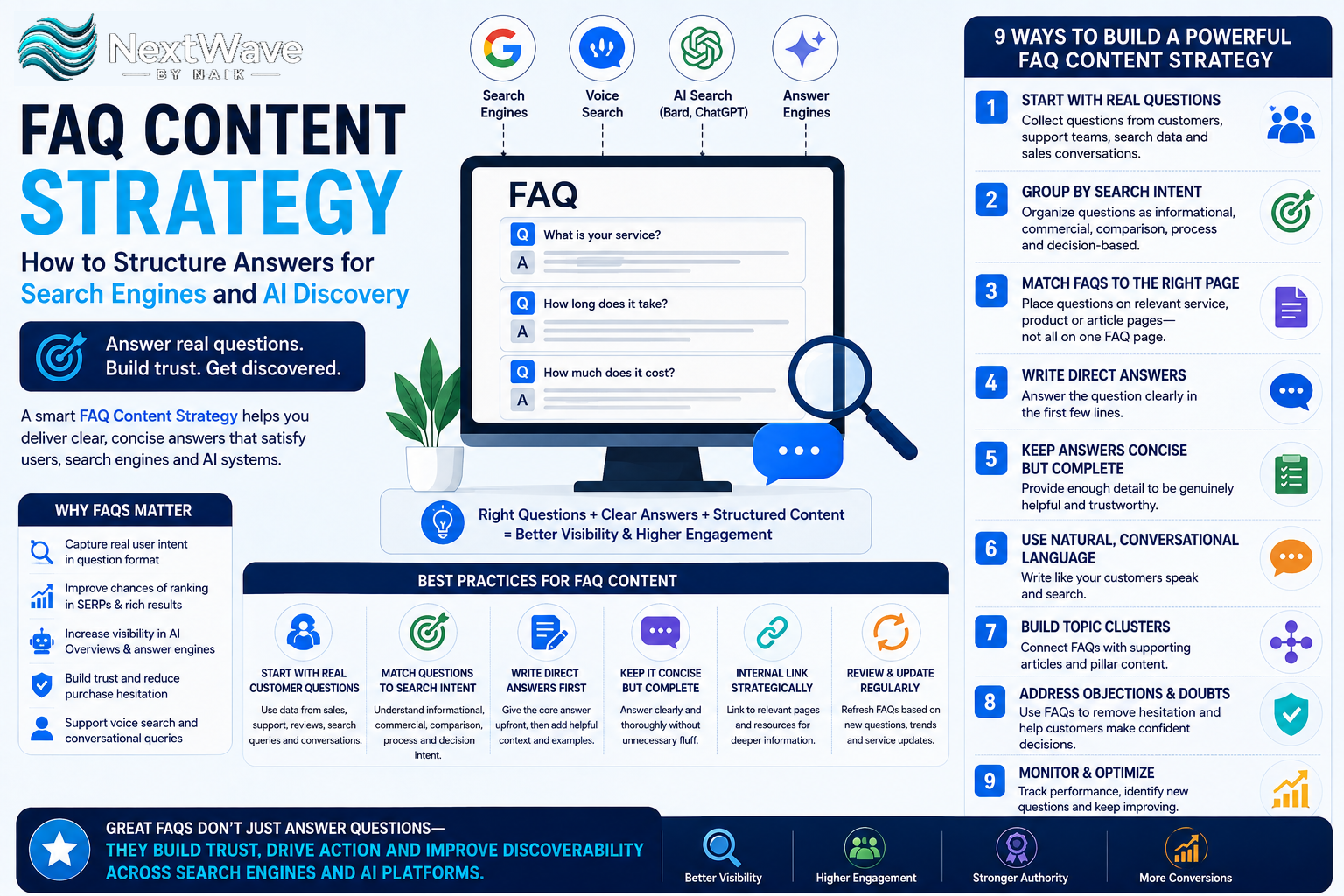
9 Steps to Build an Effective FAQ Content Strategy
1. Start With Real Customer Questions
The best FAQ content usually comes from questions customers actually ask.
Look at:
- Sales conversations
- Customer support tickets
- Website enquiries
- Contact forms
- WhatsApp conversations
- Search queries
- Product reviews
- Comments
- Social media questions
- Internal sales documentation
For example, a website development company might repeatedly receive:
How long does a business website take to build?
That is a much stronger FAQ candidate than an invented question created only because it contains a target keyword.
2. Group Questions by Search Intent
Not every question has the same purpose.
Organize FAQs according to the customer’s intent.
Informational
What is technical SEO?
Commercial
How much does SEO cost?
Comparison
SEO vs Google Ads: which is better?
Process-Based
How does your website development process work?
Decision-Based
Should a small business invest in local SEO?
Grouping questions this way makes it easier to build useful FAQ sections across different pages.
3. Match FAQs to the Correct Page
One of the biggest FAQ mistakes is putting every question on one giant FAQ page.
Instead, place questions where they naturally belong.
SEO Service Page
- What does SEO include?
- How long does SEO take?
- What is included in an SEO campaign?
Website Development Page
- How long does website development take?
- Can you redesign an existing website?
- Do you provide website maintenance?
Google Ads Page
- How much should a business spend on Google Ads?
- How quickly can Google Ads generate leads?
- What affects Google Ads costs?
This creates stronger topical relevance.
4. Write Direct Answers First
When answering a question, provide the core answer immediately.
For example:
How long does SEO take?
SEO typically requires several months of consistent work before meaningful results can be evaluated, although the timeline varies depending on competition, website condition, industry and strategy.
Then provide additional context.
This is generally more useful than beginning with several paragraphs before answering the question.
A good structure is:
Question → Direct answer → Explanation → Relevant context
5. Keep Answers Concise but Complete
FAQ answers should not be artificially short.
They should be as long as necessary to answer the question properly.
For a simple question:
What is a meta description?
A short paragraph may be enough.
For a more complex question:
How does an SEO campaign work?
You may need several paragraphs or a short list.
The goal is clarity.
Do not remove important information simply to make an answer shorter.
6. Use Natural Conversational Language
People don’t always search using formal marketing terminology.
They might ask:
“How much does a website cost?”
rather than:
“What is the average commercial website development investment?”
FAQ content should reflect how customers actually communicate.
Use natural language such as:
- How much does…?
- How long does…?
- What is the difference between…?
- Can I…?
- Do I need…?
- Which option is better…?
- What happens if…?
This makes content more useful for conversational search.
7. Build Topic Clusters Around Important Questions
FAQ content doesn’t have to exist separately from your broader content strategy.
Suppose your primary topic is:
SEO for Small Businesses
Your FAQ questions could include:
- What is SEO for small businesses?
- How long does local SEO take?
- How much does SEO cost?
- Does a small business need technical SEO?
- Can SEO generate local leads?
- How do I measure SEO results?
Some questions can be answered directly in an FAQ.
More complex questions can become dedicated articles.
This creates a connection between:
FAQ → Supporting Article → Pillar Content → Service Page
That structure can strengthen your broader content strategy.
8. Use FAQs to Remove Sales Objections
FAQs aren’t only an SEO tool.
They can help customers make decisions.
For example:
Is SEO suitable for a small business?
A useful answer could explain:
- When SEO makes sense
- What results depend on
- How long it can take
- Which businesses benefit most
- What realistic expectations look like
Similarly:
Do you provide website maintenance after development?
A clear answer can explain the available support options.
These answers reduce uncertainty and help prospects move closer to a decision.
9. Review and Update FAQs Regularly
Customer questions change.
Products change.
Services change.
Pricing models change.
Search behaviour changes.
AI-powered search experiences also continue to evolve.
Review FAQ sections periodically and check:
- Are the answers still accurate?
- Are customers asking new questions?
- Are any questions outdated?
- Are there duplicate questions?
- Are answers too vague?
- Do some questions deserve dedicated articles?
- Are there important objections missing?
Your FAQ section should be treated as living content, not something created once and forgotten.
FAQ SEO: What Should You Optimize?
A useful FAQ SEO strategy can include:
Question Structure
Use the actual question customers ask.
Answer Quality
Provide a clear, accurate answer.
Relevance
Keep the question related to the page topic.
Internal Links
Link to useful supporting pages when appropriate.
Natural Language
Use terminology customers understand.
Content Accuracy
Keep answers updated.
The focus should be usefulness rather than keyword repetition.
FAQ Content for AI Search
AI-powered search systems often need to understand relationships between questions, answers, topics and entities.
Well-structured FAQ content can make those relationships easier to interpret.
For example:
Question:
What is local SEO?
Answer:
Local SEO is the process of improving a business’s online visibility for searches associated with its geographic area.
Then the page could connect to:
Local SEO Services
Google Business Profile Optimization
Local Keyword Research
This provides a clear content relationship.
However, no FAQ structure can guarantee that an AI system will cite or recommend a particular website.
How Answer Engine Optimization Fits In
Answer Engine Optimization (AEO) focuses on making content useful and accessible for systems that provide direct answers to user questions.
FAQ content can support AEO by:
- Addressing specific questions
- Providing direct answers
- Using clear headings
- Explaining concepts accurately
- Connecting related topics
- Demonstrating expertise
Instead of asking:
“How can we get AI to mention our website?”
a better approach is:
“How can we create the most useful answer to the questions our customers need?”
That mindset produces stronger content.
FAQ Content Strategy vs Keyword Stuffing
Consider these two approaches.
Poor Approach
What is SEO? SEO is important. SEO services help with SEO. SEO companies provide SEO. SEO strategy is important for SEO.
This may contain the target keyword repeatedly, but it provides little value.
Better Approach
What is SEO?
SEO is the process of improving a website’s visibility in organic search results. It can involve technical improvements, content optimization, internal linking, search-intent research and other activities designed to make a website more useful and discoverable.
The second approach provides context and actually answers the question.
Where Should FAQs Appear?
FAQs can appear in several places.
Service Pages
Answer questions directly related to the service.
Product Pages
Address product-specific concerns.
Location Pages
Answer location-specific questions where genuinely useful.
Blog Articles
Answer questions related to the article topic.
Dedicated FAQ Page
Useful for broader company-level questions.
The right location depends on the question.
Should Every FAQ Have Schema Markup?
No.
FAQ structured data should only be considered when the content meets the relevant requirements and guidelines.
Adding FAQ markup does not guarantee a rich result.
Also, structured data should accurately represent content visible on the page.
The quality of the actual FAQ content remains more important than simply adding markup.
How to Find New FAQ Questions
Businesses have many sources for FAQ ideas.
1. Sales Teams
Ask salespeople what prospects repeatedly ask.
2. Customer Support
Review common support questions.
3. Search Data
Look at search queries that bring visitors to your website.
4. Website Forms
Analyze questions submitted through enquiry forms.
5. Social Media
Review comments and direct questions.
6. Customer Reviews
Look for recurring concerns and misunderstandings.
7. Competitor Research
Identify questions competitors address, then create better and more useful answers where relevant.
A Practical FAQ Planning Framework
Use this process:
Step 1: Collect real customer questions.
↓
Step 2: Remove duplicates.
↓
Step 3: Group questions by topic.
↓
Step 4: Identify search intent.
↓
Step 5: Match questions to relevant pages.
↓
Step 6: Write direct, accurate answers.
↓
Step 7: Add useful internal links.
↓
Step 8: Add appropriate structured data where eligible.
↓
Step 9: Monitor and update.
This turns FAQs into a structured content asset rather than an afterthought.
Common FAQ Content Mistakes
Creating Questions Nobody Asks
Start with real customer intent.
Writing Extremely Generic Answers
Avoid answers that don’t actually solve the question.
Stuffing Keywords
Natural language is better than forced repetition.
Putting Everything on One FAQ Page
Distribute questions across relevant pages when appropriate.
Copying Competitor FAQs
Use research to identify opportunities, but create original and genuinely useful answers.
Ignoring Commercial Questions
Customers often need answers about pricing, process, timelines and suitability.
Never Updating Answers
Outdated information can reduce trust.
FAQ Content and the Customer Journey
FAQ content can support different stages of the customer journey.
Awareness
What is SEO?
Consideration
Does my small business need SEO?
Evaluation
How much does SEO cost?
Decision
What is included in your SEO service?
Post-Purchase
How do I provide access to my website for SEO?
This means FAQ content can support both search visibility and customer experience.
Measuring FAQ Performance
Don’t measure FAQ success only through rankings.
Consider tracking:
- Organic impressions
- Organic clicks
- Search queries
- Engagement
- Internal-link clicks
- Enquiry generation
- Conversion rate
- Assisted conversions
- Questions leading to sales conversations
You can also ask sales and support teams whether the FAQ content reduces repetitive customer questions.
That is a practical business outcome.
Conclusion
A strong FAQ Content Strategy is not about adding dozens of questions to a website simply because FAQs are popular in SEO.
It is about understanding what customers genuinely want to know and providing clear, accurate answers.
Start with real questions from customers, sales teams and search data. Organize them by intent and topic. Place each question on the most relevant page, answer it directly and provide additional context where necessary.
Then connect FAQs with your broader content strategy through internal links, supporting articles and service pages.
For businesses preparing for answer engine optimization, AI search optimization and conversational search, this approach creates a stronger foundation because the content is structured around real user questions rather than keyword repetition.
The goal is simple:
Don’t create FAQs for search engines. Create better answers for people—and make those answers easy for search systems to understand.
Ready to turn blogging into a powerful SEO growth engine for your business?
At NextWave By Naik, we specialize in creating data-driven blogging strategies that improve rankings, attract organic traffic, and build long-term authority. From keyword research to content creation and optimization, we handle everything—so you can focus on growing your business.