
Content Hub Strategy: 9 Powerful Steps to Build Strong Topical Authority
Publishing blog after blog does not automatically make a website authoritative.
A business can publish dozens of articles and still struggle to rank if those articles are disconnected, repetitive, or unrelated to its most valuable services.
A better approach is to build a Content Hub Strategy.
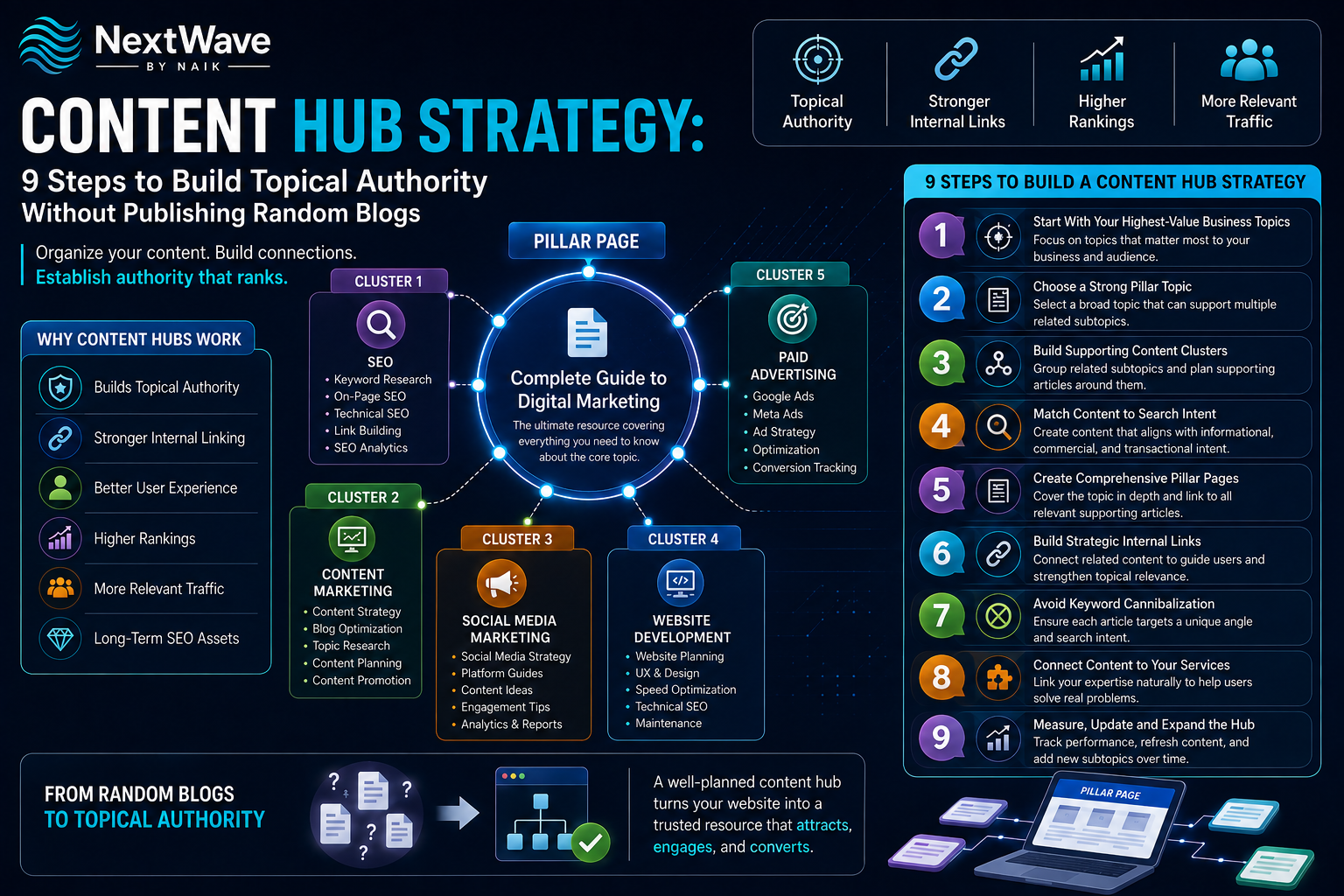
Instead of treating every blog as a separate piece of content, a content hub organizes related pages around a central topic. A comprehensive pillar page covers the main subject, while supporting articles answer specific questions and explore related subtopics.
This creates a structured network of content that helps users find useful information while giving search engines clearer context about the website’s expertise.
A strong Content Hub Strategy can therefore support topical authority SEO, improve internal linking, strengthen content clusters, and create a more focused approach to SEO content planning.
What Is a Content Hub Strategy?
A Content Hub Strategy is an organized approach to creating and connecting content around an important business topic.
Instead of publishing unrelated articles such as:
- “5 Digital Marketing Tips”
- “How to Get More Instagram Followers”
- “What Is SEO?”
- “Best Website Design Trends”
a business could build a focused content hub around a valuable service such as SEO for Small Businesses.
The hub might contain:
Pillar Page
Complete Guide to SEO for Small Businesses
Supporting Articles
- Local SEO for Small Businesses
- Keyword Research for Small Businesses
- Technical SEO Checklist
- Google Business Profile Optimization
- SEO Content Strategy
- SEO Reporting and Measurement
Each article supports the broader subject while addressing a specific search need.
That is the basic principle behind content clusters.
Why Random Blog Publishing Is Not Enough
Publishing random blogs can create several problems.
1. Topics Become Disconnected
Search engines may have difficulty understanding the website’s main areas of expertise.
2. Internal Linking Becomes Weak
If articles are not planned together, there may be few natural connections between them.
3. Important Services Receive Less Support
A business may publish interesting topics while barely covering the services it actually wants to promote.
4. Content Becomes Repetitive
Without a content plan, multiple articles may target almost the same search intent.
5. Resources Are Wasted
Every article requires research, writing, optimization, design, and promotion.
A Content Hub Strategy helps solve these problems by making content creation more intentional.
9 Steps to Build a Content Hub Strategy
1. Start With Your Highest-Value Business Topics
Do not begin by asking:
“What blog should we publish this week?”
Start by asking:
“Which topics are most important to our business?”
Look at your:
- Products
- Services
- Target customers
- Revenue priorities
- Commercial keywords
- Customer questions
- Sales objections
For example, a digital marketing agency may identify these core themes:
- SEO
- Website Development
- Google Ads
- Social Media Marketing
- Marketing Automation
These can become potential content-hub themes.
Your content should support business priorities rather than simply chase whatever topic happens to be trending.
2. Choose a Strong Pillar Topic
The next step is selecting the central topic for your hub.
A pillar page should be broad enough to connect several related subtopics but specific enough to have a clear purpose.
For example:
Pillar:
Complete SEO Strategy for Small Businesses
Supporting topics could include:
- Keyword Research
- Local SEO
- Technical SEO
- On-Page SEO
- Link Building
- SEO Analytics
- SEO Content Planning
The pillar page provides the broader explanation.
The supporting articles provide depth.
Together, they form a structured content ecosystem.
3. Build Supporting Content Clusters
Once the pillar topic is selected, identify the questions and subtopics surrounding it.
A useful framework is:
Main Topic
↓
Subtopics
↓
Specific Questions
↓
Detailed Supporting Articles
For example:
Main Topic
SEO
Cluster
Local SEO
Supporting Articles
- Local SEO Keyword Research
- Google Business Profile Optimization
- Local Citations
- Local SEO Reviews
- Local Search Ranking Factors
This structure helps prevent random publishing.
Every new article has a reason for existing.
4. Match Content to Search Intent
Not every article should have the same purpose.
A strong content hub strategy considers different types of search intent.
Informational
The user wants to learn.
Example:
What Is Technical SEO?
Commercial Investigation
The user is comparing solutions.
Example:
SEO Agency vs In-House SEO Team
Transactional
The user is closer to taking action.
Example:
SEO Services for Small Businesses
Navigational
The user is looking for a specific brand, website, or resource.
Understanding intent helps you decide what type of content belongs inside the hub.
5. Create Comprehensive Pillar Pages
A pillar page should provide a strong overview of the main subject.
It does not necessarily need to answer every question in extreme detail.
Instead, it should:
- Explain the main topic
- Introduce important subtopics
- Link to detailed supporting articles
- Answer common questions
- Provide practical guidance
- Lead users toward relevant next steps
For example, an SEO pillar page could contain sections covering:
- What SEO is
- Keyword research
- On-page SEO
- Technical SEO
- Local SEO
- Content strategy
- Link building
- Analytics
- SEO measurement
Each section can then connect to a deeper supporting article.
This creates a natural information hierarchy.
6. Build Strategic Internal Links
Internal linking is one of the most important parts of a content hub.
The goal is not to add links randomly.
Links should help users move naturally between related information.
For example:
Pillar Page
→ Technical SEO Guide
→ Keyword Research Guide
→ Local SEO Guide
→ SEO Content Strategy
Those supporting articles can also link back to the pillar page when relevant.
A useful structure might look like:
Pillar Page
↕
Supporting Article A
↕
Supporting Article B
↕
Supporting Article C
The exact linking structure depends on the site, but the relationships should make sense to users.
7. Avoid Keyword Cannibalization
Creating multiple articles around the same topic can sometimes cause pages to compete with each other.
For example, publishing:
- “Best SEO Content Strategy”
- “SEO Content Strategy Guide”
- “How to Create an SEO Content Strategy”
- “SEO Content Planning Tips”
could create significant overlap if all four pages target essentially the same search intent.
Before creating a new article, ask:
Does this answer a genuinely different question?
If the answer is no, consider:
- Updating an existing article
- Combining pages
- Changing the search intent
- Creating a more specific supporting topic
This makes SEO content planning more efficient.
8. Connect Content to Your Services
A content hub should not exist only to generate traffic.
It should also help users understand how your business can solve their problems.
For example, a website development company might create a hub around:
Website Performance
Supporting articles could cover:
- Website Speed Optimization
- Core Web Vitals
- Image Optimization
- Mobile Performance
- Hosting Performance
- Conversion-Focused Website Design
Relevant articles can naturally connect readers to the company’s website development services.
The connection should be useful rather than forced.
The goal is:
Education → Trust → Consideration → Action
9. Measure, Update and Expand the Hub
A content hub is not finished when all the articles are published.
Monitor performance over time.
Track:
- Organic traffic
- Keyword rankings
- Click-through rate
- Engagement
- Internal-link clicks
- Leads
- Conversions
- Pages per session
- Top-performing articles
Suppose your pillar page performs well but one supporting article receives little traffic.
You could:
- Improve its search intent alignment
- Add more useful information
- Strengthen internal links
- Improve its title
- Add examples
- Update outdated information
You can also identify missing subtopics based on search data and customer questions.
This turns the content hub into an evolving SEO asset.
Example of a Complete Content Hub
Imagine a company provides Website Development Services.
Instead of publishing random website-related blogs, it could build this hub:
Pillar Page
Complete Guide to Website Development for Businesses
Cluster 1: Website Planning
- Website Planning Checklist
- Website Sitemap Guide
- Website Content Structure
Cluster 2: UX
- Website Navigation Structure
- Website Content Hierarchy
- Mobile UX Optimization
Cluster 3: Performance
- Website Speed Optimization
- Image Optimization
- Core Web Vitals
Cluster 4: Conversion
- Website Conversion Optimization
- Lead Generation Forms
- CTA Optimization
Cluster 5: SEO
- Technical SEO
- Website SEO Structure
- Internal Linking
- SEO-Friendly Navigation
Now every article has a relationship to the larger topic.
That is much stronger than publishing isolated website articles without a clear structure.
Content Hub vs Random Blog Strategy
| Random Blog Publishing | Content Hub Strategy |
|---|---|
| Topics chosen individually | Topics planned as groups |
| Weak relationships | Strong topical relationships |
| Limited internal-link planning | Strategic internal linking |
| Higher risk of repetition | Better topic coverage |
| Difficult to build depth | Builds topical depth |
| Short-term publishing focus | Long-term authority strategy |
| Less connection to services | Content supports business priorities |
The objective is not necessarily to publish more.
It is to publish more strategically.
How Content Hubs Support Topical Authority SEO
Topical authority SEO is about demonstrating depth and relevance around a subject rather than simply publishing isolated pages.
Consider a website that has one article about SEO.
Now compare it with a website that comprehensively covers:
- Keyword research
- Search intent
- On-page SEO
- Technical SEO
- Internal linking
- Local SEO
- Content optimization
- SEO analytics
- SEO reporting
The second website provides much broader coverage of the subject.
A well-planned content hub helps create that depth.
However, topical authority is not achieved simply by publishing a certain number of articles. Content quality, relevance, expertise, useful internal linking, search intent alignment, and overall site quality still matter.
How to Plan a Content Hub Before Writing
Before creating your first article, create a simple content map.
Step 1
Choose the business priority.
Step 2
Select the pillar topic.
Step 3
Research related questions.
Step 4
Group related queries into clusters.
Step 5
Identify search intent.
Step 6
Check existing website content.
Step 7
Remove overlapping topics.
Step 8
Create internal-link relationships.
Step 9
Prioritize articles based on business and search value.
This approach gives writers a roadmap instead of asking them to continually invent new blog ideas.
What Makes a Good Content Hub?
A strong content hub should have five characteristics:
Relevant
Every article belongs to the broader subject.
Useful
Each page answers a real customer question.
Connected
Related pages are linked logically.
Comprehensive
Important subtopics are covered.
Commercially Relevant
The content supports the company’s products or services where appropriate.
When these elements work together, the website becomes easier for users to navigate and easier for search engines to understand.
Common Content Hub Mistakes
Creating Too Many Similar Articles
More URLs do not automatically mean more authority.
Ignoring Existing Content
Always audit what has already been published before creating another article.
Building Hubs Around Low-Value Topics
Focus on subjects that matter to your audience and business.
Forgetting Internal Links
A group of articles without meaningful connections is not a strong content hub.
Writing Only for Search Engines
Content should solve user problems first.
Never Updating the Hub
Information, search behaviour, and business priorities change.
The Long-Term Advantage of a Content Hub Strategy
A well-built content hub can become a long-term digital asset.
One pillar page can attract visitors interested in the broad topic.
Supporting articles can capture more specific searches.
Those visitors can move between related pages through internal links.
Some may then explore relevant services.
Over time, the structure can help the website build:
Visibility → Relevance → Topical Depth → Trust → Qualified Traffic
This is why a Content Hub Strategy is more than a blogging calendar.
It is a framework for organizing a website’s knowledge around the topics that matter most.
Conclusion
Publishing random blogs may keep a website active, but activity alone does not create a strong SEO strategy.
A Content Hub Strategy provides a more structured approach.
Start with an important business topic. Build a comprehensive pillar page. Identify related questions. Create supporting content clusters. Connect everything with strategic internal links and continuously improve the content based on performance.
The objective is not to publish hundreds of disconnected articles.
It is to build depth around the topics your audience actually cares about.
With thoughtful SEO content planning, businesses can turn their blog from a collection of individual posts into an organized knowledge resource that supports users, search visibility, and long-term business growth.
Ready to turn blogging into a powerful SEO growth engine for your business?
At NextWave By Naik, we specialize in creating data-driven blogging strategies that improve rankings, attract organic traffic, and build long-term authority. From keyword research to content creation and optimization, we handle everything—so you can focus on growing your business.