
Automated Lead Scoring: 9 Smart Ways to Identify Your Best Sales Opportunities
Not every lead deserves the same level of attention.
A business may receive 100 enquiries in a month, but only a portion of them may have the budget, urgency, requirements, and intent needed to become customers. If the sales team treats every lead equally, valuable opportunities can easily get lost while time is spent following up with low-quality prospects.
This is where Automated Lead Scoring becomes useful.
Automated lead scoring helps businesses assign scores to leads based on predefined signals such as their source, website activity, requirements, budget, engagement, and interactions with marketing campaigns.
Instead of asking:
“Which leads should our sales team call first?”
businesses can use data to answer:
“Which leads are showing the strongest buying signals?”
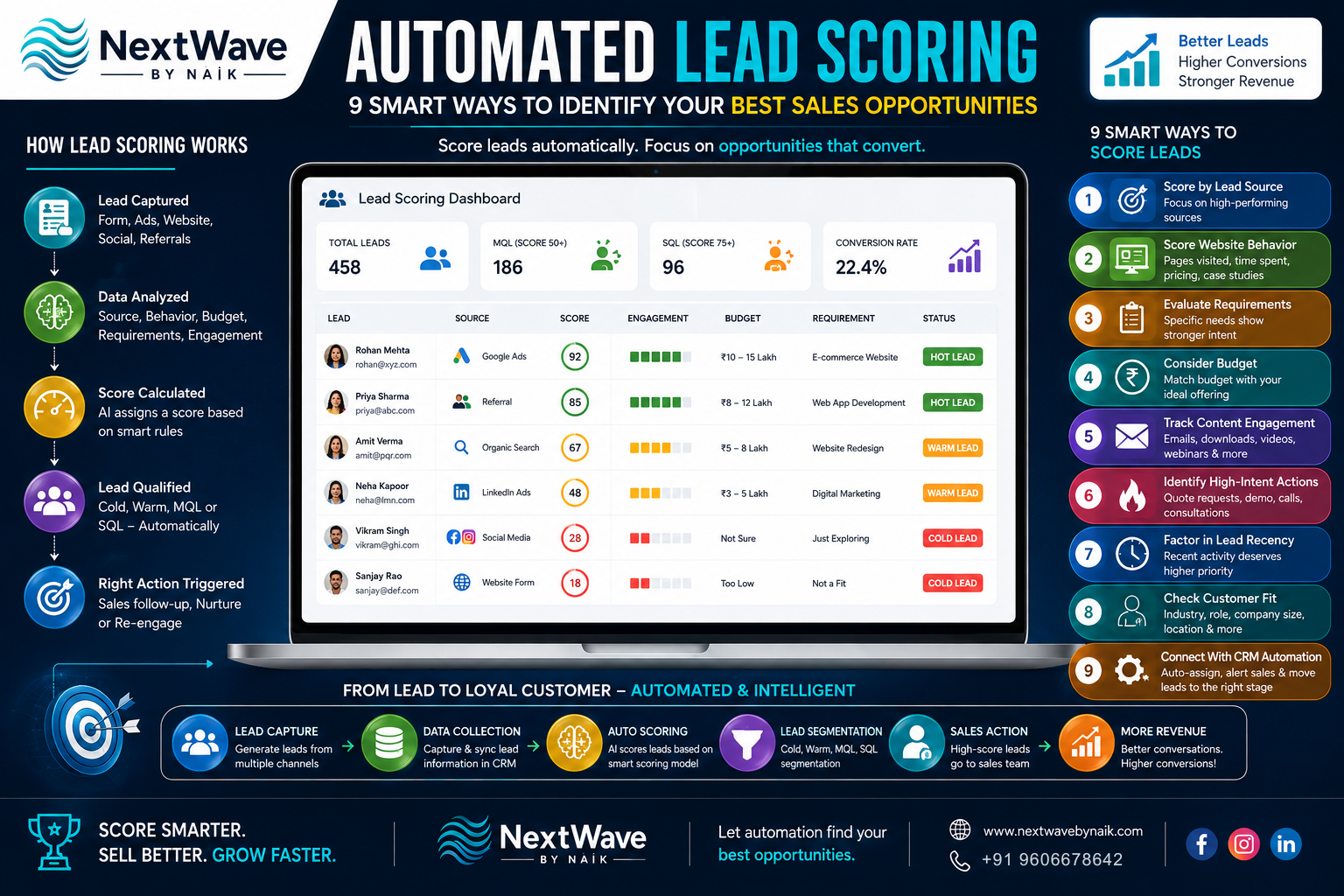
A well-designed lead scoring automation system can help marketing and sales teams prioritize qualified leads, improve sales lead management, and make better use of CRM data.
What Is Automated Lead Scoring?
Automated Lead Scoring is the process of automatically assigning a numerical score or qualification level to a lead based on specific characteristics and behaviours.
For example:
| Lead Signal | Example Score |
|---|---|
| Requested a quotation | +20 |
| Visited pricing page | +10 |
| Downloaded a brochure | +5 |
| Opened an email | +2 |
| High-value service selected | +15 |
| Budget matches business offering | +15 |
| Unrelated requirement | -15 |
| No engagement for 90 days | -10 |
A lead could then be categorized as:
Cold → Warm → Marketing Qualified → Sales Qualified
The exact scoring model should be customized to the business.
The purpose is not simply to give every lead a number.
The purpose is to identify which leads are most likely to deserve immediate sales attention.
Why Lead Scoring Matters
Imagine two people submit the same contact form.
Lead A
- Came from a targeted Google Ads campaign
- Requested a quotation
- Selected a premium service
- Has an appropriate budget
- Wants to start within 15 days
Lead B
- Downloaded a free resource
- Has not visited the website again
- Has no defined requirement
- Has not responded to emails
Both are technically leads.
But they clearly do not have the same sales potential.
Without scoring, both might enter the same sales queue.
With Automated Lead Scoring, Lead A can be prioritized immediately.
9 Smart Ways to Identify Your Best Sales Opportunities
1. Score Leads Based on Their Source
Not all lead sources produce the same quality.
A business might receive leads from:
- Google Ads
- Organic search
- Website forms
- Referral partners
- Email campaigns
- Landing pages
Historical data may show that some sources consistently generate better customers.
For example:
| Lead Source | Example Score |
|---|---|
| Existing customer referral | +25 |
| High-intent Google Ads | +20 |
| Organic service page | +18 |
| LinkedIn campaign | +15 |
| Social media enquiry | +10 |
| General website enquiry | +8 |
These values are only examples.
Your scoring model should be based on actual conversion and revenue data.
Source-based scoring is particularly useful because it allows sales teams to understand where high-value opportunities are coming from.
2. Score Based on Website Behaviour
A visitor’s actions can reveal their level of interest.
Someone who reads one blog post may still be researching.
Someone who visits:
- Pricing page
- Service page
- Case studies
- Portfolio
- Contact page
may have stronger commercial intent.
For example:
Pricing page visit → +10
Case study visit → +8
Contact page visit → +12
Multiple service pages → +10
This type of behavioural scoring helps identify leads that are actively researching the business.
However, website behaviour should be interpreted alongside other signals rather than treated as proof that someone is ready to buy.
3. Give Higher Scores to Specific Requirements
A generic enquiry may provide limited information.
A detailed enquiry can reveal much stronger intent.
Compare:
“Please send details.”
with:
“We need an e-commerce website for approximately 500 products, including payment integration. We want to start next month.”
The second enquiry gives the sales team much more information.
You can score leads based on:
- Service required
- Project size
- Product type
- Number of users
- Number of locations
- Technical requirements
- Expected timeline
The more closely the requirement matches your ideal customer profile, the higher the potential score.
4. Use Budget as a Qualification Signal
Budget can be an important scoring factor for businesses where project value varies significantly.
For example:
Budget below minimum requirement → -10
Matches standard package → +10
Premium budget → +20
This does not mean that a low-budget lead should automatically be rejected.
Instead, the score can help sales teams determine how to prioritize their time.
A company selling high-value B2B services, for example, may want its sales team to immediately focus on opportunities with realistic purchasing capacity.
5. Score Engagement With Marketing Content
Engagement can provide useful information about buying interest.
Possible signals include:
- Email opens
- Email clicks
- Webinar registration
- Whitepaper download
- Product brochure download
- Video views
- Case-study views
- Return website visits
For example:
Brochure download → +5
Email link click → +5
Case study viewed → +8
Demo requested → +20
The important distinction is between passive engagement and meaningful intent.
An email open alone may not mean much.
A demo request usually provides a much stronger buying signal.
6. Give Extra Weight to High-Intent Actions
Some actions should have significantly more influence on a lead score.
Examples include:
- Requesting a quotation
- Booking a consultation
- Requesting a demo
- Starting an application
- Adding a product to cart
- Contacting sales
- Selecting a project timeline
- Asking for pricing
These are often stronger indicators than general website activity.
A useful scoring model therefore assigns different weights to different actions.
For example:
Blog visit → +2
Service page visit → +5
Pricing page → +10
Quote request → +20
This helps lead scoring automation distinguish between curiosity and stronger commercial intent.
7. Use Lead Recency
A lead’s activity from yesterday may be more important than identical activity from six months ago.
Consider two leads.
Lead A
Visited pricing page yesterday.
Lead B
Visited pricing page five months ago.
Both performed the same action.
But Lead A may currently be much more relevant.
This is why scoring systems can use recency.
For example:
- Activity within 7 days → +10
- Activity within 30 days → +5
- Activity older than 90 days → 0
Some systems may also reduce scores when leads remain inactive.
This prevents old engagement from making inactive prospects appear artificially valuable.
8. Score Leads Based on Customer Fit
Behaviour is only one part of qualification.
A lead can be highly engaged but still be a poor fit.
For example, a company may only serve:
- Businesses above a certain size
- Specific industries
- Specific geographic markets
- Certain project types
- Certain budget ranges
Lead scoring can therefore include firmographic or profile information such as:
- Company size
- Industry
- Location
- Job role
- Business type
- Revenue range
- Number of employees
For B2B businesses, a decision-maker from an ideal customer profile may receive a higher score than a student or unrelated job role.
This helps combine:
Intent + Fit
rather than measuring engagement alone.
9. Connect Lead Scores With CRM Automation
The biggest advantage of Automated Lead Scoring appears when scoring connects with the CRM.
For example:
0–30 Points
Cold Lead
Automated nurturing continues.
31–60 Points
Warm Lead
Marketing continues engagement.
61–80 Points
Marketing Qualified Lead
Sales receives an alert.
81+ Points
High-Priority Sales Opportunity
Sales follows up quickly.
The CRM can automatically:
- Assign leads
- Notify sales representatives
- Change lead status
- Start email sequences
- Add leads to segments
- Create follow-up tasks
- Update pipeline stages
This turns lead scoring from a simple reporting system into an operational sales process.
How an Automated Lead Scoring System Works
A basic workflow could look like this:
Lead Captured
↓
CRM Creates Lead Record
↓
Source Is Identified
↓
Customer Profile Is Evaluated
↓
Website & Campaign Activity Is Tracked
↓
Requirements & Budget Are Evaluated
↓
Score Is Calculated
↓
Lead Is Categorized
↓
Sales or Marketing Action Is Triggered
This can happen automatically without a salesperson manually checking every lead.
Lead Scoring Example
Imagine a website development company receives an enquiry.
The lead:
- Came through Google Ads: +15
- Visited three service pages: +8
- Viewed pricing: +10
- Requested a quotation: +20
- Has a suitable budget: +15
- Wants to start within 30 days: +15
Total Score: 83
The CRM could classify this as:
High-Priority Sales Opportunity
The sales team could immediately receive:
New high-priority lead: Score 83/100
Compare that with another lead scoring only 28.
The sales team can now prioritize its follow-up instead of treating both enquiries identically.
Lead Scoring Should Not Be Based Only on Behaviour
This is a common mistake.
A person may visit your website ten times because they are:
- Researching competitors
- Comparing prices
- Looking for information
- Writing an article
- Studying your industry
That does not necessarily mean they are ready to purchase.
This is why strong sales lead management combines multiple categories.
Behaviour
What did the person do?
Fit
Who are they?
Intent
What are they trying to achieve?
Value
How valuable could the opportunity be?
Recency
How recently did they engage?
Combining these signals creates a more useful qualification model.
Lead Scoring Automation for B2B Businesses
B2B companies can benefit significantly from structured scoring.
A B2B scoring model might evaluate:
- Company industry
- Employee count
- Job title
- Project requirement
- Budget
- Timeline
- Website activity
- Content engagement
- Demo request
- Previous conversations
For example:
Decision-maker +20
Target industry +15
Budget above threshold +20
Demo request +20
Start within 30 days +15
This could create a score of:
90/100
The sales team knows that this lead deserves immediate attention.
Lead Scoring for E-Commerce
E-commerce businesses can also use automated scoring.
Potential signals include:
- Product views
- Repeat visits
- Add-to-cart activity
- Checkout initiation
- Purchase history
- Email engagement
- Wishlist activity
For example:
Product view → +2
Multiple product views → +5
Add to cart → +15
Checkout started → +20
Previous purchase → +15
This can help businesses identify customers who may be close to purchasing.
The appropriate scoring approach depends on the business model and customer journey.
Lead Scoring and Sales Follow-Up
A score is only useful if someone acts on it.
For example:
High Score
Immediate sales call
Medium Score
Automated email + sales follow-up
Low Score
Nurture campaign
This creates a connection between marketing automation and sales operations.
Instead of sales representatives manually sorting hundreds of leads, the CRM can surface the opportunities that deserve attention first.
How to Build a Lead Scoring Model
Start with your existing customer data.
Look at customers who actually purchased.
Ask:
- Where did they come from?
- What did they request?
- How long did they take to convert?
- What pages did they visit?
- What budget did they have?
- What industry were they in?
- Which campaigns generated them?
- What actions happened before the sale?
Then compare those characteristics with leads that did not convert.
Patterns can help you build your initial scoring system.
Avoid Making the Scoring Model Too Complicated
More rules do not automatically mean better scoring.
A business does not need 100 different conditions on day one.
Start with the signals that matter most:
- Lead source
- Customer fit
- Requirement
- Budget
- Engagement
- High-intent action
- Recency
Then test the model.
As more data becomes available, adjust the scoring weights.
Review and Improve Your Lead Scores
Lead scoring should not be a “set it and forget it” system.
Review your model regularly.
Ask:
- Are high-scoring leads actually converting?
- Are low-scoring leads being ignored even though they convert?
- Which signals correlate with sales?
- Are certain sources consistently producing better customers?
- Are sales representatives satisfied with lead quality?
If a lead repeatedly receives a score of 90 but rarely becomes a customer, the model needs adjustment.
The goal is to make the score increasingly predictive.
Common Automated Lead Scoring Mistakes
Giving Every Action the Same Weight
A blog visit should not necessarily have the same value as a quotation request.
Ignoring Lead Source
Different acquisition channels can produce different customer quality.
Ignoring Customer Fit
High engagement does not always mean high business value.
Never Removing Old Engagement
A lead’s behaviour from years ago should not necessarily remain influential forever.
Not Connecting Scores to Sales
Sales outcomes should influence scoring decisions.
Overcomplicating the Model
Start with the signals that genuinely matter.
Failing to Update Scores
Customer behaviour and business priorities change over time.
Automated Lead Scoring Checklist
Before launching a scoring system, define:
- Ideal customer profile
- Lead sources
- Important website actions
- High-intent actions
- Budget thresholds
- Requirement categories
- Engagement signals
- Recency rules
- Score thresholds
- CRM actions
- Sales alerts
- Lead-nurturing rules
Then test whether the scoring system actually identifies better opportunities.
The Future of Sales Lead Management Is More Data-Driven
As businesses generate leads across websites, social platforms, advertising campaigns, WhatsApp, email, and other channels, manually evaluating every opportunity becomes increasingly difficult.
Automated Lead Scoring provides a way to organize these signals.
Instead of simply asking:
“How many leads did we generate?”
businesses can ask:
“How many high-quality opportunities did we generate?”
That is a much more useful question for sales and marketing teams.
Conclusion
Generating leads is only the first step.
The real challenge is identifying which prospects deserve attention first.
Automated Lead Scoring helps businesses evaluate leads using multiple signals, including source, customer fit, website behaviour, requirements, budget, engagement, and recency.
When connected with CRM automation, these scores can automatically trigger sales alerts, lead assignments, nurturing campaigns, and follow-up workflows.
The most effective systems do not simply reward activity.
They combine:
Fit + Intent + Engagement + Value + Recency
to create a clearer picture of sales potential.
For businesses receiving large numbers of enquiries, a well-designed lead scoring automation system can help sales teams spend less time sorting leads and more time converting the opportunities that matter.
Ready to turn blogging into a powerful SEO growth engine for your business?
At NextWave By Naik, we specialize in creating data-driven blogging strategies that improve rankings, attract organic traffic, and build long-term authority. From keyword research to content creation and optimization, we handle everything—so you can focus on growing your business.