
Ad Landing Page Message Match: 9 Proven Ways to Increase PPC Landing Page Conversions
Introduction
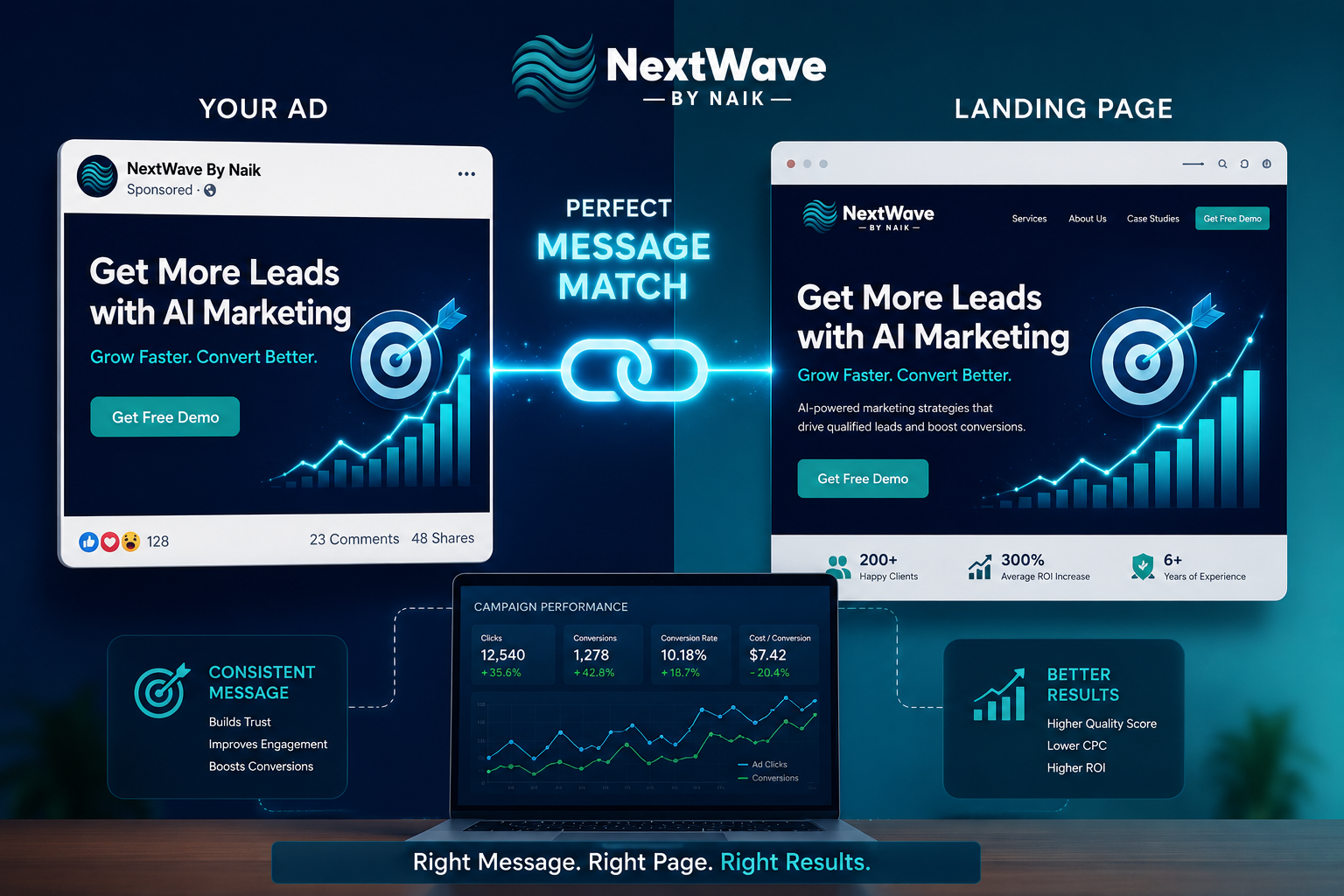
Ad Landing Page Message Match is one of the most overlooked factors affecting the success of paid advertising campaigns. Businesses often spend significant budgets on Google Ads, Meta Ads, LinkedIn Ads, and other PPC campaigns, only to see disappointing conversion rates because visitors encounter a landing page that feels disconnected from the advertisement they clicked.
When your advertisement promises one thing but your landing page communicates something different, users become confused and leave without taking action. This disconnect increases bounce rates, reduces trust, lowers Quality Scores, and wastes advertising budgets.
Creating a strong Ad Landing Page Message Match ensures that your advertisements and landing pages work together seamlessly. Every headline, image, CTA, offer, and design element should reinforce the same message users saw in the advertisement. This consistency builds trust, improves user experience, and significantly increases paid traffic conversion.
Let’s explore why message matching matters and how it can dramatically improve your PPC landing page performance.
What is Ad Landing Page Message Match?
Ad Landing Page Message Match refers to maintaining complete consistency between your advertisement and the landing page users visit after clicking it.
This consistency includes:
- Headlines
- Value propositions
- Offers
- Visual elements
- CTA buttons
- Brand messaging
- Tone of communication
For example:
Google Ad
Get 30% Off Website Design Services
Landing Page Headline
Save 30% on Professional Website Design Today
The visitor immediately recognizes they are in the right place, increasing confidence and encouraging them to continue.
Why Message Match Matters for SEO and PPC
Although message match is primarily associated with paid advertising, it also indirectly supports SEO performance.
Benefits include:
- Lower bounce rates
- Better user engagement
- Higher conversion rates
- Increased average session duration
- Improved Google Ads Quality Score
- Reduced Cost Per Click (CPC)
- Better return on ad spend (ROAS)
When users quickly find exactly what they expected, they’re more likely to remain on the page and convert.
1. Match Your Headlines
The landing page headline should closely resemble your ad headline.
Instead of introducing a completely different topic, reinforce the same promise.
Example:
Ad
Free SEO Audit for Small Businesses
Landing Page
Claim Your Free SEO Audit Today
This creates immediate reassurance.
2. Keep Your Offer Consistent
One of the biggest reasons campaigns fail is inconsistent offers.
Never advertise:
- Free consultation
Then promote:
- Paid consultation
Similarly, avoid changing discounts, pricing, or bonus offers between the ad and landing page.
Consistency builds trust instantly.
3. Use Matching Visuals
Images create expectations.
If your advertisement uses:
- Blue branding
- Product screenshots
- Team photos
Your landing page should continue using similar visuals.
Visual consistency improves recognition and reduces confusion.
4. Reinforce the Same Value Proposition
Every advertisement answers one question:
“Why should someone click?”
Your landing page should immediately reinforce that answer.
For example:
Ad Promise:
Generate More Leads with AI Marketing
Landing Page:
Discover How AI Marketing Generates Qualified Leads Faster
The visitor immediately understands they’re in the correct place.
5. Optimize Your Call-to-Action
Your CTA should continue the user’s journey rather than forcing them to rethink their decision.
Examples include:
- Get Started
- Book Free Demo
- Download Guide
- Schedule Consultation
- Claim Your Discount
CTA wording should reflect the original advertisement whenever possible.
6. Reduce Friction on the Landing Page
Visitors arriving through paid advertising expect a simple experience.
Avoid:
- Long paragraphs
- Multiple navigation menus
- Unrelated offers
- Too many buttons
- Confusing layouts
Instead, create focused pages designed around one conversion goal.
This significantly improves paid traffic conversion.
7. Build Trust Immediately
Trust signals reassure visitors that they made the right decision.
Include:
- Customer testimonials
- Client logos
- Google reviews
- Certifications
- Awards
- Security badges
- Case studies
These elements support both campaign consistency and conversion optimization.
8. Maintain Consistent Brand Voice
Your advertisement and landing page should sound like they belong to the same brand.
If your ad uses:
- Friendly language
- Professional tone
- Technical messaging
Maintain that style throughout the landing page.
Consistent communication strengthens brand identity and improves user confidence.
9. Test and Improve Continuously
Even the best landing pages benefit from ongoing optimization.
Conduct A/B tests on:
- Headlines
- CTA buttons
- Images
- Forms
- Colors
- Page layouts
- Testimonials
Track metrics such as:
- Conversion rate
- Bounce rate
- Average session duration
- Cost per conversion
- Click-through rate
- Return on ad spend
Small improvements often produce significant gains over time.
Common Message Match Mistakes
Many businesses unintentionally reduce conversions through avoidable mistakes.
Common issues include:
- Different headlines on ads and landing pages
- Inconsistent pricing
- Missing promotional offers
- Generic landing pages
- Poor visual consistency
- Slow page loading
- Weak CTAs
- Too many distractions
- Confusing navigation
- Irrelevant content
Fixing these issues often leads to immediate improvements in PPC performance.
Best Practices for Better Campaign Consistency
To maximize results:
- Create dedicated landing pages for every campaign.
- Use the same keywords in advertisements and headlines.
- Align images with ad creatives.
- Keep offers identical across channels.
- Write benefit-focused copy.
- Display trust signals prominently.
- Minimize distractions.
- Optimize for mobile devices.
- Improve page loading speed.
- Continuously test and refine your pages.
Strong campaign consistency helps users move smoothly from click to conversion.
Measuring Success
Monitor these KPIs to evaluate the effectiveness of your Ad Landing Page Message Match strategy:
- Conversion Rate
- Bounce Rate
- Quality Score
- Cost Per Acquisition (CPA)
- Cost Per Click (CPC)
- Return on Ad Spend (ROAS)
- Average Time on Page
- Form Completion Rate
Consistently reviewing these metrics helps identify opportunities for further optimization.
Conclusion
Ad Landing Page Message Match is the missing link between attracting clicks and generating meaningful conversions. Even the most compelling ad creative cannot compensate for a landing page that fails to deliver on its promise. By aligning headlines, offers, visuals, messaging, and calls to action, businesses create a seamless user journey that builds trust and encourages visitors to take the desired action.
Whether you’re running Google Ads, Meta Ads, or LinkedIn campaigns, prioritizing message match will improve your PPC landing page performance, strengthen campaign consistency, and increase paid traffic conversion. Combined with ongoing testing and landing page optimization, this strategy can reduce advertising costs while delivering stronger ROI and long-term business growth.