
10 Powerful Content Repurposing Workflow Ideas to Maximize One Business Idea
Creating high-quality content consistently can be one of the biggest challenges for businesses. Teams often spend hours researching topics, writing articles, designing graphics, recording videos, and preparing social media posts. Once that content is published, they immediately have to start thinking about what comes next.
This creates a constant demand for new ideas.
But businesses do not necessarily need hundreds of completely different ideas to maintain a strong online presence. Instead, they can create a system that extracts more value from every good idea they already have.
That is where a Content Repurposing Workflow becomes valuable.
A structured workflow allows one core business idea to become multiple useful content assets. A detailed blog can become a carousel, a LinkedIn post, a Reel, an email newsletter, an FAQ, short video clips, an infographic, a checklist, and several additional social media posts.
The objective is not to duplicate the same content everywhere. It is to adapt one valuable idea into different formats that match the expectations of different platforms and audiences.
For businesses trying to improve their social media content creation, this approach can save time, strengthen consistency, and make every piece of original content work harder.
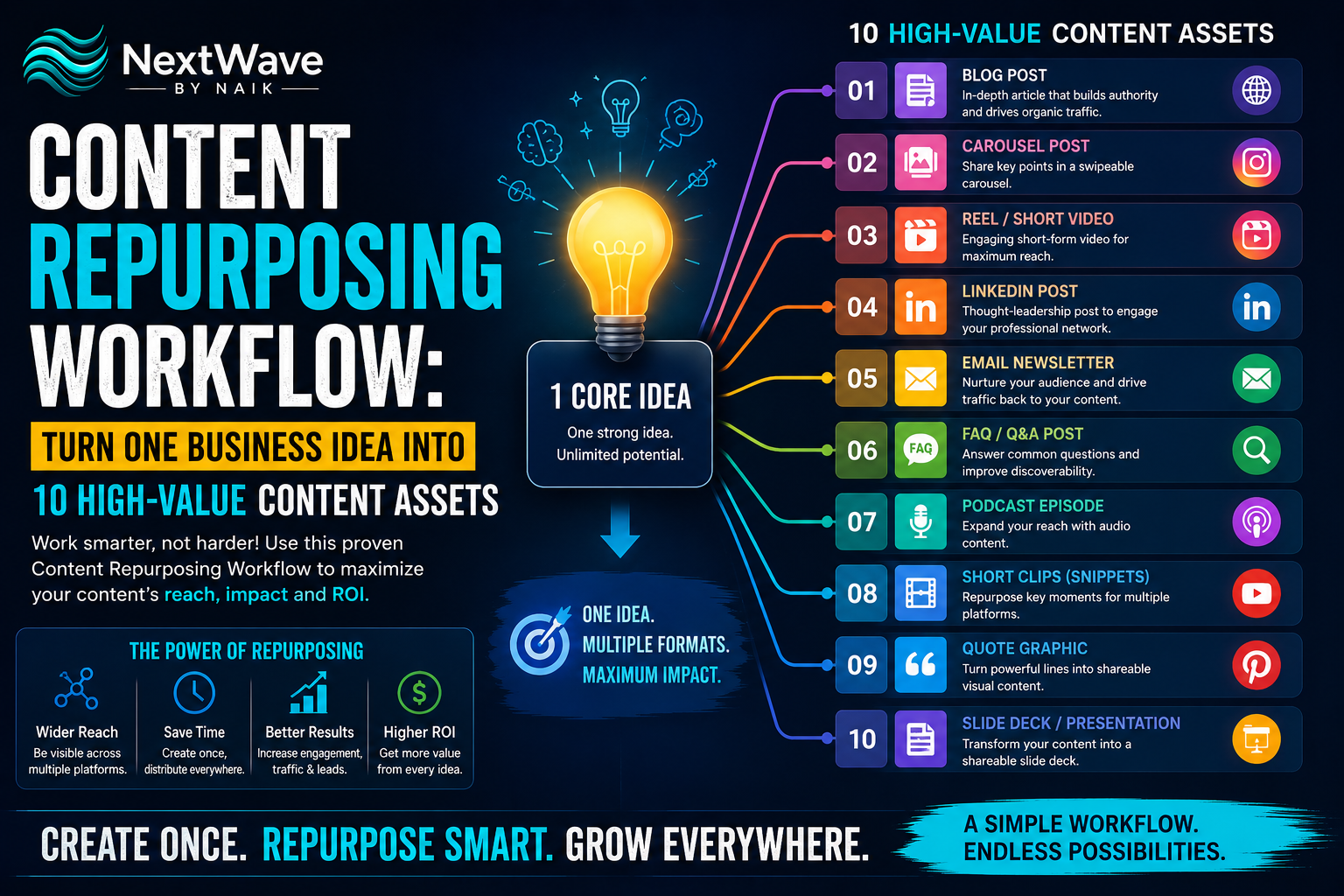
What Is a Content Repurposing Workflow?
A Content Repurposing Workflow is a repeatable process for transforming one original content idea into multiple pieces of content for different platforms and formats.
Think of your original idea as the source.
For example, a digital marketing agency might create a detailed guide about:
“How Businesses Can Generate More Qualified Leads Online.”
That one topic could become:
- A long-form blog
- An Instagram carousel
- A LinkedIn post
- A short-form video
- An Instagram Reel
- An email newsletter
- An FAQ section
- Several short video clips
- An infographic
- A downloadable checklist
The main message stays connected, but each asset is created for a specific purpose.
This is the foundation of an effective content repurposing strategy.
Rather than constantly starting from a blank page, businesses build a system that allows them to get more output from the research and expertise already invested in their original content.
Why Businesses Need a Content Repurposing Strategy
Content marketing can become inefficient when every platform is treated as a completely separate project.
Imagine a company publishes one blog every week. After publishing the blog, the team starts from scratch to create social media content, email content, videos, and other marketing assets.
That means the same research may effectively need to be repeated several times.
A better content repurposing strategy treats the original content as a central source from which other assets can be developed.
This approach can help businesses:
- Save time during content production
- Maintain a consistent publishing schedule
- Increase the lifespan of valuable content
- Reach different audience segments
- Improve brand consistency
- Reduce creative fatigue
- Strengthen multi-platform content distribution
- Generate more value from existing expertise
The important point is that repurposing should not reduce quality.
Each version should be adapted to its intended platform rather than copied without modification.
10 Ways to Turn One Idea Into Multiple Content Assets
1. Start With a Comprehensive Blog
One of the easiest ways to build a Content Repurposing Workflow is to begin with a strong long-form piece of content.
A detailed blog gives you a large amount of material to work with.
For example, a 2,000-word article might contain:
- Several major points
- Statistics
- Examples
- Questions
- Tips
- Common mistakes
- Step-by-step instructions
- Expert insights
- Practical recommendations
Each of these elements can later become an individual content asset.
The blog therefore becomes the foundation of your content workflow.
Instead of thinking of the article as one finished piece, think of it as a content library containing multiple smaller ideas.
This approach makes future social media content creation considerably easier.
2. Transform the Main Points Into a Social Media Carousel
A long-form article can be converted into a visual carousel for platforms such as Instagram or LinkedIn.
Start by identifying the five to eight most useful points from the article.
For example:
Slide 1:
“7 Ways to Improve Your Digital Marketing Results”
Slide 2:
Define your ideal audience.
Slide 3:
Create content around real customer problems.
Slide 4:
Optimize your website experience.
Slide 5:
Use paid advertising strategically.
Slide 6:
Track meaningful conversions.
Slide 7:
Repurpose your best-performing content.
The carousel should not reproduce the entire blog.
Instead, it should provide concise, visually engaging information that is easy to consume.
This is an important part of a multi-platform content strategy because users on social platforms often prefer quick, structured information.
3. Create a Short-Form Video
Video gives you another opportunity to extract value from the same idea.
Choose one particularly useful or surprising point from your original content and turn it into a 30–60 second video.
A simple structure could be:
Hook:
“Your business doesn’t need more content. It needs a better content system.”
Problem:
Explain how businesses repeatedly create content from scratch.
Solution:
Introduce the concept of repurposing one core idea into multiple assets.
Example:
Show how one blog can become several social posts and videos.
Closing:
Encourage viewers to think about how their existing content can be reused.
Short-form videos are particularly useful for social media content creation because they allow businesses to communicate expertise quickly.
4. Convert the Idea Into a LinkedIn Post
Your original topic can also be adapted into a LinkedIn post.
Instead of copying sections from your blog, identify one strong business insight.
For example:
Most businesses don’t have a content shortage. They have a content system problem.
You could then explain why businesses should stop treating every social media post as a completely new creative project.
A LinkedIn post can focus on:
- A professional observation
- A common mistake
- A business lesson
- A practical recommendation
- An industry insight
- A personal experience
This gives your original idea another format without making the audience feel like they are reading the same content again.
5. Turn the Topic Into an Email Newsletter
Email is another powerful destination within a Content Repurposing Workflow.
Select one useful idea from the original content and expand on it in a short newsletter.
For example:
Subject:
Are You Creating Too Much Content?
The email could explain how businesses can create more efficiently by repurposing existing ideas.
You do not need to send the complete article.
Instead, provide one valuable insight and direct interested readers toward the complete resource.
This allows your existing audience to consume the same expertise through another channel.
6. Build an FAQ From the Original Content
Every detailed piece of content contains questions that your audience may have.
Those questions can become an FAQ section.
For example:
What is content repurposing?
Content repurposing involves adapting an existing content idea or asset into different formats for different channels.
Does repurposed content need to be completely rewritten?
Not necessarily. The core idea can remain the same, but the presentation should be adapted to the platform and audience.
How often should businesses repurpose content?
There is no universal frequency. Businesses can repurpose valuable content whenever the topic remains relevant and the format provides additional value.
Can old content be repurposed?
Yes. Evergreen content can often be refreshed and adapted into new formats.
These questions can support your website while also providing additional material for future multi-platform content.
7. Extract Multiple Short Video Clips
If your business records long-form videos, webinars, interviews, or presentations, you already have a valuable source of short-form content.
A 20-minute video could potentially contain several useful moments.
For example:
- A 30-second opening insight
- A common mistake
- A useful statistic
- A practical tip
- A customer question
- A controversial opinion
- A step-by-step explanation
Each section can potentially become its own short clip.
This is one of the most efficient approaches to a content workflow because the research and recording have already been completed.
Instead of recording ten separate videos, one longer recording can provide material for several pieces of content.
8. Create an Infographic
Some information works better visually than through paragraphs.
Processes, statistics, comparisons, frameworks, and step-by-step instructions can often be converted into infographics.
For example, a blog titled:
“The 8-Step Digital Marketing Process”
could become a visual diagram showing:
- Research
- Audience identification
- Strategy development
- Content creation
- Distribution
- Advertising
- Measurement
- Optimization
Infographics can be shared on social platforms, included in blogs, added to presentations, or used in downloadable resources.
This extends the reach of the original idea while giving audiences another way to understand the information.
9. Create a Checklist or Downloadable Resource
A useful business idea can also become a practical resource.
Suppose your original content explains how to improve social media marketing.
You could convert the key recommendations into a checklist:
Social Media Content Checklist
- Define the target audience
- Select relevant platforms
- Establish content pillars
- Create a content calendar
- Develop original content
- Repurpose valuable ideas
- Optimize content for each platform
- Monitor engagement
- Measure conversions
- Improve future content
Checklists are useful because they turn educational information into something actionable.
They can also become downloadable resources that businesses use to generate leads.
10. Create Multiple Social Media Posts
One of the most useful benefits of a Content Repurposing Workflow is the ability to create several social media posts from one core topic.
Instead of publishing one post about the subject, identify different angles.
For example:
Post 1: The Problem
“Why are businesses struggling to create content consistently?”
Post 2: The Mistake
“Creating every social media post from scratch is not always the most efficient approach.”
Post 3: The Solution
“One strong idea can become multiple content assets.”
Post 4: The Process
“Here’s a simple five-step content repurposing process.”
Post 5: The Question
“How many pieces of content could you create from your latest blog?”
Post 6: The Tip
“Always adapt your content to the platform instead of copying it everywhere.”
This gives your business several opportunities to communicate the same expertise from different perspectives.
How to Build an Efficient Content Workflow
Creating multiple assets is useful, but without organization it can quickly become complicated.
A structured content workflow helps your team move from one idea to multiple finished assets.
A simple process can look like this:
Step 1: Choose the Core Idea
Start with a topic that answers a genuine audience question or solves a business problem.
Step 2: Create the Main Asset
Develop your strongest and most comprehensive piece first.
This could be a blog, podcast, webinar, presentation, or long-form video.
Step 3: Break It Into Content Pillars
Identify the major points, questions, examples, statistics, and takeaways.
Step 4: Assign Each Point to a Format
Decide whether each insight works best as a Reel, carousel, email, LinkedIn post, FAQ, infographic, or another format.
Step 5: Adapt the Content
Change the structure, length, hook, language, and presentation according to the platform.
Step 6: Schedule Everything
Use a content calendar to distribute the assets over time.
Step 7: Measure Performance
Identify which formats, topics, and messages perform best.
Step 8: Repurpose the Winners Again
If one piece of content performs particularly well, consider developing additional variations from it.
This creates a continuous content workflow rather than a one-time production process.
How to Adapt Content for Different Platforms
A successful content repurposing strategy does not mean publishing exactly the same material everywhere.
Each platform has its own audience behavior.
A blog can provide detailed explanations.
A LinkedIn post can focus on professional insights.
An Instagram carousel can communicate several points visually.
A Reel can deliver one idea quickly.
An email can provide a more direct and personal explanation.
An FAQ can answer specific questions.
The core message can remain consistent while the format changes.
This is what makes multi-platform content effective.
The objective is to make the content feel natural on each platform rather than forcing one format into every channel.
Common Content Repurposing Mistakes to Avoid
Although repurposing can save time, businesses can make mistakes when they focus too heavily on quantity.
Copying the Same Content Everywhere
Simply duplicating a LinkedIn post onto Instagram may not produce the best experience.
Adapt the content.
Changing Only the Headline
Changing the title while leaving everything else identical is not genuine repurposing.
The format should match the platform.
Repurposing Weak Content
Not every piece of content deserves to be reused.
Start with ideas that are valuable, relevant, useful, or proven to perform well.
Ignoring Audience Intent
Different audiences may consume the same topic differently.
Always consider what the audience expects from the platform.
Prioritizing Quantity Over Quality
The purpose of repurposing is to increase efficiency, not flood every channel with low-value content.
Measure What Works
A strong Content Repurposing Workflow should include performance measurement.
Track metrics such as:
- Engagement
- Reach
- Video views
- Website traffic
- Email clicks
- Leads
- Conversions
- Saves
- Shares
- Comments
The most important metric depends on your objective.
For example, a brand-awareness campaign may prioritize reach and engagement, while a lead-generation campaign may focus more heavily on qualified inquiries and conversions.
Over time, performance data can show you which topics and formats deserve additional attention.
If a particular blog produces strong traffic and several social posts perform well, you can continue extracting additional ideas from that topic.
The Long-Term Value of Content Repurposing
The biggest benefit of a Content Repurposing Workflow is not simply that it saves a few hours each week.
It changes how a business thinks about content.
Instead of viewing content as individual posts, businesses can start viewing content as a connected system.
One strong idea becomes a central asset.
That asset produces multiple smaller pieces.
Those pieces reach different audiences.
Some of them generate engagement.
Some generate website traffic.
Some generate leads.
And high-performing pieces can potentially be developed into even more content.
This creates a more sustainable approach to social media content creation.
Conclusion
Businesses do not always need more ideas.
They often need a better system for using the ideas they already have.
A well-designed Content Repurposing Workflow allows one valuable business idea to become a blog, carousel, Reel, LinkedIn post, email, FAQ, video clips, infographic, checklist, and multiple social media posts.
The process starts with one strong idea and ends with a complete collection of useful content assets.
The key is to avoid simply copying the same material across platforms. Instead, adapt each asset to its specific audience, format, and purpose.
With a consistent content repurposing strategy, businesses can reduce the pressure of constantly creating from scratch while maintaining a stronger and more consistent digital presence.
A smart content workflow also makes it easier for teams to plan, produce, schedule, measure, and improve their content over time.
Ultimately, the goal of multi-platform content is not to publish more just for the sake of publishing.
It is to get more value from every strong idea your business creates.
Create one valuable idea. Break it down. Adapt it. Distribute it. Measure it. Then build on what works.
Ready to turn blogging into a powerful SEO growth engine for your business?
At NextWave By Naik, we specialize in creating data-driven blogging strategies that improve rankings, attract organic traffic, and build long-term authority. From keyword research to content creation and optimization, we handle everything—so you can focus on growing your business.