
Social Media to Website Strategy: How to Turn Followers Into Website Visitors
Having thousands of followers may look impressive, but follower count alone does not necessarily create business growth.
Someone can watch your Reel, like your post, save your carousel and follow your account without ever visiting your website.
That creates an important marketing question:
How do you move people from social media engagement to meaningful website activity?
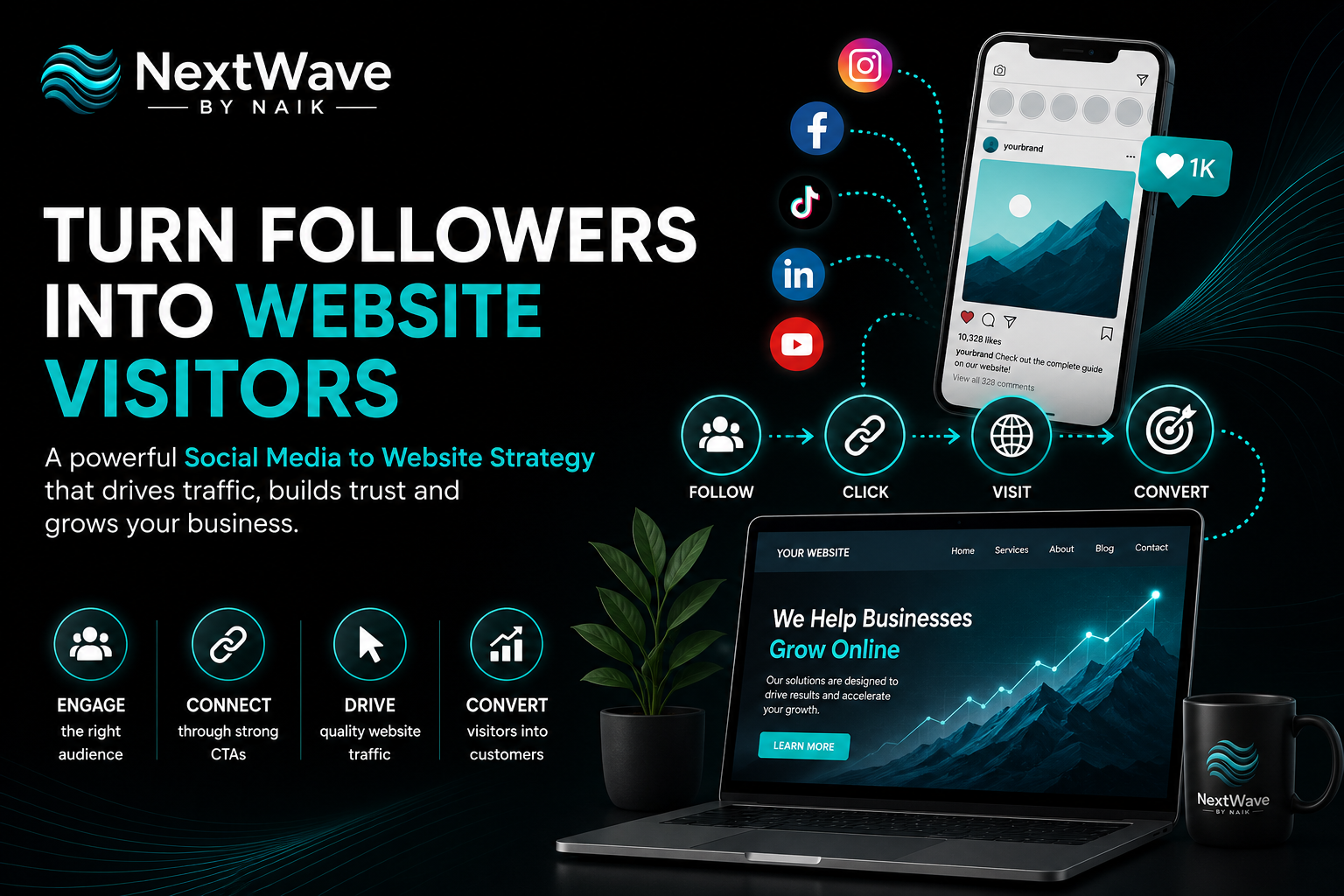
A Social Media to Website Strategy creates a clear path between the content someone discovers and the action you want them to take on your website.
The journey may look simple:
Social Content → CTA → Profile → Website → Landing Page → Conversion
However, every step matters.
If your content has no clear call to action, people may not know where to go. If your profile does not communicate your value, visitors may not click your website link. If your landing page does not match the promise made in your social post, they may leave immediately.
A successful approach connects these touchpoints into one intentional customer journey.
In this guide, we explore 9 powerful ways to turn followers into website visitors, increase valuable social traffic and build a stronger path from attention to conversion.
Why Should Social Media Drive Traffic to Your Website?
Social platforms are excellent for discovery, engagement and relationship building.
Your website, however, gives you a more controlled environment where people can explore your products, services and expertise.
Your website can offer:
- Detailed product information
- Service pages
- Case studies
- Pricing information
- Lead forms
- Booking options
- Ecommerce functionality
- Downloadable resources
- Educational content
- Email subscriptions
Social media can introduce your brand and create interest. Your website can then provide the deeper information needed to support a decision.
That makes social media website traffic more than a simple traffic metric.
A visitor who arrives on the right page, explores your content and eventually becomes a lead or customer can be much more valuable than hundreds of visitors who leave immediately.
The goal is therefore not simply to get people from one platform to another.
The goal is to create a connected journey where every click has a purpose.
9 Powerful Ways to Turn Followers Into Website Visitors
1. Give Every Content Piece a Clear Website CTA
One of the easiest ways to increase website visits is to tell your audience what to do next.
A social media post can educate your audience, entertain them or solve a small problem. But if the post ends without a clear next step, the journey may stop there.
Instead of ending with:
“What do you think?”
you could use:
“Read the complete guide on our website.”
Or:
“Explore the full collection through the link in our bio.”
Or:
“Get the complete checklist from our website.”
Your CTA should naturally connect with the content.
For example, if a Reel explains three website mistakes, direct users to a detailed article covering ten mistakes and how to fix them.
This gives people a logical reason to click.
A strong CTA answers three questions:
Where should I go?
Why should I go there?
What will I get when I arrive?
That clarity is an essential part of a Social Media to Website Strategy.
A useful CTA should also feel like the next logical step rather than an interruption. If the content has already created a question, the website should provide the answer. If the post introduces a product, the website should provide a deeper product experience.
2. Optimize Your Social Media Profile for Clicks
Your profile is often the bridge between content discovery and your website.
A person may discover your Reel, become interested and then visit your profile to understand who you are.
At that moment, your profile should quickly communicate:
- Who you are
- What you offer
- Who you help
- Why people should trust you
- What they should do next
Your website link should be easy to find.
Your bio should also support the reason for clicking.
Weak Bio
Helping businesses grow online.
Stronger Bio
Helping businesses generate more leads through websites and digital marketing.
↓ Get our free website checklist
The second version creates a clearer value exchange.
This is particularly important for Instagram website traffic, where the profile can become the primary transition point between content discovery and a website visit.
Your profile should not simply describe your business.
It should guide people toward the next step.
This is one of the simplest areas to improve because you can update your profile without creating new content. Make the website destination obvious, explain the benefit of clicking and remove unnecessary distractions from the bio.
3. Match Your CTA to Content Intent
Not every follower is ready to purchase.
Someone discovering your brand for the first time may need education.
Someone who has watched several product videos may be ready to visit a product page.
Someone who has already interacted with your website may be ready for a consultation or purchase.
Your CTA should reflect that intent.
Awareness Content
Use CTAs such as:
- Read the guide
- Learn more
- Explore the topic
- See the full explanation
Consideration Content
Use:
- Compare your options
- See how it works
- Explore our services
- View case studies
Conversion Content
Use:
- Book a consultation
- Request a quote
- Shop now
- Get started
This creates a more natural social media funnel.
Instead of pushing every follower directly toward a sales page, you give them a relevant next step based on their relationship with your brand.
This makes a Social Media to Website Strategy more useful because it recognizes that different people require different levels of information before converting.
The CTA should also match the format. A quick Reel may work best with a simple action, while an educational carousel may justify a longer guide or resource. Matching the CTA to the user’s context reduces friction.
4. Create Dedicated Landing Pages for Social Traffic
Sending every social media visitor to your homepage is a common mistake.
Your homepage may contain multiple services, products, messages and navigation options.
A dedicated landing page can be much more focused.
For example, suppose an Instagram post promotes a free SEO checklist.
Instead of sending visitors to your homepage, send them to a page specifically created for that resource.
The landing page should immediately reinforce the promise from your social content.
If the post says:
“Download our 20-point SEO checklist.”
the landing page should clearly communicate:
“Download the 20-Point SEO Checklist.”
This consistency matters.
When the social post, CTA and landing page all communicate the same value, users don’t have to figure out whether they’ve landed in the right place.
A strong Social Media to Website Strategy therefore considers the destination before publishing the social post.
The landing page should also load quickly, work well on mobile devices and make the intended action obvious. Avoid forcing social visitors to search through several pages before finding the information promised in the original post.
5. Turn Social Content Into Website Content Hubs
Your social content shouldn’t exist in isolation.
One social topic can become an entire website content ecosystem.
Imagine you create an Instagram carousel titled:
“5 Ways to Improve Your Website Homepage.”
The carousel can point users toward a detailed website article.
That article can then link to:
- Homepage design services
- Conversion optimization resources
- Related blogs
- Case studies
- Contact pages
Now one social post has become an entry point to a larger customer journey.
The structure can look like:
Social Post → Blog → Related Content → Service Page → Conversion
You can repeat this model across different topics.
For example:
Social Post: Website SEO mistakes
↓
Blog: Complete SEO guide
↓
Resource: SEO checklist
↓
Service: SEO services
↓
Conversion: Consultation
This approach can increase useful website engagement while giving your audience more opportunities to explore your expertise.
A Social Media to Website Strategy becomes stronger when social content is treated as the entrance to a larger content ecosystem rather than as a standalone post.
This also gives your website more opportunities to rank for relevant searches while giving social followers a reason to explore beyond the original post.
6. Give People a Strong Reason to Click
Sometimes saying “visit our website” isn’t enough.
People need a reason to leave the platform.
One of the most effective approaches is to offer something useful that exists on your website.
Examples include:
- Free templates
- Checklists
- Guides
- Calculators
- Case studies
- Downloadable resources
- Product comparisons
- Free tools
- Detailed tutorials
For example, an Instagram carousel could say:
“7 Website SEO Mistakes You Should Avoid.”
Then the CTA could be:
“Want the complete SEO checklist? Get it free on our website.”
Now the website visit provides a clear benefit.
This is a strong social conversion strategy because you’re not simply asking people to leave the platform. You’re offering a useful reason to do so.
The more closely the resource matches the content, the more natural the transition becomes.
A good Social Media to Website Strategy focuses on the value of the click, not simply the number of clicks. When users understand what they will receive after clicking, they are more likely to make the transition.
7. Use Stories and Short-Form Content to Create Click Opportunities
Short-form content can generate significant attention, but attention needs a next step.
Stories, Reels and other short-form formats can create frequent opportunities to guide interested users toward your website.
For example:
Story 1
“Struggling to generate leads from your website?”
Story 2
“Here are 3 mistakes that could be costing you leads.”
Story 3
“We explain all 10 mistakes in our complete guide.”
Story 4
“Read the full guide →”
This creates a mini journey rather than inserting a random link.
The same principle applies to short-form video.
Start with a problem.
Provide useful information.
Create curiosity around the deeper solution.
Then provide a relevant CTA.
This approach can make Instagram website traffic more intentional and useful because users understand why they’re being directed to the website.
A strong Social Media to Website Strategy uses short-form content to create curiosity and then gives users a clear destination where they can continue learning.
You can also experiment with different CTA placements. Some audiences may respond to an early prompt, while others may be more motivated after receiving useful information first.
8. Build a Consistent Social-to-Website Funnel
A strong Social Media to Website Strategy should have a repeatable funnel rather than depending on individual posts.
A basic journey could look like this:
Stage 1 — Discovery
Users discover your content through:
- Reels
- Posts
- Stories
- Search
- Shares
- Recommendations
Stage 2 — Engagement
They:
- Watch
- Like
- Save
- Comment
- Follow
- Visit your profile
Stage 3 — Website Visit
Your CTA sends them to:
- Blog
- Product page
- Service page
- Landing page
- Resource
Stage 4 — Conversion
They:
- Submit a form
- Book a call
- Make a purchase
- Download a resource
- Subscribe
- Request information
This structure makes it easier to identify where people are dropping out.
If content gets strong engagement but few profile visits, your CTA may need improvement.
If profile visits are high but website clicks are low, your bio or link destination may need work.
If website clicks are high but conversions are low, your landing page may be the problem.
The important point is that your Social Media to Website Strategy should not stop at the click. Website behavior is what tells you whether the traffic was actually valuable.
9. Measure the Journey From Follower to Customer
A successful strategy needs measurement.
Don’t only track follower growth.
Track what happens after people engage with your social content.
Useful metrics include:
- Profile visits
- Link clicks
- Website sessions
- Landing page views
- Engaged sessions
- Lead submissions
- Purchases
- Conversion rate
- Cost per conversion
- Revenue from social traffic
You can then identify which content produces valuable website activity.
| Metric | What It Tells You |
|---|---|
| Reach | How many people saw the content |
| Engagement | How strongly the content resonated |
| Profile Visits | Whether content generated deeper interest |
| Link Clicks | Whether the CTA encouraged action |
| Website Sessions | How much traffic social generated |
| Conversions | How much business value was created |
| Revenue | Financial impact of social traffic |
This changes the question from:
“How many likes did this post receive?”
to:
“Did this content move people closer to becoming customers?”
That is a much more useful marketing question.
Your Social Media to Website Strategy should therefore connect social analytics with website analytics. Looking at both sides of the journey helps you understand which content creates attention and which content creates actual business results.
How to Build a Social Media to Website Strategy Step by Step
Creating a reliable system doesn’t require complicated technology.
Start by mapping the journey from your social content to the desired conversion.
Step 1: Define the Goal
Decide what you want social traffic to accomplish.
For example:
- Generate leads
- Sell products
- Promote services
- Grow email subscribers
- Increase bookings
- Promote educational content
Step 2: Identify the Best Website Destination
Choose the page that best supports the goal.
Don’t automatically select your homepage.
Step 3: Create Relevant Social Content
Build content around a problem, question or interest your target audience already has.
Step 4: Add a Specific CTA
Tell people exactly what they should do next.
Step 5: Match the Landing Page
Make sure the destination fulfills the promise made in the social content.
Step 6: Track Results
Measure clicks, engagement, website behavior and conversions.
Step 7: Improve the Weakest Step
Find the biggest drop-off and optimize that part of the journey.
This process turns a collection of social posts into a repeatable system.
A Social Media to Website Strategy should be documented so your team can repeat what works. Create a simple journey map for each major campaign showing the content, CTA, profile destination, landing page and final conversion action.
How to Increase Social Media Website Traffic Without Posting More
More content isn’t always the answer.
You can often improve results by making existing content more effective.
Start by reviewing your best-performing posts.
Ask:
Which topics generate the most engagement?
Which posts create profile visits?
Which CTAs generate clicks?
Which website pages receive the most social traffic?
Which posts generate leads or sales?
Then create variations around proven topics.
For example, if a Reel about website speed generates strong website traffic, you could create:
- A carousel explaining common speed problems
- A short video showing a speed test
- A case study about improving loading time
- A checklist for website speed
- A detailed blog about page performance
All of these can point toward relevant website resources.
This creates a content loop:
High-performing social topic → More content → Website resource → Conversion opportunity
The goal is to make every successful topic work harder instead of constantly searching for completely new ideas.
A Social Media to Website Strategy becomes more efficient when your best-performing ideas are repeatedly transformed into different content formats and connected to useful website destinations.
How to Improve Instagram Website Traffic
Instagram deserves special attention because people often discover content first and investigate the brand later through its profile.
To improve website visits:
Optimize Your Bio
Clearly explain what you do and who you serve.
Use a Strong Profile CTA
Give people a clear reason to visit your website.
Keep Your Link Relevant
Send visitors to the page most closely connected to the content or campaign.
Use Stories Strategically
Create story sequences that naturally lead users toward a website resource.
Repurpose High-Performing Content
Turn successful posts into new formats and connect them to deeper website resources.
Track Website Behavior
Use analytics and campaign tracking to understand which Instagram activities generate meaningful traffic and conversions.
The objective isn’t simply to get more people to click.
It’s to get the right people to click.
That distinction is important because a large amount of low-quality traffic may create impressive analytics without producing meaningful business results.
A Social Media to Website Strategy for Instagram should therefore focus on relevance. The person clicking the link should understand what the website offers and why it is worth their time.
The Role of Content in a Social Conversion Strategy
Content is the engine that moves people into your funnel.
Different content types can serve different purposes.
Educational Content
Builds awareness and authority.
Problem-Focused Content
Helps users recognize a need.
Demonstration Content
Shows how your product or service works.
Social Proof
Reduces uncertainty.
Case Studies
Demonstrate real-world outcomes.
Offer Content
Encourages action.
When these content types work together, your social conversion strategy becomes stronger.
Instead of repeatedly posting promotional messages, you build a sequence that educates, builds trust and eventually creates a reason to visit the website.
For example:
Educational post
→ Introduces a problem
Problem-focused Reel
→ Shows why it matters
Case study
→ Demonstrates the solution
Website guide
→ Provides deeper information
Service page
→ Presents the offer
CTA
→ Encourages conversion
This approach gives users multiple opportunities to move forward.
Your Social Media to Website Strategy should use these content types together rather than expecting one post to perform every job.
Creating a Connected Social Media Funnel
Your social media funnel should feel natural to the user.
A practical structure is:
Attention
↓
Social content
↓
Interest
↓
Profile visit
↓
Intent
↓
Website click
↓
Consideration
↓
Landing page or product/service page
↓
Action
↓
Lead, purchase, booking or signup
Each stage should have a clear purpose.
If a user isn’t ready to purchase, give them educational content.
If they show stronger interest, give them a relevant resource.
If they’re ready to act, make the conversion path simple.
This prevents you from treating every follower as though they have the same level of buying intent.
A well-designed Social Media to Website Strategy respects this progression and gives people the information they need at the right moment.
Website Elements That Support Social Traffic
Getting someone to your website is only half the job.
The website itself needs to help them continue toward the intended action.
Make sure your landing pages have:
A Clear Headline
Tell visitors immediately what the page offers.
Strong Value Proposition
Explain why the visitor should care.
Relevant Visuals
Use imagery that supports the message from the social content.
Simple Navigation
Don’t overwhelm visitors with unnecessary choices.
Strong CTA
Make the next action obvious.
Social Proof
Use reviews, testimonials, case studies or relevant trust signals.
Mobile-Friendly Design
Social traffic frequently arrives through mobile devices, so pages should be easy to read and navigate on smaller screens.
If your social content creates strong interest but the website creates friction, the entire journey suffers.
That’s why social traffic and website conversion should be planned together.
A Social Media to Website Strategy is incomplete if the website cannot convert the attention generated by social platforms.
Common Social Media-to-Website Mistakes
Sending Every Visitor to the Homepage
A generic destination may not provide the information users expected from the social post.
Using Weak CTAs
“Check us out” is less compelling than a specific, benefit-driven CTA.
Creating Mismatched Landing Pages
If your social post promises one thing and your landing page discusses something else, visitors may leave.
Focusing Only on Follower Count
A large audience isn’t automatically valuable if it never takes meaningful action.
Making the Website Difficult to Navigate
Even motivated visitors can leave if they can’t quickly find what they need.
Ignoring Mobile Experience
A poor mobile experience can turn interested social visitors into immediate exits.
Tracking Only Clicks
Clicks matter, but conversions and revenue tell you whether that traffic is actually valuable.
Using the Same CTA Everywhere
Different content and funnel stages require different next steps.
Avoiding these mistakes can make your Social Media to Website Strategy more efficient without requiring a larger audience or significantly more content.
How to Create Better Social-to-Website CTAs
A CTA becomes stronger when it combines action + value.
Instead of:
“Visit our website.”
Try:
“Get the complete checklist.”
Instead of:
“Learn more.”
Try:
“See how the process works.”
Instead of:
“Click the link.”
Try:
“Explore the full guide.”
Instead of:
“Check our services.”
Try:
“See how we can help your business generate more leads.”
The CTA should feel like the natural continuation of the content.
A good Social Media to Website Strategy doesn’t force the click.
It makes the click feel worthwhile.
You can also test different CTA styles across similar content. Compare direct action language, benefit-led language and curiosity-driven language to learn which approach creates the strongest website engagement.
How to Repurpose Social Content for More Website Visits
You don’t need to create a completely new website campaign every week.
One strong idea can be repurposed across several formats.
For example, a website article about 10 SEO mistakes could become:
- Instagram carousel: 5 mistakes
- Reel: The biggest SEO mistake
- Story: Quick SEO quiz
- LinkedIn post: SEO lesson
- Short video: Before-and-after example
- CTA: Read the complete guide
Each piece can send interested users toward the same website resource.
This gives your website content a longer lifespan and creates multiple opportunities for social media website traffic.
Over time, your strongest website resources can become recurring destinations for your social content.
This approach also helps maintain consistency. Instead of creating unrelated posts every day, your team can build a connected content system where social posts support website content and website content gives social followers somewhere useful to continue.
How to Create a Stronger Social Media to Website Strategy for Different Audiences
Not every follower has the same needs, so the journey should adapt to audience intent.
New Followers
People who have just discovered your brand may respond best to educational content, introductory guides and helpful resources.
The CTA can encourage them to learn more rather than immediately asking for a purchase.
Engaged Followers
People who regularly watch, save or comment on your content may be ready for deeper resources, case studies or comparison pages.
Here, the CTA can lead them to a more specific website destination.
High-Intent Followers
People who have already shown strong interest may be ready for product pages, service pages, pricing information, consultations or booking forms.
This segmentation makes a Social Media to Website Strategy more relevant because the destination reflects the user’s likely stage.
The principle is simple:
Don’t send everyone to the same page. Send each audience toward the next page that makes sense for them.
How to Improve Your Social-to-Website Journey Over Time
A strategy should evolve based on data.
Start by identifying your strongest social posts and the website destinations connected to them.
Then compare:
- Which content gets attention?
- Which content drives profile visits?
- Which CTAs generate website clicks?
- Which landing pages keep visitors engaged?
- Which pages generate leads or sales?
If one topic consistently drives valuable visitors, build more content around it.
If a CTA receives strong engagement but very few clicks, test different wording.
If a landing page receives traffic but produces few conversions, improve its headline, offer, trust signals or CTA.
This creates an ongoing optimization loop:
Publish → Measure → Learn → Improve → Republish
Over time, your Social Media to Website Strategy becomes more efficient because decisions are based on actual audience behavior rather than assumptions.
Conclusion
Social media shouldn’t be treated as the final destination.
It can be the beginning of a much larger customer journey.
A strong Social Media to Website Strategy connects your content, CTA, profile, website and landing pages into one clear path.
The most important steps are:
- Create content around genuine audience needs
- Use clear website-focused CTAs
- Optimize your social profile
- Send users to relevant landing pages
- Build website content hubs
- Give people valuable reasons to click
- Use Stories and short-form content strategically
- Create a structured social media funnel
- Measure website traffic and conversions
The objective isn’t to turn every follower into a website visitor immediately.
The objective is to create enough value and clarity that the right followers naturally want to take the next step.
When social content attracts attention, your profile builds interest, your website provides value and your landing page makes action easy, the journey becomes much more effective.
The best results come when social media and your website work as one connected marketing system, rather than two separate channels.
A Social Media to Website Strategy ultimately turns social attention into a measurable customer journey. Instead of measuring success only through likes and follower growth, you can evaluate the real business outcomes created by your social presence.
Don’t just build followers. Build a path from attention to action.
That is what turns social media from an engagement channel into a meaningful source of website traffic, leads and business growth.
Ready to turn blogging into a powerful SEO growth engine for your business?
At NextWave By Naik, we specialize in creating data-driven blogging strategies that improve rankings, attract organic traffic, and build long-term authority. From keyword research to content creation and optimization, we handle everything—so you can focus on growing your business.