
Creative Testing Matrix: 9 Powerful Ways to Find Winning Meta Ads Without Guesswor
Running Meta Ads is easy.
Finding creatives that consistently perform is the hard part.
You can launch multiple ads, spend money on testing, and still end up asking the same question:
“Which creative should we scale?”
The problem is often not the lack of ideas. It is the lack of a structured creative testing process.
A Creative Testing Matrix gives your team a systematic way to test different elements of an ad—such as hooks, visuals, formats, offers, messaging, and calls to action—so you can understand what actually drives performance.
Instead of testing random combinations, you create controlled experiments that generate useful insights.
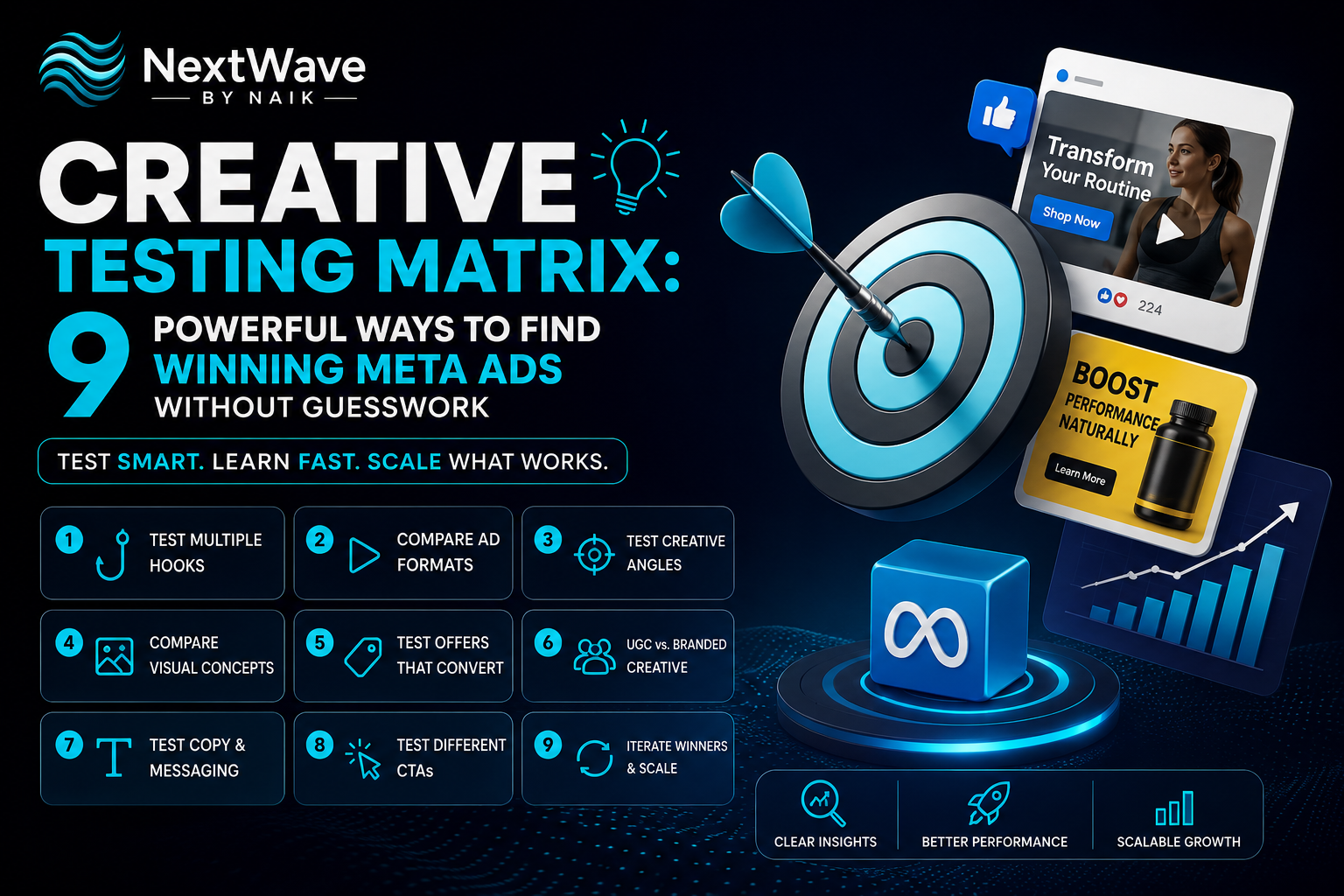
In this guide, we’ll explore 9 powerful ways to use a Creative Testing Matrix for Meta Ads and build a repeatable ad creative testing system.
What Is a Creative Testing Matrix?
A Creative Testing Matrix is a structured framework used to organize, compare, and evaluate different advertising creative variables.
For Meta Ads, those variables can include:
- Hooks
- Headlines
- Primary copy
- Images
- Videos
- UGC
- Ad formats
- Offers
- CTAs
- Product demonstrations
- Social proof
- Angles
- Audiences
Instead of simply creating “more ads,” the matrix helps you understand why one creative performs better than another.
For example, imagine you’re selling a skincare product.
Rather than testing five completely unrelated ads, you could test:
| Variable | Test A | Test B | Test C |
|---|---|---|---|
| Hook | Problem-focused | Benefit-focused | Curiosity |
| Format | UGC video | Product demo | Static |
| Offer | 10% off | Buy 2, Get 1 | Free shipping |
| CTA | Shop Now | Get Yours | Learn More |
This creates a testing structure where every result can teach you something.
Why Meta Ads Need a Creative Testing System
Meta’s advertising environment is highly competitive.
Your audience may see dozens of advertisements every day. That means your creative needs to stop the scroll, communicate value quickly, and give users a reason to take action.
A common mistake is to change several things at once.
For example:
New video + new hook + new offer + new audience + new landing page.
If performance improves, you don’t know what caused the improvement.
If performance declines, you don’t know what went wrong.
That’s why effective Meta Ads testing focuses on isolating variables wherever practical.
The goal isn’t simply to find a winning ad.
The goal is to discover the ingredients that make an ad win.
9 Powerful Ways to Use a Creative Testing Matrix
1. Test Multiple Hooks Before Changing Everything Else
The hook is one of the first things a user encounters.
A strong hook can immediately communicate a problem, benefit, curiosity gap, or relevant insight.
Try testing different hook categories:
Problem Hook
“Still wasting money on ads that don’t convert?”
Benefit Hook
“Turn your best-performing creative into a scalable ad system.”
Curiosity Hook
“Here’s why your best-looking ad may not be your best-performing ad.”
Contrarian Hook
“More ad creatives don’t automatically mean better Meta Ads.”
Social Proof Hook
“Thousands of customers switched after trying this approach.”
The important point is to keep the rest of the creative relatively consistent while testing the hook.
This helps you determine whether the opening message is influencing performance.
2. Build an Ad Format Testing Framework
Different formats can communicate the same message in completely different ways.
Your Creative Testing Matrix should include multiple formats such as:
- UGC videos
- Founder-led videos
- Product demonstrations
- Static images
- Carousels
- Testimonials
- Before-and-after concepts
- Screen recordings
- Educational videos
- Motion graphics
For example, you could take one core advertising message and create:
Version A: UGC testimonial
Version B: Product demonstration
Version C: Static image
Version D: Founder explanation
Now you’re testing the format, rather than four completely different marketing ideas.
This creates cleaner insights for your performance creative strategy.
3. Test Different Creative Angles
Your product can have multiple selling points.
The mistake is assuming that every customer responds to the same one.
For example, a fitness product could be promoted through:
- Convenience
- Results
- Time savings
- Affordability
- Beginner friendliness
- Expert credibility
- Social proof
- Lifestyle transformation
These are different creative angles.
One audience may respond strongly to:
“Get fit with just 20 minutes a day.”
Another may respond to:
“A simple workout system for complete beginners.”
The product hasn’t changed.
The perspective has changed.
Testing angles is one of the most valuable parts of a performance creative strategy because it helps uncover what motivates your audience.
4. Compare Visual Concepts
Your visual is responsible for earning attention before the user reads your copy.
Create multiple visual concepts around the same message.
For example:
Concept A: Product close-up
Concept B: Person using the product
Concept C: Problem visualization
Concept D: Product transformation
Concept E: Text-led graphic
For video ads, test differences such as:
- First-frame composition
- Camera angle
- Presenter
- Background
- Product visibility
- On-screen text
- Editing speed
- Demonstration style
Don’t assume that the most polished visual will win.
On Meta, a simple, authentic-looking creative can sometimes outperform a highly produced advertisement because it feels more native to the platform.
5. Test Offers, Not Just Creatives
Creative performance isn’t always about the creative itself.
The offer can significantly influence the user’s decision.
Depending on your business model, you could test:
- Percentage discounts
- Flat discounts
- Free shipping
- Free trials
- Bundles
- Limited-time offers
- Bonuses
- Buy-one-get-one offers
- Free consultations
- Lead magnets
For example:
Creative A: “Save 10% today.”
Creative B: “Get free shipping on your first order.”
The creative may be similar, but the perceived value changes.
This is why your Creative Testing Matrix should include offer testing alongside visual and messaging tests.
6. Test UGC vs. Branded Creative
User-generated content has become a major creative format for performance advertisers.
But that doesn’t mean every brand should rely exclusively on UGC.
Test UGC against other creative styles.
For example:
| Creative Type | Main Strength |
| UGC | Authenticity |
| Founder video | Trust and authority |
| Product demo | Product clarity |
| Static creative | Fast communication |
| Testimonial | Social proof |
| Professional video | Brand perception |
The winning format depends on the audience, offer, product, and stage of the customer journey.
Instead of asking:
“Should we use UGC?”
Ask:
“Which creative format produces the strongest business outcome for this audience and offer?”
That’s a much better testing question.
7. Test Different Copy and Messaging Structures
Your visuals may attract attention, but your messaging needs to turn that attention into interest.
Test different copy structures, including:
Short & Direct
Better results. Less guesswork. Start testing smarter.
Problem → Solution
Your ads aren’t necessarily failing because of your budget. You may simply be testing the wrong creative variables.
Story-Based
We tested dozens of creative variations and discovered that one simple change consistently improved performance.
Educational
Here’s a simple framework for testing Meta Ads without changing five variables at once.
Social Proof
More customers are choosing this approach because it solves a problem traditional methods often overlook.
Testing copy structures allows you to identify the messaging style that resonates most with your audience.
8. Test Different Calls to Action
The CTA may look like a small part of an ad, but it can influence what the user expects to happen next.
Depending on your campaign objective, test CTAs such as:
- Shop Now
- Learn More
- Get Started
- Book Now
- Sign Up
- Download Now
- Claim Offer
- Get Your Free Quote
For example, a high-consideration service may perform better with:
“Book a Free Consultation”
rather than:
“Buy Now.”
The CTA should match both the offer and the user’s level of intent.
9. Turn Winning Insights Into a Repeatable Testing System
The biggest mistake in creative testing is stopping after finding one winning ad.
A winning creative should become a source of new testing ideas.
Suppose your winning ad has:
- Strong problem-focused hook
- UGC format
- Customer testimonial
- Free-shipping offer
- Product demonstration
Instead of simply scaling that exact ad forever, break it into components.
Then create variations:
Hook: Test 5 new problem-focused hooks.
Format: Recreate the message using static, UGC, and founder-led videos.
Testimonial: Try different customer stories.
Offer: Compare free shipping against a percentage discount.
Visual: Test product demonstration against lifestyle footage.
This creates a creative iteration loop.
The goal is to turn one winner into many informed experiments.
How to Build Your Own Creative Testing Matrix
A practical matrix can be organized around seven major variables:
| Variable | Examples |
| Hook | Problem, benefit, curiosity, social proof |
| Angle | Convenience, price, results, authority |
| Format | UGC, static, carousel, demo |
| Visual | Product, person, lifestyle, transformation |
| Copy | Short, story, educational, direct |
| Offer | Discount, bundle, free shipping, bonus |
| CTA | Shop, Learn, Book, Sign Up |
You don’t need to test everything simultaneously.
Instead, prioritize the variables most likely to influence performance.
A simple testing structure could look like this:
Round 1 → Test Hooks
Find your strongest messaging openings.
Round 2 → Test Formats
Apply winning hooks across UGC, static, and video formats.
Round 3 → Test Angles
Determine which customer motivation performs best.
Round 4 → Test Offers
Compare different value propositions.
Round 5 → Iterate Winners
Create new variations based on the strongest combinations.
This creates a continuous ad creative testing cycle.
What Metrics Should You Track?
Don’t judge an ad using only one metric.
Your Creative Testing Matrix should connect creative performance to the stage of the funnel.
For Awareness
Look at:
- Thumb-stop rate
- Video views
- Video watch time
- Engagement
- Reach
For Consideration
Look at:
- Link CTR
- Landing page views
- CPC
- Content engagement
For Conversion
Look at:
- Conversion rate
- Cost per acquisition
- ROAS
- Purchase volume
- Lead cost
- Revenue
A creative can have a high CTR but poor conversion performance.
Another may have a lower CTR but generate significantly better customers.
The final business outcome matters more than vanity metrics.
Common Creative Testing Mistakes to Avoid
Testing Too Many Variables at Once
If everything changes between Version A and Version B, your results become difficult to interpret.
Declaring Winners Too Quickly
Give your tests enough data to produce meaningful insights rather than making decisions based on very early fluctuations.
Testing Only Visuals
A new image won’t solve a weak offer or unclear message.
Creating Random Variations
More creatives don’t automatically mean better testing.
Every variation should answer a question.
Ignoring Business Metrics
A creative with cheap clicks isn’t necessarily a winning creative if those clicks don’t produce customers.
Stopping After One Winner
Winning creatives should create new hypotheses for future tests.
A Simple Creative Testing Matrix Template
You can use this structure when planning your next Meta Ads testing cycle:
| Test | Variable | Version A | Version B | Primary KPI | Learning |
| 1 | Hook | Problem | Benefit | CTR | Which message earns attention? |
| 2 | Format | UGC | Static | CPA | Which format converts better? |
| 3 | Angle | Convenience | Results | CPA | What motivates buyers? |
| 4 | Visual | Product | Lifestyle | CTR | Which visual stops the scroll? |
| 5 | Offer | 10% Off | Free Shipping | ROAS | Which offer creates more value? |
| 6 | Copy | Short | Story | CPA | Which structure drives action? |
| 7 | CTA | Shop Now | Learn More | Conversion Rate | Which CTA fits intent? |
| 8 | Social Proof | Review | Testimonial | CPA | Which proof is stronger? |
| 9 | Iteration | Winner A | Winner B | ROAS | Which variation scales? |
This framework makes your testing process more organized and, more importantly, more learnable.
The Real Goal of Meta Ads Testing
Creative testing isn’t about producing hundreds of ads and hoping something works.
It’s about building a feedback loop.
Test → Measure → Learn → Iterate → Test Again
Every test should answer a question.
Every winner should create a new hypothesis.
Every losing creative should provide information about what your audience doesn’t respond to.
That’s how a Creative Testing Matrix becomes more than a spreadsheet.
It becomes a performance creative strategy.
Conclusion
The brands that consistently improve their Meta Ads aren’t necessarily the brands producing the most creative.
They’re the brands that learn fastest from every creative test.
A strong Creative Testing Matrix allows you to systematically experiment with:
- Hooks
- Formats
- Angles
- Visuals
- Copy
- Offers
- CTAs
- Social proof
- Winning creative variations
Instead of asking:
“Which ad looks best?”
Ask:
“Which creative variable is driving the result?”
That shift—from guessing to structured experimentation—can make your Meta Ads testing process more efficient, measurable, and scalable.
Test smarter. Learn faster. Scale what works.
Ready to turn blogging into a powerful SEO growth engine for your business?
At NextWave By Naik, we specialize in creating data-driven blogging strategies that improve rankings, attract organic traffic, and build long-term authority. From keyword research to content creation and optimization, we handle everything—so you can focus on growing your business.