
Schema Markup for Service Businesses: 9 Powerful Ways Structured Data Can Improve Search Visibility
A service business website can have excellent content, strong branding and a well-optimized website, yet search engines may still need additional context to understand exactly what each page represents.
Is the page describing an organization? A specific service? A local business? A breadcrumb trail? Frequently asked questions?
This is where Schema Markup for Service Businesses can help.
Schema markup, commonly implemented using Schema.org vocabulary and structured data formats such as JSON-LD, provides machine-readable information about the content of a webpage. For service businesses, it can help communicate important relationships between the organization, services, location, website structure and other relevant information.
However, structured data should not be treated as a shortcut to higher rankings. Implementing schema does not guarantee rich results or improved rankings. Its primary value is helping eligible search systems interpret page content more clearly and potentially qualify pages for supported search features.
In this guide, we’ll explore nine practical ways businesses can use structured data as part of a broader technical SEO strategy.
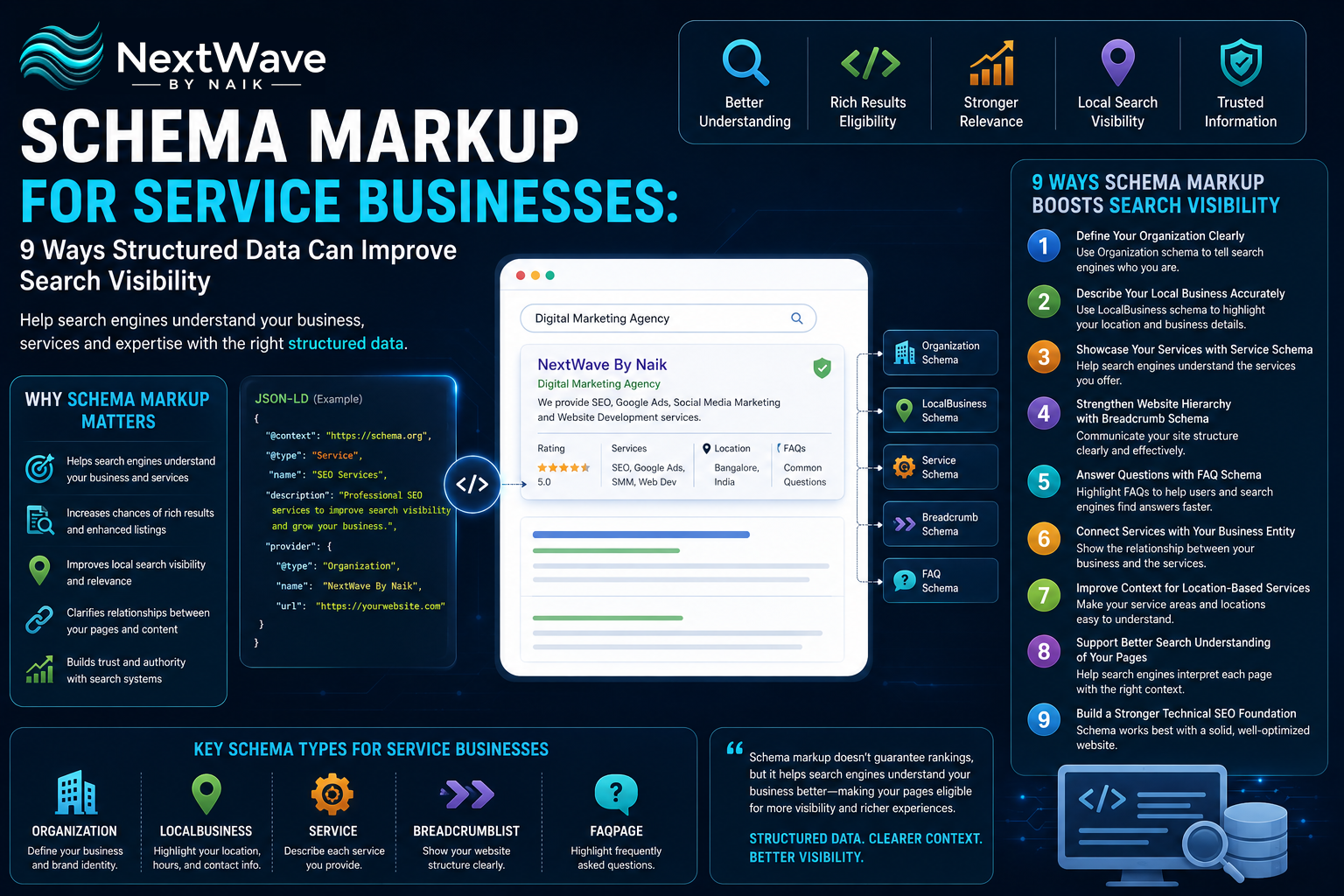
What Is Schema Markup for Service Businesses?
Service-focused structured data refers to using structured data to describe important information about a service-based organization and its webpages in a standardized, machine-readable format.
For example, a digital marketing agency might have:
- An Organization entity
- LocalBusiness information
- SEO services
- Google Ads services
- Website development services
- Breadcrumb navigation
- Frequently asked questions
- Individual service pages
Structured data can help communicate these concepts explicitly.
A simplified relationship might look like:
Business → offers → SEO Service
Business → located at → Business Location
Service Page → belongs to → Business
Webpage → has breadcrumb → Website Hierarchy
This provides additional context beyond the visible text on the page.
Why Structured Data Matters for Service Businesses
Service businesses often have complex websites.
A company may offer several services, operate in multiple locations and publish dozens of educational articles.
Without clear information architecture and structured data, search systems need to interpret these relationships primarily from the page content and site structure.
Structured data gives website owners a standardized way to describe certain information.
It can support clearer understanding of:
- Who the business is
- What services it provides
- Where it operates
- What a page is about
- How pages are organized
- What questions are answered
This makes structured data a useful component of a broader structured data SEO strategy.
9 Ways structured data Can Help Service Businesses
1. Clearly Define Your Organization
An Organization schema can help describe the business behind a website.
Relevant properties may include information such as:
- Organization name
- Logo
- Website
- Contact information where applicable
- Social profiles
- Other identifying information
For example, a business website could establish a clear relationship between its website and its organization.
Website → represents → Organization
This is particularly useful for businesses that want their digital identity to be clearly represented.
However, only include information that is accurate and actually supported by the website.
2. Describe Your Local Business
Local service businesses can use appropriate LocalBusiness structured data when the business qualifies for and accurately represents that type.
Potential information can include:
- Business name
- Address
- Opening hours where applicable
- Phone number
- Website
- Geographic information
- Business category
For example:
Business: Digital Marketing Agency
Location: Bangalore
Service: SEO
This creates additional machine-readable context around the organization.
Important:
Do not add fake addresses, locations, opening hours or other information simply to populate schema.
Structured data should accurately represent visible and verifiable information about the business.
3. Explain Your Services With Service Schema
One of the most relevant use cases for service companies is structured data.
Suppose a digital marketing company offers:
- SEO
- Google Ads
- Social Media Marketing
- Website Development
Each service can have a dedicated page explaining:
- What the service includes
- Who it is for
- Benefits
- Process
- FAQs
- Related services
- Relevant business information
Appropriate structured data can then help identify the page as representing a particular service.
For example:
Organization → offers → SEO Service
This can provide clearer context about the relationship between the company and the service.
4. Strengthen Website Hierarchy With Breadcrumb Schema
A large service website can contain several levels of navigation.
For example:
Home → Services → Digital Marketing → SEO
Breadcrumb structured data can represent this hierarchy in machine-readable form.
This helps search engines understand where a page sits within the site’s structure.
Breadcrumbs can also help users understand their position within the website.
A strong combination is:
Clear navigation + useful internal links + breadcrumb markup
Structured data should support the website’s existing hierarchy rather than attempting to create a hierarchy that does not exist.
5. Use FAQ Structured Data Carefully
Service businesses often answer questions such as:
- How much does SEO cost?
- How long does website development take?
- What does a Google Ads campaign include?
- Do you provide local SEO?
- How does your service work?
These questions can be useful sections on service pages.
Where the content meets the relevant requirements, FAQ structured data can communicate the question-and-answer structure to search engines.
However, businesses should not assume that adding FAQ markup will automatically generate an FAQ rich result.
Search features and eligibility can change, and search engines decide whether to display enhanced results.
The priority should always be creating genuinely useful FAQs for visitors.
6. Connect Services With the Business Entity
Service schema becomes more useful when it fits into the broader website structure.
For example:
Company
↓
Digital Marketing
↓
SEO Service
↓
Local SEO
↓
Technical SEO
This creates a logical relationship between the business and its services.
The website’s visible content, internal links and structured data should all communicate the same basic relationships.
This is particularly useful for businesses offering multiple services.
7. Improve Context for Location-Based Services
A service business operating in specific locations should make its service area clear.
For example:
Business
→ operates in → Bangalore
→ offers → SEO Services
→ serves → Local Businesses
The website can reinforce this through:
- Location pages where genuinely useful
- Service pages
- Business information
- Internal linking
- Appropriate local structured data
This approach is more useful than creating dozens of thin location pages with minimal differences.
Local structured data should describe the actual business and its legitimate location information.
8. Support Better Search Understanding of Your Pages
A service website can contain many different page types:
- Homepage
- About page
- Service pages
- Location pages
- Blog articles
- Contact page
- Case studies
- FAQ content
Structured data can help distinguish these different types of content where appropriate.
For example:
Homepage → Organization
Service Page → Service
Article → Article
Navigation → BreadcrumbList
Eligible FAQ Content → FAQPage
The goal is not to add every possible schema type to every page.
The goal is to use the most appropriate structured data for the content that actually exists.
9. Create a More Complete Technical SEO Foundation
Schema markup should not be viewed as an isolated SEO tactic.
It works best alongside:
- Crawlable pages
- Good site architecture
- Fast performance
- Mobile usability
- High-quality content
- Internal linking
- Clear service pages
- Accurate business information
- Search-intent optimization
Think of technical SEO as a larger system.
Schema markup is one component within that system.
If a website has poor content, confusing navigation and broken pages, adding structured data alone will not solve those problems.
Key Schema Types for Service Businesses
Different pages may require different schema types.
| Schema Type | Potential Use |
|---|---|
| Organization | Describes the business or organization |
| LocalBusiness | Describes an eligible local business |
| Service | Describes a service offered |
| BreadcrumbList | Represents breadcrumb navigation |
| FAQPage | Describes eligible FAQ content |
| Article | Describes blog or editorial content |
| WebSite | Describes the website |
| WebPage | Describes webpage-level information |
The correct implementation depends on the actual content and business model.
Schema should always reflect reality.
Example: Digital Marketing Agency
Imagine a digital marketing agency offers:
SEO
Google Ads
Social Media Marketing
Website Development
The website could have this structure:
Homepage
Organization / WebSite information
↓
Services
Overview of services
↓
SEO Service
Service information
↓
Local SEO
Detailed supporting service
↓
SEO Blog Content
Educational articles
↓
FAQ
Common customer questions
Breadcrumb structured data can help represent the hierarchy.
Service markup can describe individual services.
Organization information can describe the company.
Together, these elements form a more structured website.
How Service Schema Can Fit Into a Service Page
Consider a page titled:
SEO Services for Small Businesses
The visible page might contain:
Introduction
What the SEO service provides.
Services Included
- Keyword research
- Technical SEO
- On-page optimization
- Content strategy
- Local SEO
Process
How the company delivers the service.
Benefits
What customers can expect.
FAQs
Common questions.
CTA
How visitors can enquire.
Appropriate structured data can then reinforce the page’s underlying meaning.
The important point is that the visible page should come first.
Schema should describe the content, not replace it.
Schema Markup vs SEO Rankings
One of the most common misconceptions is:
“If I add schema markup, my website will rank higher.”
That is not guaranteed.
Structured data can help search engines understand content and can make pages eligible for certain supported search features.
But rankings depend on many factors.
These can include:
- Content relevance
- Content quality
- Search intent
- Website authority
- Technical health
- Links
- User experience
- Competition
- Location
- Query context
Therefore, schema should be considered a supporting SEO technology rather than a standalone ranking solution.
Common Schema Markup Mistakes
Adding Irrelevant Schema
Do not add schema simply because a type exists.
Use markup that accurately represents the page.
Adding Fake Business Information
Never invent addresses, phone numbers, ratings, reviews or other details.
Marking Up Invisible Content
Structured data should accurately correspond to the page content and applicable guidelines.
Using the Wrong Schema Type
A service page should not be incorrectly represented as something unrelated just because it may appear attractive in search.
Assuming Rich Results Are Guaranteed
Search engines ultimately decide whether eligible markup results in enhanced search features.
Forgetting Validation
Always validate your implementation and check for errors.
How to Implement Schema Markup
For most websites, JSON-LD is a practical implementation format.
A simplified example might look like this:
{
  "@context": "https://schema.org",
  "@type": "Service",
  "name": "SEO Services",
  "description": "Search engine optimization services for businesses.",
  "provider": {
    "@type": "Organization",
    "name": "Your Business Name"
  }
}
This is only a basic illustration.
Your actual schema should use accurate information and the appropriate properties for your business.
Do not copy example markup blindly and replace only the business name.
A Practical Schema Audit Checklist
Before publishing structured data, check the following:
Business Information
- Is the organization name accurate?
- Is the website correct?
- Is the logo correct?
- Are contact details accurate?
Services
- Are service names accurate?
- Does each service match the visible page?
- Is the provider correctly identified?
Local Information
- Is the address legitimate?
- Is the business category appropriate?
- Are opening hours accurate where provided?
Navigation
- Do breadcrumbs match the actual website hierarchy?
FAQ
- Are the questions visible on the page?
- Are the answers complete?
- Does the page genuinely contain FAQ content?
Technical
- Is the markup valid?
- Are there syntax errors?
- Does the implementation match the page?
- Are unnecessary schema types removed?
How Schema Fits Into a Broader Technical SEO Strategy
A strong technical SEO system might look like:
Crawlability
↓
Site Architecture
↓
Internal Linking
↓
Page Performance
↓
Quality Content
↓
Structured Data
↓
Search Monitoring
Schema is therefore one part of a larger process.
Businesses should first make sure search engines can access and understand the actual website.
Then structured data can provide additional machine-readable context.
Should Every Service Page Have Schema?
Not necessarily.
The correct approach depends on the page.
If a website has ten genuine service pages, each page may have an appropriate Service representation.
But adding multiple unnecessary schema types simply to increase the amount of markup is not a good strategy.
Ask:
What does this page actually represent?
Then use structured data that accurately describes that content.
Conclusion
Schema Markup for Service Businesses can provide useful machine-readable context around organizations, services, locations, breadcrumbs and eligible FAQ content.
The biggest mistake is treating structured data as a shortcut to rankings.
Instead, use it as part of a broader technical SEO strategy.
Start with accurate business information. Create useful service pages. Build logical website architecture. Connect related pages through internal links. Then implement relevant structured data that accurately describes what is already present on the page.
The goal is simple:
Help search engines understand what your business is, what it offers, where it operates and what each page represents.
When structured data is accurate, relevant and supported by a strong website, it becomes a valuable part of a modern SEO foundation.
Ready to turn blogging into a powerful SEO growth engine for your business?
At NextWave By Naik, we specialize in creating data-driven blogging strategies that improve rankings, attract organic traffic, and build long-term authority. From keyword research to content creation and optimization, we handle everything—so you can focus on growing your business.