
Entity SEO: How to Help Search Engines Understand Your Brand, Services and Expertise
Ranking for keywords is no longer the only challenge in modern search.
Search engines increasingly need to understand who a business is, what it offers, which topics it is associated with, and how different pieces of information connect.
For example, consider a digital marketing agency that provides SEO, Google Ads, social media marketing and website development. It is not enough for the website to mention these keywords repeatedly. Search systems also need to understand that these services belong to the same organization and that the organization has expertise in those areas.
This is where Entity SEO becomes important.
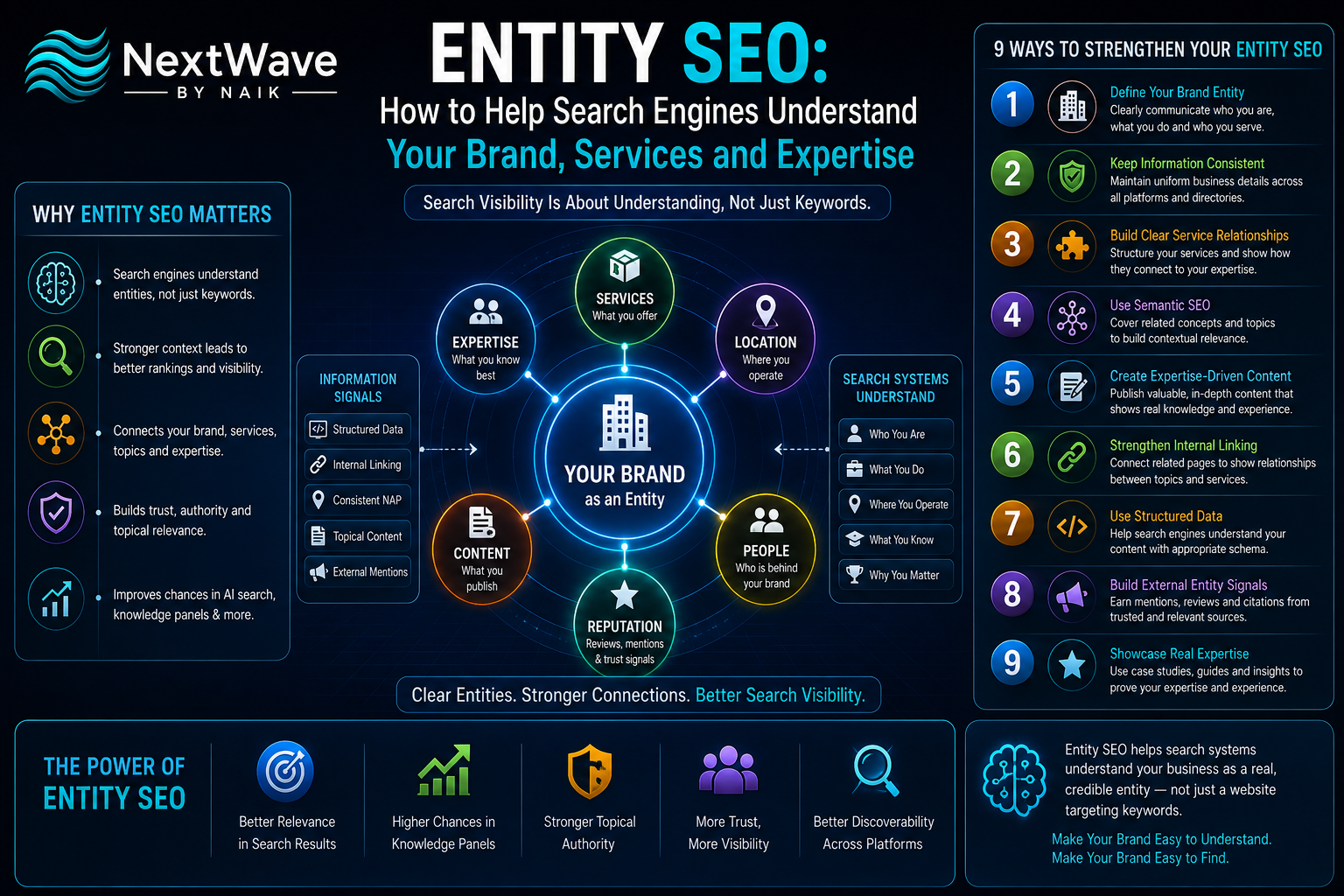
Rather than focusing only on individual keywords, Entity SEO helps businesses establish clear relationships between their brand, services, people, locations, topics and expertise.
A strong entity-focused approach can support semantic SEO, strengthen brand entity optimization, and provide clearer search entity signals across a business’s digital presence.
What Is Entity SEO?
Entity SEO is the practice of helping search engines and other search systems understand a business, person, organization, product, service or other identifiable entity and the relationships surrounding it.
A keyword describes a word or phrase.
An entity represents a real-world thing or concept.
For example:
Keyword: Digital Marketing Agency
Entity: A specific company that provides digital marketing services.
Search engines can connect information about that company with:
- Its official website
- Services
- Business location
- Social profiles
- Team members
- Products
- Reviews
- Published content
- Industry
- Related topics
The objective is to make these relationships clearer and more consistent.
Why Entity SEO Matters
Traditional SEO often focuses on questions such as:
What keyword should this page rank for?
Entity-focused SEO adds another question:
What should search systems understand about this business?
This distinction matters because modern search experiences increasingly provide answers, summaries, knowledge panels, maps, recommendations and other structured results.
A business therefore needs more than keyword visibility.
It needs context.
For example, search systems may need to understand:
Brand → provides → SEO Services
Brand → provides → Website Development
Brand → located in → Bangalore
Brand → specializes in → Digital Marketing
Brand → publishes content about → SEO
These relationships help create a clearer digital identity.
Entity SEO vs Traditional Keyword SEO
Keyword SEO and Entity SEO are not competing strategies.
They work together.
| Keyword-Focused SEO | Entity-Focused SEO |
|---|---|
| Focuses on search phrases | Focuses on entities and relationships |
| Targets specific queries | Builds broader topical understanding |
| Optimizes individual pages | Connects information across the web |
| Focuses heavily on wording | Focuses on meaning and context |
| Targets rankings | Supports broader search visibility |
For example, a company might target:
“SEO agency in Bangalore”
But Entity SEO can help search systems understand:
Company → Digital marketing agency → SEO services → Bangalore → Business website
That additional context can make the organization’s online presence more coherent.
9 Ways to Strengthen Your Entity SEO
1. Clearly Define Your Brand Entity
Start with the basics.
Your website should make it immediately clear:
- Who your business is
- What your business does
- Where it operates
- Which services it provides
- Who it serves
- What makes it different
Your About page, homepage and service pages should communicate this consistently.
For example:
NextWave By Naik is a digital marketing agency providing SEO, website development, social media and performance marketing solutions.
The exact wording can vary, but the underlying information should remain consistent across important business assets.
2. Maintain Consistent Business Information
Search engines need reliable information.
If your company name appears differently across different platforms, it can create unnecessary ambiguity.
Check important business details across:
- Website
- Google Business Profile
- Social media
- Business directories
- Industry profiles
- Review platforms
- Press coverage
- Partner websites
Pay attention to:
Business name
Website
Location
Phone number
Business description
Services
Consistency is an important part of brand entity optimization.
And importantly, businesses should never add invented information simply to create consistency. Use accurate, verified information everywhere.
3. Build Clear Service Relationships
Your services should not exist as isolated pages.
Connect them logically to your business.
For example:
Brand
↓
Digital Marketing
↓
SEO
↓
Local SEO
↓
Keyword Research
↓
Technical SEO
This structure gives search engines and users a clearer understanding of your expertise.
Each important service should have a dedicated page where appropriate.
The page should clearly explain:
- What the service is
- Who it is for
- What problems it solves
- What the business provides
- Related services
- Relevant examples
- Frequently asked questions
4. Use Semantic SEO to Build Context
Semantic SEO focuses on meaning and relationships rather than repeatedly inserting an exact keyword.
For example, if your primary topic is:
SEO Services
Related concepts could include:
- Search engine optimization
- Keyword research
- Technical SEO
- On-page SEO
- Internal linking
- Search visibility
- Organic traffic
- Search intent
- Content optimization
- Local SEO
Using relevant concepts naturally helps create a richer topical context.
The objective is not to stuff every related phrase into a page.
It is to explain the subject comprehensively.
5. Create Content Around Your Expertise
Your blog can help establish the topics your brand is associated with.
Suppose a digital marketing company wants to demonstrate expertise in SEO.
Its content could cover:
- Technical SEO
- Local SEO
- SEO content strategy
- Internal linking
- Search intent
- Website SEO
- Keyword research
- SEO analytics
- Search visibility
Over time, this creates a connected body of information around the organization’s expertise.
This is where Entity SEO overlaps with topical authority.
Your content should consistently reinforce the subjects your business genuinely understands.
6. Strengthen Internal Linking
Internal links help connect related concepts across your website.
Imagine your website has:
SEO Services
linked to:
- Technical SEO
- Local SEO
- SEO Content Strategy
- Keyword Research
- Internal Linking
- SEO Analytics
Those supporting pages can link back to the main service page when relevant.
This creates a clear relationship between:
Business → Service → Topic → Supporting Knowledge
Internal linking also helps users discover related information and navigate your website more efficiently.
7. Use Structured Data Where Appropriate
Structured data can provide search engines with machine-readable information about certain entities and content.
Depending on your business and website, relevant structured data may include:
- Organization
- LocalBusiness
- Person
- Product
- Service
- Article
- BreadcrumbList
- FAQPage where eligible and appropriate
For example, organization-related structured data can help communicate information such as:
- Organization name
- Logo
- Website
- Social profiles
Structured data does not guarantee enhanced search results.
Its purpose is to provide clearer information about the content and entities represented on the page.
8. Build Consistent External Entity Signals
Your website is only one part of your digital identity.
Search systems can encounter information about your organization across many sources.
Relevant signals can include:
- Business directories
- Industry websites
- Professional profiles
- News mentions
- Interviews
- Partnerships
- Social media profiles
- Reviews
- Event listings
- Guest contributions
The objective is not to create hundreds of low-quality listings.
Instead, focus on accurate and relevant references that reinforce the same business identity.
Quality and consistency are more valuable than creating profiles everywhere.
9. Make Your Expertise Easy to Understand
Search engines are not the only audience.
People also need to understand why your business is credible.
Create content that demonstrates genuine expertise through:
- Detailed guides
- Case studies
- Original insights
- Expert commentary
- Service explanations
- Research
- Examples
- Industry analysis
- Helpful FAQs
For example, instead of simply writing:
“We are experts in SEO.”
show that expertise through useful content explaining SEO problems and practical solutions.
Your website should demonstrate expertise rather than simply claim it.
Entity SEO and Knowledge Graphs
You may have heard the term Knowledge Graph SEO.
Knowledge graphs are systems that organize information about entities and relationships between them.
Consider a simplified example:
Company A
→ provides → SEO Services
→ provides → Website Development
→ operates in → Bangalore
→ website → Company Website
→ social profile → LinkedIn
→ publishes → SEO Content
The more clearly these relationships can be established through reliable information, the easier it becomes for systems to understand the broader context.
However, businesses should not assume that adding structured data automatically places them inside a knowledge panel or guarantees a particular search feature.
Entity understanding is based on many signals.
Entity SEO for Local Businesses
Entity optimization can be particularly useful for local businesses.
A local business should clearly communicate:
- Business name
- Location
- Service area
- Services
- Opening information where applicable
- Contact information
- Website
- Reviews
- Business category
These details should be accurate and consistent.
For example:
Business → Digital Marketing Agency
Location → Bangalore
Services → SEO, Google Ads, Social Media
This gives search systems a clearer understanding of what the organization represents.
Entity SEO for Service Businesses
Service businesses should connect their brand with the services they actually provide.
Imagine a website development company offering:
- WordPress Development
- Custom Website Development
- E-commerce Development
- Website Maintenance
- UI/UX Design
Rather than creating disconnected pages, the website can establish a clear structure:
Company
↓
Website Development
↓
Specific Services
↓
Supporting Guides
↓
Case Studies
This helps create a more coherent information architecture.
Entity SEO and AI Search
Search behaviour is increasingly expanding beyond traditional blue-link results.
Users may discover information through:
- AI-generated answers
- Search summaries
- Conversational search
- Voice assistants
- Knowledge panels
- Maps
- Shopping experiences
- Social platforms
This makes clear business information increasingly important.
If your organization is described differently across different platforms, it can be harder for systems to establish a consistent understanding.
Entity-focused optimization therefore supports a broader goal:
Make your business easy for both people and search systems to understand.
What Are Search Entity Signals?
Search entity signals are the various pieces of information that can help establish the identity and relationships of an entity.
Examples can include:
On-Website Signals
- Business name
- About page
- Service pages
- Structured data
- Internal links
- Author information
- Contact details
External Signals
- Business profiles
- Reviews
- Industry references
- Press mentions
- Social profiles
- Citations
- Partnerships
Content Signals
- Expertise
- Topic coverage
- Consistent terminology
- Relevant supporting content
- Original information
No single signal should be treated as a guaranteed ranking factor.
Entity understanding is broader than one technical optimization.
Common Entity SEO Mistakes
Inconsistent Brand Names
Using different business names across major platforms can create confusion.
Keyword Stuffing
Repeating a keyword does not automatically establish entity relevance.
Creating Thin Service Pages
A service page should provide useful information rather than simply target a keyword.
Ignoring About Pages
Your About page is an important opportunity to explain who your organization is.
Weak Internal Linking
Disconnected pages make relationships harder for users to discover.
Fake or Low-Quality Citations
Creating irrelevant profiles just to generate mentions can damage trust.
Making Unsupported Expertise Claims
Only claim expertise, certifications, awards or partnerships that are genuine and verifiable.
Entity SEO Checklist
Before publishing or updating your website, check:
Brand
- Is the business name consistent?
- Is the organization clearly described?
- Is the logo correctly represented?
Services
- Are important services clearly defined?
- Are related services internally linked?
- Are service relationships easy to understand?
Content
- Does your content demonstrate genuine expertise?
- Are related topics covered?
- Are articles connected through internal links?
Technical SEO
- Is structured data implemented appropriately?
- Are important pages crawlable?
- Is your website information architecture clear?
External Presence
- Are important business profiles accurate?
- Are social profiles consistent?
- Are third-party mentions relevant and trustworthy?
Local Presence
- Is business information accurate?
- Are location details consistent?
- Are relevant reviews and profiles maintained?
How to Build an Entity SEO Strategy
A practical strategy can follow this sequence:
Step 1: Define Your Core Entity
Who is your business?
Step 2: Define Your Services
What exactly do you provide?
Step 3: Define Your Expertise
Which subjects does your business genuinely specialize in?
Step 4: Map Relationships
How are your services, topics and customers connected?
Step 5: Improve Website Structure
Create clear pages and logical internal links.
Step 6: Strengthen Content
Publish useful information around your core expertise.
Step 7: Implement Relevant Structured Data
Help search engines interpret important information where appropriate.
Step 8: Audit External Profiles
Make important business information accurate and consistent.
Step 9: Keep Everything Updated
Entity information can change as businesses grow.
Entity SEO vs Keyword Stuffing
The difference can be summarized simply.
Keyword Stuffing:
SEO agency, best SEO agency, SEO company, SEO services, SEO agency Bangalore…
Entity-Focused Content:
Our digital marketing agency provides SEO services for businesses in Bangalore, including technical SEO, content optimization, local SEO and search performance analysis.
The second example communicates a relationship between:
Organization + Service + Location + Expertise
That is much more useful than repeatedly inserting the same keyword.
Conclusion
Modern search visibility is increasingly about understanding, not just matching words.
A successful Entity SEO strategy helps search systems understand your business as a connected entity with specific services, expertise, locations, content and relationships.
Start by clearly defining your brand.
Then create strong service pages, build related content, use strategic internal links, maintain consistent business information and implement relevant structured data.
At the same time, strengthen your presence across trustworthy external platforms and demonstrate genuine expertise through useful content.
The goal is not to manipulate search systems.
It is to make your digital identity clear, consistent, connected and useful.
When search engines and other search systems can better understand who your business is and what it does, your website has a stronger foundation for modern search visibility.
Ready to turn blogging into a powerful SEO growth engine for your business?
At NextWave By Naik, we specialize in creating data-driven blogging strategies that improve rankings, attract organic traffic, and build long-term authority. From keyword research to content creation and optimization, we handle everything—so you can focus on growing your business.