
Customer Journey Mapping across Website, Social Media, WhatsApp and Sales Teams
Today’s customers do not move in a straight line. They may discover a business on Instagram, visit the website later, ask a question on WhatsApp, and finally speak to a sales representative before making a decision. If these touchpoints are disconnected, the customer experience becomes confusing, slow, and inconsistent.
That is why building an Omnichannel Customer Journey Map is so important.
An Omnichannel Customer Journey Map helps businesses understand how people interact with their brand across every stage—from awareness to enquiry, follow-up, conversion, and retention. Instead of treating the website, social media, WhatsApp, and sales team as separate channels, journey mapping connects them into one unified customer experience.
This is especially useful for businesses that want stronger digital touchpoint mapping, a clearer lead journey strategy, and better marketing and sales alignment.
In this guide, we will break down how to map the customer journey across website, social media, WhatsApp, and sales teams in a practical and actionable way.
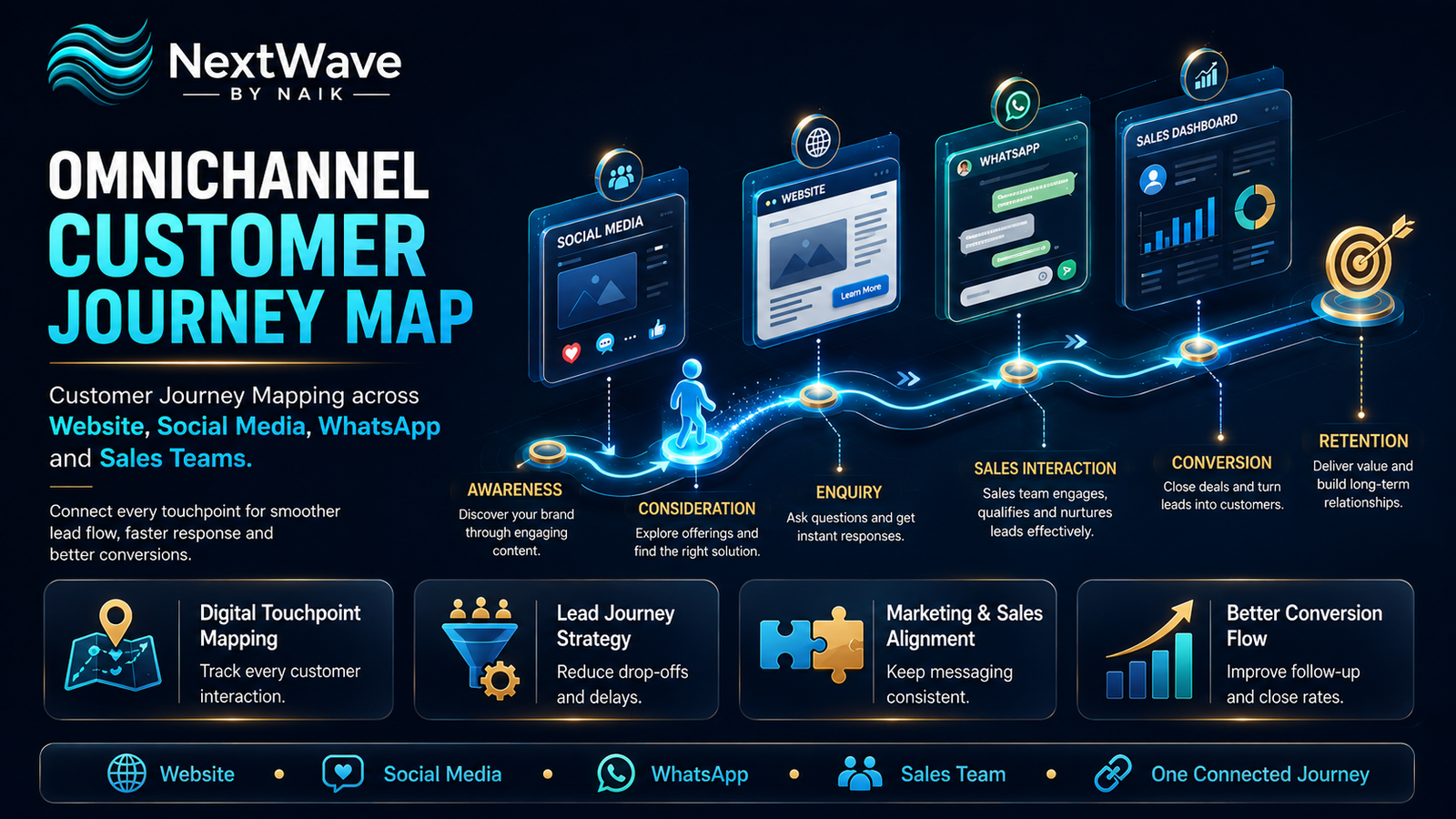
What Is an Omnichannel Customer Journey Map?
An Omnichannel Customer Journey Map is a structured view of how customers move through different brand touchpoints before, during, and after a purchase or enquiry.
It shows:
- Where customers first discover the business
- Which channels they use next
- What questions or doubts they have
- How they interact with content and communication
- When the sales team becomes involved
- What causes delays or drop-offs
- Which actions lead to conversion
Unlike a simple sales funnel, an omnichannel journey map recognizes that customers move back and forth between platforms.
For example, a typical path may look like this:
- See a Reel on Instagram
- Visit the website
- Read testimonials
- Click the WhatsApp button
- Ask for pricing
- Receive follow-up from sales
- Revisit the service page
- Confirm interest
- Convert into a customer
This connected path is the foundation of an effective Omnichannel Customer Journey Map.
Why Customer Journey Mapping Matters
Many businesses lose leads not because of poor services, but because the customer experience is fragmented.
Common problems include:
- Social media content that does not match the website
- Slow or inconsistent WhatsApp replies
- Sales teams unaware of what marketing promised
- Repeated questions because data is not shared
- No follow-up after the first enquiry
- Confusing calls to action across channels
- Poor visibility into where leads are dropping off
An Omnichannel Customer Journey Map helps solve these problems by making the full path visible.
It helps businesses:
- Improve customer experience
- Reduce friction
- Speed up response times
- Build trust across channels
- Improve conversion rates
- Align marketing and sales
- Identify gaps in communication
- Understand how leads actually move
This makes digital touchpoint mapping more practical and helps businesses create a more effective lead journey strategy.
The Core Stages of the Omnichannel Customer Journey
To build a clear Omnichannel Customer Journey Map, divide the journey into key stages.
1. Awareness
This is where the customer first becomes aware of the business.
Common awareness touchpoints include:
- Instagram Reels
- Facebook posts
- LinkedIn content
- Google Search
- Google Business Profile
- Online ads
- Referrals
- Blog articles
- YouTube Shorts
At this stage, the customer may not be ready to enquire. They are simply discovering the business.
Your goal here is visibility and relevance.
Questions to ask:
- How are customers first finding us?
- Which channels generate the most first interactions?
- What message are they seeing first?
- Is the first impression clear and strong?
2. Consideration
In the consideration stage, the customer wants to learn more.
They may:
- Visit your website
- Read service pages
- Check reviews
- Compare offers
- Explore your social profile
- View your portfolio
- Watch testimonials
- Save a post
- Read FAQs
This is where trust begins to matter more.
A strong Omnichannel Customer Journey Map should show exactly what content or proof points the customer sees before they decide to enquire.
Questions to ask:
- Are we giving the customer enough information?
- Do website and social messages match?
- Are trust signals easy to find?
- What objections are customers likely to have here?
3. Enquiry or Intent
This stage happens when the customer takes action.
That action may include:
- Filling out a contact form
- Sending a WhatsApp message
- Clicking a call button
- Booking an appointment
- Downloading a brochure
- Replying to an ad
- Sending a DM on social media
Here, response time matters a lot.
An effective lead journey strategy should ensure that no enquiry is lost, delayed, or handled inconsistently.
Questions to ask:
- Which enquiry channels are most common?
- How fast are responses?
- Is the process easy for the customer?
- Are customer details captured properly?
4. Sales Interaction
At this stage, the sales team becomes more involved.
They may:
- Call the lead
- Send pricing
- Explain services
- Share packages
- Solve objections
- Book a meeting
- Send payment details
- Follow up after no response
This is where marketing and sales alignment becomes critical.
If the marketing team promises one thing but the sales team communicates something else, trust breaks.
Questions to ask:
- Does sales know the source of the lead?
- Does sales know what message the customer saw first?
- Is sales following up on time?
- Are objections being tracked and shared with marketing?
5. Conversion
Conversion happens when the customer takes the final desired action.
This may be:
- Purchase
- Booking confirmation
- Service sign-up
- Payment
- Consultation confirmation
- Registration
A good Omnichannel Customer Journey Map should show what final step leads to conversion and what helps move the lead forward.
Questions to ask:
- What pushes the customer to convert?
- Where do most customers convert?
- What delays decisions?
- Are there checkout or process barriers?
6. Retention and Advocacy
The journey does not end at the sale.
After conversion, the business should continue the experience through:
- Service follow-up
- Order updates
- Customer care
- Review requests
- Re-engagement campaigns
- Upsell offers
- Referral requests
- WhatsApp support
- Loyalty communication
Retention is an important part of digital touchpoint mapping because returning customers often generate more value than first-time leads.
Questions to ask:
- Are customers receiving follow-up after the sale?
- Are reviews being requested?
- Are repeat opportunities being tracked?
- Is the customer being guided into the next step?
Mapping the Journey Across Key Channels
Website
The website is often the central hub in an Omnichannel Customer Journey Map.
It supports the journey by providing:
- Business information
- Service or product details
- Pricing clarity
- Testimonials
- Contact forms
- WhatsApp buttons
- Booking options
- FAQs
- Trust signals
The website should answer the customer’s key questions quickly and guide them to the next step.
Map points such as:
- Landing page visited
- Time spent
- CTA clicked
- Form completed
- Exit page
- Pages revisited before enquiry
This gives better visibility into your lead journey strategy.
Social Media
Social media plays a major role in both awareness and consideration.
It helps customers:
- Discover the brand
- See real content
- Understand brand personality
- Watch quick explanations
- View social proof
- Compare offers
- Build familiarity
When doing digital touchpoint mapping, social media should not be treated as only a content platform. It is often an entry point into the full customer journey.
Track:
- Post that triggered profile visit
- Reel that drove website traffic
- Link clicks
- DM enquiries
- Saved posts
- Audience questions
- Content themes that generate leads
This helps marketing understand what brings quality traffic.
WhatsApp often becomes the bridge between marketing and sales.
Customers like it because it is fast, familiar, and personal.
In many businesses, the real conversion journey begins when the lead moves to WhatsApp.
WhatsApp touchpoints may include:
- Auto-reply messages
- Pricing requests
- Product catalogues
- Service details
- Follow-up reminders
- Appointment scheduling
- Support messages
- Payment sharing
- Order confirmation
Your Omnichannel Customer Journey Map should clearly show:
- When the customer moves to WhatsApp
- What they usually ask first
- How long the team takes to reply
- Whether the message comes from marketing or sales
- What follow-up sequence is used
WhatsApp can improve conversion, but only if the communication is organized and timely.
Sales Teams
Sales teams turn interest into action.
But they perform best when they understand the full journey.
A lead coming from a website contact form after reading detailed content is different from a lead coming from a quick Instagram ad response. The sales conversation should reflect that.
For stronger marketing and sales alignment, the sales team should know:
- Lead source
- Campaign source
- Content engaged with
- Service interest
- Previous conversation history
- Objections already raised
- Page visited
- WhatsApp status
- Follow-up history
This prevents repetition and improves conversion quality.
How to Build an Omnichannel Customer Journey Map
1. Define the Customer Persona
Start with the type of customer you are mapping.
For example:
- Local service seeker
- Small-business owner
- E-commerce buyer
- Returning customer
- High-ticket consultation lead
Each audience may follow a different path.
A useful Omnichannel Customer Journey Map should be built around real customer behaviour, not assumptions.
2. List All Touchpoints
Write down every customer touchpoint across the journey.
Examples include:
- Instagram Reel
- Facebook ad
- Website home page
- Product page
- Blog article
- WhatsApp click
- Contact form
- Phone call
- Email reply
- Sales follow-up
- Payment page
- Review request
This is the basis of digital touchpoint mapping.
3. Identify Customer Goals at Each Stage
At every stage, the customer wants something.
Examples:
- Awareness: “What is this business?”
- Consideration: “Can I trust them?”
- Enquiry: “How much does it cost?”
- Sales: “Is this right for me?”
- Conversion: “How do I proceed?”
- Retention: “What happens next?”
A strong lead journey strategy must answer each of these questions clearly across the right channel.
4. Capture Emotions and Friction
Journey mapping is not only about actions. It is also about feelings.
At different stages, the customer may feel:
- Curious
- Interested
- Confused
- Impressed
- Uncertain
- Urgent
- Frustrated
- Reassured
Map where these emotional shifts happen.
For example:
- Curious after viewing a Reel
- Reassured after reading testimonials
- Frustrated by slow WhatsApp reply
- Confident after clear sales call
This helps improve weak points in the journey.
5. Assign Ownership
Every stage of the journey should have internal ownership.
For example:
- Social media team handles awareness content
- Website team handles landing-page clarity
- Support or sales handles WhatsApp replies
- Sales team handles consultation and follow-up
- Retention team handles reviews and post-sale communication
Without ownership, the journey becomes fragmented.
This is where marketing and sales alignment becomes operational, not theoretical.
6. Measure Key Metrics
Track performance at each stage.
Useful metrics include:
Website
- Sessions
- CTA clicks
- Form completions
- Bounce rate
- Page-to-enquiry conversion
Social Media
- Reach
- Profile visits
- Link clicks
- Saves
- DMs
- Lead-driving content
- Response time
- Number of conversations
- Lead qualification rate
- Follow-up completion
- Conversion from chat
Sales
- Call connection rate
- Quote sent
- Follow-up rate
- Lead-to-sale conversion
- Time to close
Metrics help turn your Omnichannel Customer Journey Map into a working system.
Common Gaps in the Customer Journey
A business may think it has good marketing, but still lose leads due to disconnected touchpoints.
Common issues include:
Inconsistent Messaging
The Instagram offer, website copy, and sales message do not match.
Poor Handover Between Teams
Sales has no visibility into how the lead arrived.
Slow Response on WhatsApp
Customers enquire, then wait too long for answers.
Weak Website CTAs
Visitors cannot easily move to the next step.
No Follow-Up Process
Enquiries are captured but not nurtured.
No Post-Sale Journey
Customers are forgotten after conversion.
A better Omnichannel Customer Journey Map helps identify and fix these weak spots.
Best Practices for a Strong Omnichannel Customer Journey Map
Keep Messaging Consistent
Your website, social media, WhatsApp, and sales team should all communicate the same value clearly.
Reduce Repetition
Customers should not have to repeat the same information at every stage.
Respond Quickly
Faster replies improve trust and conversion.
Use CRM or Lead Tracking
Track the movement of each lead between touchpoints.
Align Marketing and Sales Weekly
Review common objections, lead quality, and content performance regularly.
Build for Mobile
Many journeys start and continue on mobile devices.
Use Automation Carefully
Auto-replies and templates help, but they should still feel human.
Review the Journey Regularly
Customer behaviour changes. Your map should evolve too.
Omnichannel Customer Journey Map Checklist
Before finalizing your process, make sure:
- Customer personas are clearly defined
- Every digital touchpoint is listed
- Website journeys are mapped
- Social-media entry points are tracked
- WhatsApp interactions are documented
- Sales follow-up steps are defined
- Messaging is consistent across channels
- Ownership is assigned internally
- Friction points are identified
- Key metrics are being tracked
- Post-sale communication is included
- Review and retention stages are mapped
Conclusion
Customers no longer engage with businesses through just one platform. They move across social media, websites, messaging apps, and human conversations before they decide.
That is why an Omnichannel Customer Journey Map is essential.
It helps businesses create better digital touchpoint mapping, build a smarter lead journey strategy, and improve marketing and sales alignment across every customer interaction.
When the website informs, social media attracts, WhatsApp supports, and sales teams respond strategically, the full customer journey becomes smoother and more effective.
The result is not just more leads—but better customer experiences, stronger trust, and higher conversion potential.
Ready to turn blogging into a powerful SEO growth engine for your business?
At NextWave By Naik, we specialize in creating data-driven blogging strategies that improve rankings, attract organic traffic, and build long-term authority. From keyword research to content creation and optimization, we handle everything—so you can focus on growing your business.