
Video SEO Beyond YouTube: Helping Short Videos Appear Across Search and Social Platforms
Short-form video is now one of the most powerful ways to attract attention online. Businesses use Reels, Shorts, TikToks, website videos, product clips, tutorials, testimonials, and behind-the-scenes content to reach potential customers quickly.
However, creating a good video is only one part of the process.
A video may look professional and still receive limited visibility if search engines and social platforms cannot clearly understand its topic. This is where Video Search Optimization becomes important.
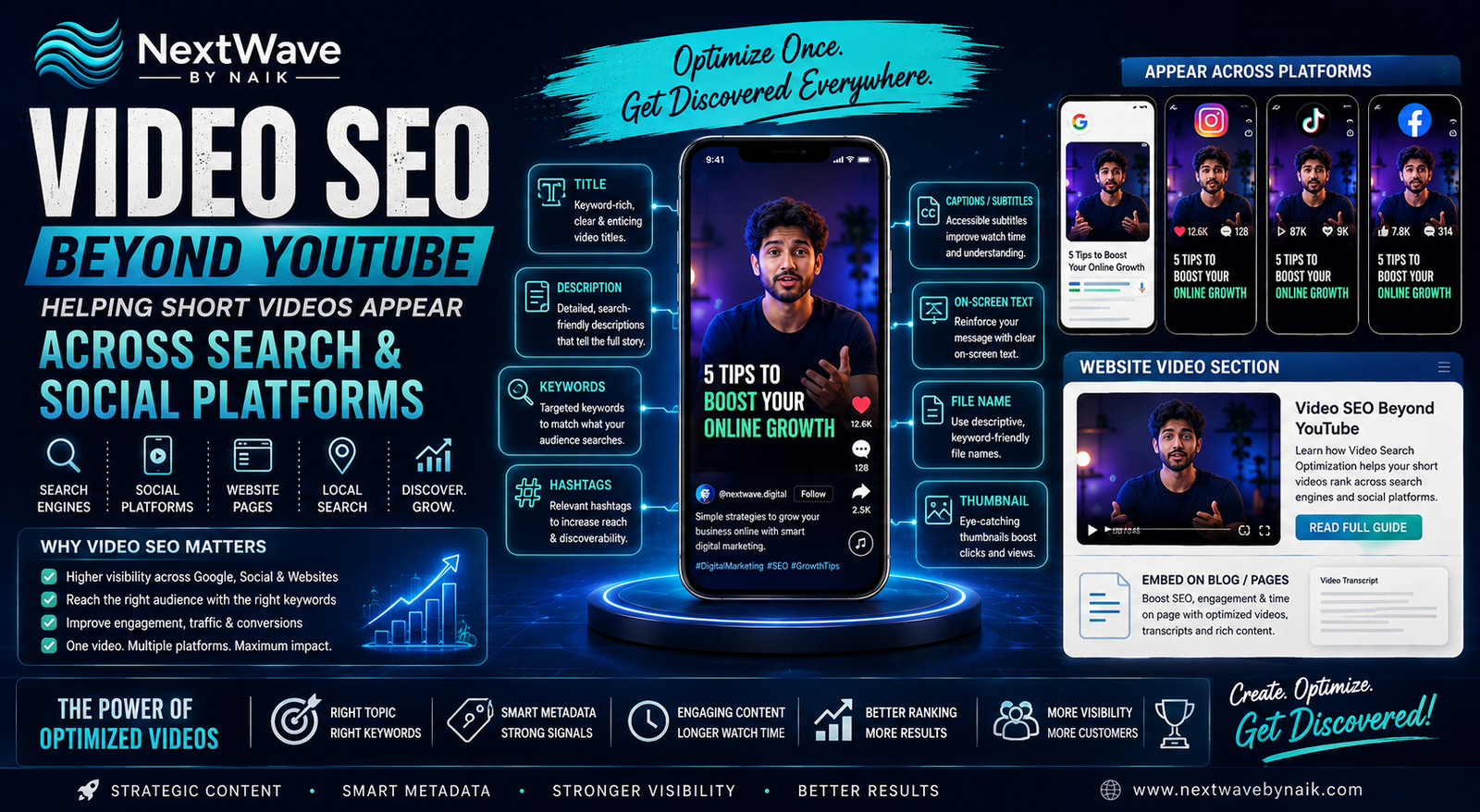
Video Search Optimization helps short videos become easier to discover across search engines, social platforms, websites, and recommendation feeds. It combines strong content, accurate metadata, useful captions, clear keywords, and proper website placement.
This guide explains how businesses can improve short video SEO, build a strong video metadata strategy, and create search-friendly reels that have a better chance of appearing in front of the right audience.
What Is Video Search Optimization?
Video Search Optimization is the process of improving a video so that search engines, social media platforms, and website visitors can understand what the video is about.
It includes elements such as:
- Video titles
- Captions
- Spoken keywords
- On-screen text
- File names
- Descriptions
- Hashtags
- Thumbnails
- Website placement
- Structured page content
- Audience engagement
The goal is not simply to make a video “go viral.” The goal is to make the video relevant, searchable, understandable, and useful.
A well-optimized video can appear in:
- Google search results
- Social-media search
- Platform recommendation feeds
- Website video sections
- Blog pages
- Product pages
- Local search results
- Suggested content feeds
Why Video SEO Matters Beyond YouTube
Many businesses think video SEO only applies to YouTube. In reality, short videos are now discovered across multiple platforms.
People may search for:
- A product demonstration
- A quick tutorial
- A salon transformation
- A local business
- A restaurant review
- A digital marketing tip
- A skincare routine
- A manufacturing process
- A service explanation
They may search through Google, Instagram, TikTok, Facebook, LinkedIn, Pinterest, or a business website.
This means businesses need a wider Video Search Optimization strategy.
A single video can support several channels when it is properly optimized. For example, one short tutorial can be used as:
- An Instagram Reel
- A YouTube Short
- A website video
- A LinkedIn post
- A Google Business Profile update
- A blog embed
- A product-page demonstration
This multiplatform approach gives the video more opportunities to be discovered.
How Search Engines and Social Platforms Understand Short Videos
Search engines and social platforms use several signals to understand video content.
These may include:
- The words used in the title
- The caption or description
- Spoken words in the video
- On-screen text
- Hashtags
- User engagement
- Video topic consistency
- Page content surrounding the video
- Watch time
- Replays
- Saves and shares
- Comments
- Click-through behaviour
This means the platform does not only depend on hashtags.
A successful video metadata strategy should make the topic clear in multiple places.
For example, a video about local SEO should clearly mention “local SEO” in:
- The title
- The caption
- The spoken introduction
- On-screen text
- The website page title
- The image or video file name
This consistency helps improve relevance.
A Practical Video Search Optimization System
1. Start With Search Intent
Before recording the video, identify what the audience is trying to find.
Search intent is the reason behind a search.
Common video-search intentions include:
- Learning something
- Comparing options
- Solving a problem
- Finding a local service
- Viewing a product
- Checking results
- Understanding a process
- Getting inspiration
For example, instead of creating a general video titled:
“Hair Transformation”
Create a more specific video such as:
“Short Bob Haircut Transformation for Round Faces”
The second option is easier for users and platforms to understand.
Specific topics usually create stronger short video SEO because they match clearer search intent.
2. Use the Main Keyword in the Video Title
The title should clearly describe what the video contains.
Avoid titles that are attractive but unclear.
Weak title:
You Need to See This
Better title:
3 Website Trust Signals That Increase Enquiries
The second title contains a clear topic and benefit.
For Video Search Optimization, place the main keyword naturally near the beginning of the title whenever possible.
Examples:
- Local SEO Tips for Small Businesses
- Video Search Optimization for Reels
- Festival Landing Page Conversion Tips
- How to Improve Website Speed
- Best Haircare Routine for Monsoon Season
The title should still sound natural and useful.
3. Add Search-Friendly Captions
Captions should provide context, not simply repeat the title.
A good caption should include:
- The main topic
- A short explanation
- Related keywords
- A clear benefit
- A call to action
Example:
Want your short videos to appear across search and social platforms? Use clear titles, spoken keywords, captions, metadata, and website placement to improve Video Search Optimization and reach more relevant viewers.
This caption includes the focus topic naturally and explains the value.
For search-friendly reels, avoid captions made only of emojis and hashtags. They may look attractive, but they provide limited search context.
4. Say the Keyword in the Video
Spoken content can support video understanding.
The main topic should be mentioned naturally near the beginning.
For example:
“In this video, we will explain how Video Search Optimization helps short videos appear across search and social platforms.”
This is clearer than starting with a vague line such as:
“Here is something every creator should know.”
The opening should tell viewers and platforms exactly what the video covers.
This also improves audience retention because viewers immediately know what they will learn.
5. Use On-Screen Text Strategically
On-screen text improves accessibility and helps reinforce the topic.
Useful on-screen text can include:
- The main title
- Step names
- Product names
- Service names
- Location
- Key benefit
- Call to action
For example:
Video SEO Beyond YouTube
Optimize Titles, Captions and Metadata
Keep the text readable and avoid adding too much information at once.
Large, clear text works better than crowded graphics.
6. Add Accurate Subtitles
On-screen text improves accessibility and helps reinforce the topic.
Subtitles make videos easier to understand, especially when viewers watch without sound.
They also support Video Search Optimization by making the spoken content available as text.
Subtitles should be:
- Accurate
- Properly timed
- Easy to read
- Free from spelling errors
- Consistent with the spoken content
Automatic captions can save time, but they should always be reviewed.
Incorrect subtitles can change the meaning of the video and reduce professionalism.
Useful on-screen text can include:
- The main title
- Step names
- Product names
- Service names
- Location
- Key benefit
- Call to action
For example:
Video SEO Beyond YouTube
Optimize Titles, Captions and Metadata
Keep the text readable and avoid adding too much information at once.
Large, clear text works better than crowded graphics.
7. Build a Strong Video Metadata Strategy
A video metadata strategy includes all the descriptive information connected to the video.
Important metadata elements include:
- Video title
- Description
- Caption
- File name
- Thumbnail text
- Alt text where supported
- Hashtags
- Categories
- Tags
- Upload date
- Location
- Page title
- Video transcript
Before uploading, rename the file clearly.
Instead of:
VID_20260805_001.mp4
Use:
video-search-optimization-short-video-seo.mp4
A descriptive file name helps keep content organised and may provide additional context when the video is added to a website.
8. Use Relevant Hashtags, Not Excessive Hashtags
Hashtags can help classify content, but they should support the topic rather than replace it.
Use a balanced combination of:
- Main-topic hashtags
- Industry hashtags
- Audience hashtags
- Location hashtags
- Brand hashtags
For example:
#VideoSearchOptimization #ShortVideoSEO #VideoMarketing #SearchFriendlyReels #DigitalMarketingTips
Avoid adding unrelated trending hashtags only to gain views.
Irrelevant hashtags may attract the wrong audience and reduce content quality.
9. Optimize the Thumbnail or Cover Image
A strong thumbnail improves click-through rates.
The cover should immediately communicate the video topic.
A good thumbnail may include:
- A clear headline
- A relevant visual
- Strong contrast
- Minimal text
- Consistent branding
Example headline:
Make Your Reels Searchable
Avoid using too many words.
The thumbnail should still be readable on a mobile screen.
10. Create Search-Friendly Reels
Search-friendly reels are designed around both audience interest and keyword clarity.
A strong Reel structure can include:
Opening Hook
State the problem or result quickly.
“Your Reel may be invisible because the platform does not understand its topic.”
Topic Explanation
Introduce the main keyword naturally.
“Video Search Optimization helps platforms classify and recommend short videos.”
Useful Steps
Provide two or three practical actions.
Clear Closing
End with a specific next step.
“Use the same keyword in your title, spoken introduction, caption, and on-screen text.”
This format helps improve clarity, retention, and relevance.
11. Place Videos on Relevant Website Pages
A video should not be uploaded randomly to a website.
Place it on a page that matches the video topic.
For example:
- Product video on a product page
- Service explanation on a service page
- Tutorial inside a related blog
- Customer testimonial on a case-study page
- Company introduction on the About page
The surrounding page content should clearly describe the video.
A page may include:
- A keyword-focused heading
- A short video introduction
- A transcript
- Related written content
- Internal links
- A clear call to action
This improves the relationship between the page and the video.
12. Add a Video Transcript
A transcript converts spoken information into written content.
This can help:
- Search engines understand the topic
- Users scan the information
- People with hearing difficulties access the content
- The page rank for related keywords
- Businesses reuse video content as a blog
The transcript does not need to appear as one large block. It can be edited into readable sections.
For example:
- Introduction
- Main tips
- Examples
- Final advice
A transcript can make a short video more valuable as website content.
13. Support the Video With Written Content
A video page should not rely only on the video.
Add supporting text that explains:
- What the video covers
- Who it is useful for
- Key takeaways
- Related services
- Important questions
- Next steps
This gives the page stronger SEO value.
For example, a short Reel about website speed can be added to a full blog about website performance.
The video attracts attention, while the written content provides depth.
14. Use One Video Across Multiple Platforms
A single video can be repurposed for several channels.
However, do not upload it with exactly the same caption everywhere.
Adjust the content for each platform.
Use a concise caption, relevant keywords, location details, and a clear CTA.
YouTube Shorts
Use a keyword-focused title and a descriptive summary.
Add professional context and business relevance.
Include more explanation and community-focused messaging.
Website
Add the video with a transcript and supporting written content.
Google Business Profile
Use local keywords, service details, and a direct action.
The core message can remain the same, but the metadata should fit the platform.
15. Include Location Keywords for Local Businesses
Local businesses should use location signals in their videos.
Examples:
- Digital marketing agency in Bengaluru
- Salon in BTM Layout
- Spa in Bilekahalli
- Perfume manufacturer in India
- Website developer in Bengaluru
Location can be included in:
- Caption
- Spoken content
- On-screen text
- Title
- Hashtags
- Website page
- Business profile
This can improve local relevance and help nearby customers discover the business.
16. Improve Engagement Signals
Good metadata helps platforms understand a video. Engagement helps show whether users find it useful.
Important engagement signals include:
- Watch time
- Video completion
- Replays
- Saves
- Shares
- Comments
- Profile visits
- Link clicks
To improve engagement:
- Start quickly
- Avoid long introductions
- Keep one clear topic
- Add useful information
- Use readable captions
- End with a question or CTA
- Match the title with the actual content
Do not use misleading hooks. They may increase initial views but reduce trust and retention.
17. Add Clear Calls to Action
Every video should have a purpose.
Useful calls to action include:
- Visit the website
- Read the full guide
- Book a consultation
- Send a message
- Save the video
- Follow for more tips
- View the product
- Download the checklist
- Comment with a question
The CTA should match the content.
For example:
“Read the full Video Search Optimization guide on our website.”
This connects social content to website traffic.
18. Track Video Performance Across Platforms
A strong Video Search Optimization strategy should be measured regularly.
Track:
- Search views
- Total views
- Watch time
- Completion rate
- Saves
- Shares
- Comments
- Website clicks
- Leads
- Conversions
- Traffic source
- Ranking keywords
Do not judge success only by total views.
A video with fewer views but more website enquiries may be more valuable than a video with high reach and no business results.
Common Video SEO Mistakes
Using Vague Titles
Unclear titles make it difficult for users and platforms to understand the topic.
Ignoring Captions
A short caption may miss valuable keyword context.
Depending Only on Hashtags
Hashtags are only one part of a complete video metadata strategy.
Uploading Without Subtitles
This reduces accessibility and may limit content understanding.
Using the Same Caption Everywhere
Each platform has different audience behaviour and search patterns.
Posting Videos on Unrelated Website Pages
The video should match the surrounding page topic.
Focusing Only on Views
Search visibility should support business goals, not only vanity metrics.
Using Artificial Engagement
Purchased views and fake comments do not create meaningful growth.
Video Search Optimization Checklist
Before publishing a short video, confirm that:
- The topic matches clear search intent
- The main keyword appears in the title
- The keyword is spoken naturally
- On-screen text explains the topic
- Subtitles are accurate
- The caption provides useful context
- The file name is descriptive
- Hashtags are relevant
- The thumbnail is clear
- The video has one main purpose
- The CTA is specific
- The video is placed on a relevant website page
- Supporting text is included
- A transcript is available where useful
- Location keywords are added for local businesses
- Performance tracking is active
Conclusion
Video visibility is no longer limited to YouTube.
People discover short-form content through search engines, social-media search, recommendation feeds, websites, local business listings, and product pages. This makes Video Search Optimization an important part of modern digital marketing.
A strong strategy combines clear topics, accurate captions, spoken keywords, on-screen text, subtitles, metadata, website placement, and useful supporting content.
Effective short video SEO does not depend on one trick. It depends on making the video easy for both users and platforms to understand.
By using a consistent video metadata strategy and creating search-friendly reels, businesses can give each video more opportunities to attract the right audience, generate website traffic, and support enquiries.
Ready to turn blogging into a powerful SEO growth engine for your business?
At NextWave By Naik, we specialize in creating data-driven blogging strategies that improve rankings, attract organic traffic, and build long-term authority. From keyword research to content creation and optimization, we handle everything—so you can focus on growing your business.