
A Practical Digital Growth System for Small Businesses with Limited Budgets
Small businesses often know they need digital marketing, but the process can feel overwhelming. There are websites to manage, social media posts to create, enquiries to follow up, customer reviews to collect, advertisements to run, and results to track.
The biggest challenge is usually not a lack of opportunities. It is a lack of time, budget, and a clear system.
Effective Digital Marketing for Small Business does not require being active on every platform or spending heavily on advertising. A small business can grow online by focusing on a few connected activities that consistently attract attention, build trust, generate enquiries, and convert those enquiries into customers.A structured approach to Digital Marketing for Small Business helps owners use limited time, money, and resources more effectively
This guide explains how to create a practical and affordable digital growth system without wasting money on disconnected marketing activities.
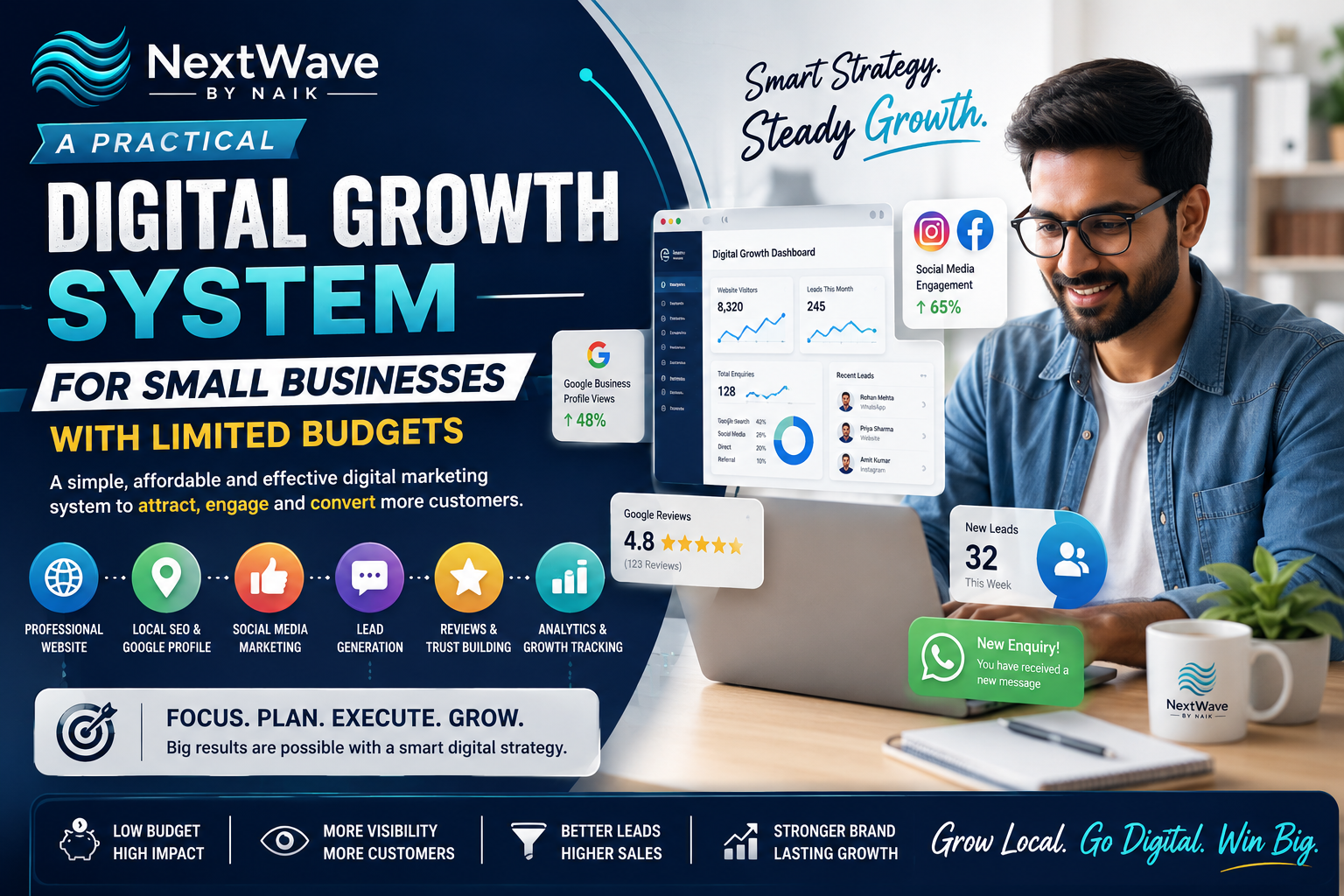
What Is a Digital Growth System?
Instead of treating the website, social media, Google Business Profile, advertisements, and customer reviews as separate tasks, a growth system connects them.
For example, a customer may:
- Discover the business through Google
- Visit the website
- Read customer reviews
- Send an enquiry through WhatsApp
- Receive a follow-up message
- Purchase the service
- Leave a review
- Recommend the business to someone else
Each digital platform supports the next stage of the customer journey.
This connected approach makes small business online growth more manageable and measurable.
Why Small Businesses Need a System Instead of Random Marketing
Many small businesses use digital marketing without a clear structure.
They may post on Instagram for a few weeks, stop posting, run an advertisement for a few days, redesign the website, and then wait for enquiries.
These isolated efforts often fail because they are not connected to a consistent customer journey.
Common problems include:
- Posting without a clear objective
- Running advertisements without a proper landing page
- Sending leads to an inactive social profile
- Having a website without strong calls to action
- Receiving enquiries without following up
- Asking for reviews inconsistently
- Tracking likes instead of leads and sales
- Spending across too many platforms
A practical affordable digital strategy focuses on the smallest number of activities that can produce steady results.
The goal is not to do more marketing. The goal is to make every marketing activity support the next one.This is why Digital Marketing for Small Business should operate as one connected system instead of several unrelated activities.
The Practical Digital Growth System
1. Start Your Digital Marketing for Small Business Plan With One Clear Goal
Before choosing platforms or creating content, decide what the business wants to achieve.
A goal should be connected to a real business result.
Examples include:
- Generate 30 qualified enquiries per month
- Increase bookings for a specific service
- Sell more of a high-margin product
- Get more customers from a particular area
- Increase repeat purchases
- Improve Google reviews
- Build awareness before launching a new service
Avoid vague goals such as:
- Get more followers
- Go viral
- Improve engagement
- Post more regularly
These may support growth, but they are not complete business outcomes.
A clear goal helps determine which channels, content, and calls to action should receive attention.
2. Define the Most Valuable Customer
A limited budget should not be used to market to everyone.
Small businesses need to identify the type of customer most likely to purchase.
Consider:
- Location
- Age group
- Budget
- Problem or need
- Buying urgency
- Preferred platform
- Main concern before purchasing
- Reason for choosing one business over another
For example, a local salon may target working professionals within five kilometres who want convenient weekend appointments.
A home-service business may focus on apartment residents who need fast support and trust verified providers.
Understanding the customer helps create better offers, website content, advertisements, and follow-up messages.
3. Build a Simple Local Business Website
A professional local business website acts as the central point of the digital growth system.In Digital Marketing for Small Business, the website becomes the main platform for building credibility, presenting services, and generating enquiries.
Social media platforms can change, advertising costs can rise, and accounts can lose reach. A website gives the business more control over its information, enquiries, and customer experience.
A small-business website does not need dozens of pages.
A basic structure can include:
- Homepage
- About page
- Services or products
- Customer reviews
- Contact page
- Frequently asked questions
- Location and service areas
The homepage should immediately answer:
- What does the business offer?
- Who is it for?
- Where is the business located?
- Why should customers trust it?
- What should the visitor do next?
Strong calls to action may include:
- Call Now
- Send a WhatsApp Message
- Request a Quote
- Book an Appointment
- Visit Our Store
- Get a Free Consultation
The website should work properly on mobile devices because many local customers will visit it through Google Maps, Instagram, WhatsApp, or mobile advertisements.
4. Optimise Google Business Profile
For local businesses, Google Business Profile can be one of the most valuable free marketing tools.
It helps businesses appear in:
- Google Search
- Google Maps
- Local search results
- “Near me” searches
The profile should include:
- Correct business name
- Address or service area
- Phone number
- Website
- Business hours
- Product or service categories
- High-quality photos
- Service descriptions
- Customer reviews
- Regular updates
Businesses should also answer customer questions and respond to reviews.
A complete and active profile supports small business online growth because customers can discover, evaluate, and contact the business without visiting multiple platforms.
5. Focus on One or Two Social Media Platforms
A small business does not need to be active everywhere.
Choose platforms based on where the target customer spends time.
For example:
- Instagram may work well for salons, restaurants, fashion, fitness, beauty, décor, and lifestyle businesses.
- Facebook can support local communities, older audiences, events, and service businesses.
- LinkedIn may be better for consultants, agencies, manufacturers, and B2B businesses.
- YouTube can help businesses that need demonstrations, tutorials, or educational content.
Consistency on one suitable platform is more valuable than irregular activity across five platforms.
A simple weekly content plan can include:
- One educational post
- One customer result or testimonial
- One product or service post
- One behind-the-scenes post
- One direct promotional post
Every post should support a purpose, such as building trust, answering questions, showing results, or generating enquiries.
6. Create Content Around Customer Questions
Small businesses often struggle with content because they focus only on promotions.
A better approach is to create content around the questions customers already ask.
Examples include:
- How much does the service cost?
- How long does it take?
- What is included?
- Which option is best?
- Is it suitable for beginners?
- Do you provide home delivery?
- Which locations do you serve?
- What happens after booking?
- How is your service different?
- Is there a warranty or guarantee?
Answering these questions through posts, reels, blogs, and videos helps attract potential customers and builds credibility.
Useful content can also reduce the time spent answering the same questions repeatedly.
7. Create One Strong Offer
Marketing becomes easier when the business has a clear offer.
A strong offer is not always a discount. It can be a combination of value, convenience, urgency, and reduced risk.
Examples include:
- Free consultation
- Free delivery above a certain order value
- First-service discount
- Product bundle
- Complimentary assessment
- Limited-time upgrade
- Trial session
- Free quotation
- Seasonal package
The offer should clearly explain:
- What the customer receives
- Who it is for
- Why it is valuable
- How long it is available
- What action to take
One strong offer can be promoted through the website, social media, Google Business Profile, email, WhatsApp, and advertisements.
This is more effective than promoting several unrelated offers at the same time.
8. Use Low-Budget Advertising Carefully
Paid advertising can support growth, but it should not be the first step.
Before running ads, confirm that the business has:
- A clear offer
- A working website or landing page
- Strong trust signals
- A simple enquiry process
- A follow-up system
- Conversion tracking
Small businesses can start with a controlled daily budget and one campaign objective.
Depending on the business, the campaign may focus on:
- WhatsApp enquiries
- Lead forms
- Website enquiries
- Calls
- Appointment bookings
- Product purchases
Avoid dividing a small budget across too many campaigns, audiences, and platforms.
A focused campaign gives clearer data and makes optimisation easier.
9. Create a Fast Lead-Response System
Generating enquiries is only one part of digital marketing.
Many businesses lose potential customers because they respond too slowly or do not follow up properly.
Create a simple lead-response process:
Immediate response
Send a quick acknowledgement through WhatsApp, email, or an automated form message.
Example:
“Thank you for contacting us. We have received your enquiry and will respond shortly.”
First conversation
Ask only the information needed to understand the requirement.
Follow-up
If the customer does not respond, send a polite reminder.
Final follow-up
Provide helpful information, an offer deadline, or an easy way to continue the conversation.
Lead information can be tracked in a spreadsheet or a simple customer relationship management tool.
Useful columns include:
- Name
- Phone number
- Enquiry date
- Required service
- Lead source
- Status
- Follow-up date
- Final result
This simple system prevents valuable enquiries from being forgotten.
10. Use WhatsApp as a Conversion ChannelFast Lead-Response System
For many small businesses, WhatsApp is one of the easiest tools for converting interest into enquiries and sales.
It can be used for:
- Product catalogues
- Appointment confirmations
- Quotations
- Follow-up messages
- Order updates
- Customer support
- Review requests
- Repeat-purchase reminders
Create standard message templates for common situations.
Examples include:
- New enquiry response
- Price quotation
- Appointment reminder
- Payment confirmation
- Delivery update
- Review request
Templates save time while keeping communication professional and consistent.
However, messages should still feel personal and relevant to the customer.
11. Build Trust Before Asking for the Sale
Customers often hesitate because they are uncertain about quality, reliability, pricing, or support.
Trust can be strengthened using:
- Customer reviews
- Testimonials
- Before-and-after examples
- Case studies
- Real business photos
- Founder or team introduction
- Certifications
- Transparent pricing
- Clear policies
- Contact information
- Google ratings
These elements should appear on the website, social profiles, landing pages, and advertisements.
A small business may not have a large brand name, but it can still look credible by being transparent, consistent, and professional.
12. Create a Review Collection Process
Reviews are valuable because they influence future customers and improve local credibility.
Do not wait for customers to leave reviews automatically.
Create a simple process:
- Complete the service or delivery
- Confirm that the customer is satisfied
- Send the direct review link
- Ask politely for honest feedback
- Respond to the review
A review request can say:
“Thank you for choosing us. Your feedback helps our small business grow and helps other customers make confident decisions.”
Reviews can later be reused as:
- Social media posts
- Website testimonials
- Sales-page proof
- Advertisement creatives
- Case-study content
This turns one customer experience into multiple trust-building assets.
13. Encourage Repeat Business
It is often easier to sell again to an existing customer than to acquire a completely new one.
Small businesses can encourage repeat purchases through:
- Reorder reminders
- Maintenance reminders
- Seasonal offers
- Loyalty benefits
- Referral rewards
- New-product updates
- Birthday or anniversary offers
- Service renewal messages
Customer contact information should be organised carefully and used respectfully.
The goal is to remain helpful and relevant, not to send excessive promotional messages.
14. Track Only the Numbers That Matter
A practical growth system does not require complicated reports.
Track a few important metrics every month:
- Website visitors
- Calls
- WhatsApp enquiries
- Form submissions
- Cost per lead
- Qualified leads
- Sales
- Revenue from digital channels
- Google review growth
- Conversion rate
- Repeat customers
Avoid judging performance only through:
- Likes
- Impressions
- Followers
- Video views
These metrics may indicate attention, but they do not always show whether marketing is generating business results.
For example:
If a campaign generates 50 leads and 10 become customers, the lead-to-customer conversion rate is 20%.
This helps the business identify whether the issue is traffic, lead quality, pricing, or follow-up.
A Simple Monthly Digital Marketing Plan
A small business can use the following monthly structure.
Week 1: Foundation
- Update the website
- Check contact forms and WhatsApp links
- Update Google Business Profile
- Review business information
- Select the monthly offer
Week 2: Content
- Publish educational content
- Share a testimonial
- Post a product or service demonstration
- Answer a frequently asked question
- Create one short video
Week 3: Promotion
- Promote the strongest offer
- Run a small advertisement
- Share the offer through WhatsApp
- Contact previous customers where appropriate
- Post the offer on Google Business Profile
Week 4: Follow-Up and Review
- Follow up with open leads
- Ask customers for reviews
- Review enquiries and sales
- Identify the best-performing content
- Adjust the next month’s plan
This creates a repeatable affordable digital strategy without requiring daily complex campaigns.
How to Allocate a Limited Digital Marketing Budget
The exact allocation depends on the business, but a simple percentage-based approach can help.
Website and Landing Pages
Invest in a functional website that can support enquiries, bookings, or purchases.
Content Creation
Create useful and reusable content rather than posting only promotional graphics.
Advertising
Use a controlled budget to promote proven offers.
Tools
Choose affordable tools for design, scheduling, analytics, lead tracking, and communication.
Testing
Keep a small amount available for testing different offers, advertisements, and landing-page messages.
Do not spend the entire budget on advertising while ignoring the website, trust signals, and follow-up process.
Advertising brings people into the system. The rest of the system determines whether they become customers.
Common Mistakes Small Businesses Should Avoid
Trying to Use Every Platform
Choose the platforms most relevant to your customers.
Posting Without a Call to Action
Tell the audience what to do next.
Running Ads Without a Clear Offer
Customers need a specific reason to respond.
Ignoring the Website
Social media alone may not provide enough information or credibility.
Responding Slowly to Leads
Fast responses improve the chance of conversion.
Focusing Only on New Customers
Existing customers can provide repeat sales, reviews, and referrals.
Not Tracking Lead Sources
Always record whether a lead came from Google, Instagram, Facebook, the website, or referrals.
Changing Strategy Too Frequently
Give a clear system enough time to produce useful data before replacing it.
Final Digital Marketing for Small Business Checklist
Use this Digital Marketing for Small Business checklist to confirm that your website, content, local visibility, lead management, reviews, and follow-up process are working together.
- One clear business goal
- A defined target customer
- A professional local business website
- An updated Google Business Profile
- One or two active social platforms
- A monthly content plan
- One strong promotional offer
- A controlled advertising budget
- A fast enquiry-response process
- A lead-tracking system
- Visible reviews and trust signals
- A review collection process
- A repeat-customer strategy
- Monthly performance tracking
Conclusion
Successful Digital Marketing for Small Business is not about having the largest budget; it is about using a clear, connected, and repeatable growth system. It is about creating a connected system that consistently moves people from discovery to trust, enquiry, purchase, review, and repeat business.
A professional local business website, active Google presence, focused social content, strong offer, fast lead follow-up, and simple reporting system can create steady small business online growth.
The most effective affordable digital strategy is one that the business can realistically maintain.
Start with the essential foundations, measure real business results, and improve one part of the system at a time. Consistent execution will usually create better long-term growthThe long-term success of Digital Marketing for Small Business depends more on consistency, customer understanding, and connected execution than on high spending. than occasional large campaigns without a clear process.
Ready to turn blogging into a powerful SEO growth engine for your business?
At NextWave By Naik, we specialize in creating data-driven blogging strategies that improve rankings, attract organic traffic, and build long-term authority. From keyword research to content creation and optimization, we handle everything—so you can focus on growing your business.