
Headless or Traditional WordPress: Choosing the Right Architecture for Business Growth
When businesses plan a new website or consider upgrading an existing one, one of the biggest decisions is choosing the right platform architecture. Today, many brands are comparing Headless WordPress vs Traditional WordPress to understand which option offers better speed, flexibility, scalability, and long-term value.
WordPress has been the backbone of millions of websites for years. It is trusted, familiar, and highly customizable. But as digital experiences become more advanced, businesses are now exploring headless setups that separate the content management system from the front-end user experience.
So, which one is better for growth?
The answer depends on your business goals, technical resources, content needs, and expansion plans. This CMS decision guide will help you understand both approaches clearly and choose the best fit for your business.
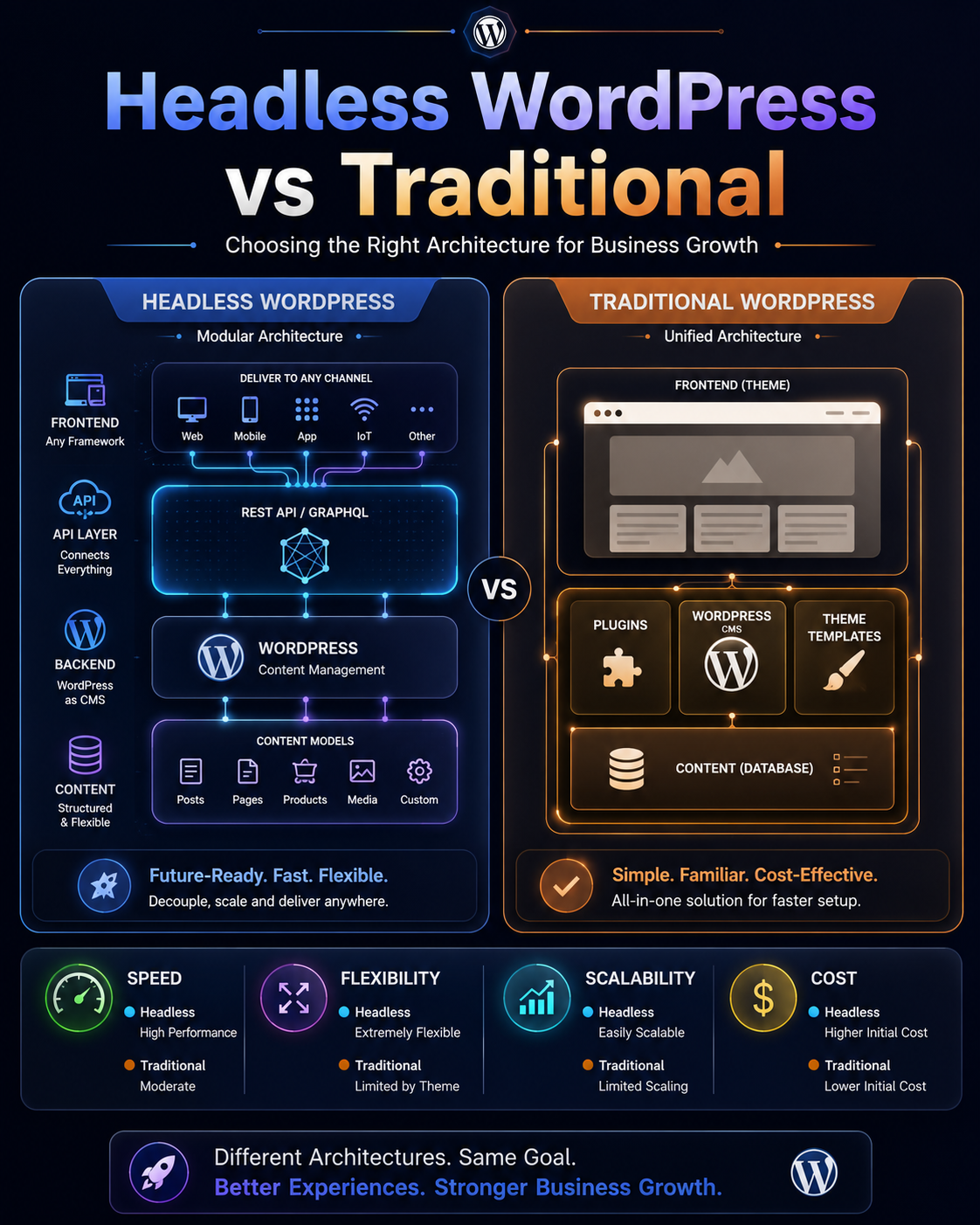
What Is Traditional WordPress?
Traditional WordPress is the standard setup most people are familiar with. In this model, WordPress manages both:
- the backend (where content is created and managed), and
- the frontend (how the website appears to visitors).
This means your website theme, plugins, content, and admin panel all work together in one unified system.
For many businesses, this setup is practical because it is easy to manage, widely supported, and cost-effective.
Key Features of Traditional WordPress
- All-in-one website management
- Easy plugin integration
- Large ecosystem of themes and developers
- Faster setup for standard business websites
- Simple content publishing workflow
Traditional WordPress works especially well for blogs, service websites, corporate sites, local businesses, and small-to-medium websites.
What Is Headless WordPress?
Headless WordPress uses WordPress only as the content management backend, while the frontend is built separately using technologies such as React, Next.js, Vue, or other frameworks.
In simple words, the “head” — meaning the presentation layer — is removed from WordPress. Content is delivered through APIs to a custom frontend.
This gives developers more control over performance, user experience, and multi-platform delivery.
Key Features of Headless WordPress
- Backend and frontend are separated
- Content is delivered through APIs
- More flexibility in frontend design and development
- Better suited for advanced applications
- Can power websites, apps, kiosks, and other digital platforms from one CMS
This approach is often used by larger brands, tech-driven businesses, and companies looking for scalable website development.
Headless WordPress vs Traditional: The Core Difference
The main difference in Headless WordPress vs Traditional comes down to how the website is built and delivered.
Traditional WordPress
- One system manages everything
- Easier to launch and maintain
- Ideal for content-driven websites with standard features
Headless WordPress
- WordPress manages content only
- Frontend is custom-built separately
- Best for advanced performance, flexibility, and complex digital experiences
Think of traditional WordPress as a ready-to-run setup, while headless WordPress is a more custom-engineered architecture.
Why Website Architecture Matters for Business Growth
Choosing the right WordPress architecture is not just a technical decision. It directly affects your business performance.
Website architecture influences:
- page speed,
- SEO performance,
- user experience,
- scalability,
- maintenance cost,
- content management efficiency,
- and future expansion.
A website that supports your business goals can improve lead generation, engagement, conversions, and brand credibility. A poor architecture choice can create limitations later.
That is why this decision should be based on long-term growth, not just current convenience.
Benefits of Traditional WordPress
Traditional WordPress remains the preferred choice for many businesses, and for good reason.
1. Easier to Build and Manage
Since everything is within one system, business owners and content teams can manage the site more easily without needing a highly technical workflow.
2. Lower Development Cost
For many websites, traditional WordPress is more affordable because it uses existing themes, plugins, and standard development processes.
3. Faster Launch Time
Businesses that need a website quickly often prefer traditional WordPress because setup and deployment are straightforward.
4. Strong Plugin Ecosystem
SEO tools, forms, e-commerce features, booking systems, performance plugins, and security tools are widely available.
5. Great for Content-Driven Websites
If your website focuses heavily on blogs, landing pages, services, and basic marketing functionality, traditional WordPress can be highly effective.
Challenges of Traditional WordPress
Traditional WordPress is powerful, but it is not perfect.
1. Limited Frontend Flexibility
Custom experiences are possible, but they may become harder to maintain as complexity increases.
2. Performance Constraints
Too many plugins, bulky themes, or poor optimization can slow down the website.
3. Security Exposure
Since the frontend and backend are connected, traditional setups may require more careful security management.
4. Scaling Can Get Messy
As business requirements become more advanced, the all-in-one structure can sometimes feel restrictive.
Challenges of Headless WordPress
Headless WordPress also comes with trade-offs.
1. Higher Development Cost
Because the frontend is custom-built, development is usually more expensive than traditional WordPress.
2. More Technical Complexity
You may need experienced developers to build, maintain, and update the system.
3. Longer Setup Time
Headless projects typically take more planning and development time.
4. Plugin Compatibility Is Different
Not all WordPress plugins work in the same way in a headless environment, especially those tied directly to frontend rendering.
5. Content Preview and Workflow Complexity
Some publishing workflows may require extra setup to give editors a smooth experience.
Headless WordPress vs Traditional: Which Is Better for SEO?
SEO depends on implementation, not just architecture alone.
Traditional WordPress for SEO
Traditional WordPress is excellent for SEO because:
- it supports plugins like Yoast or Rank Math,
- metadata management is easy,
- content publishing is simple,
- and many SEO best practices are already well supported.
Headless WordPress for SEO
Headless WordPress can also perform very well for SEO, especially when built properly. In some cases, it may even be better because of improved speed and cleaner frontend performance.
However, SEO must be handled carefully in a headless setup, including:
- metadata rendering,
- indexing structure,
- canonical tags,
- sitemap generation,
- structured data,
- and page rendering strategy.
If SEO simplicity is your priority, traditional WordPress may feel easier. If performance-driven SEO is your goal and you have technical resources, headless can be a strong option.
Headless WordPress vs Traditional: Which Is Better for Scalability?
When comparing Headless WordPress vs Traditional for growth, scalability is a major factor.
Choose Traditional WordPress if:
- your website is mainly informational,
- your content structure is straightforward,
- you want lower cost and faster deployment,
- or your team prefers easier ongoing management.
Choose Headless WordPress if:
- you need a fast, highly customized experience,
- you expect traffic growth at scale,
- you want to serve content across multiple channels,
- or your platform requirements will become more advanced over time.
For scalable website development, headless often offers more long-term flexibility, but only if your business is ready for the additional complexity.
Who Should Use Traditional WordPress?
Traditional WordPress is often the right choice for:
- small and medium businesses,
- agencies building standard business websites,
- bloggers and publishers,
- local service providers,
- portfolio websites,
- educational sites,
- and businesses that need speed and cost-efficiency.
If your goal is a professional website that is manageable, functional, and easy to update, traditional WordPress is often more than enough.
Who Should Use Headless WordPress?
Headless WordPress is better suited for:
- tech-focused startups,
- enterprise-level businesses,
- brands with custom web experiences,
- businesses needing app + website integration,
- e-commerce projects with complex UX demands,
- and companies planning long-term digital expansion.
If your website is becoming part of a larger digital ecosystem, headless WordPress may be the smarter investment.
A Simple CMS Decision Guide for Businesses
If you are still unsure, use this quick CMS decision guide:
Go with Traditional WordPress if:
- you want a cost-effective solution,
- you need a website live quickly,
- your site is content-focused,
- your team wants simplicity,
- and your functionality needs are relatively standard.
Go with Headless WordPress if:
- you need advanced flexibility,
- performance and scalability are top priorities,
- you have access to technical development resources,
- your business needs a custom digital experience,
- or you want one CMS powering multiple platforms.
Final Verdict: Headless WordPress vs Traditional
There is no one-size-fits-all answer in the Headless WordPress vs Traditional debate. The right choice depends on what your business needs today and what it will need tomorrow.
Traditional WordPress is ideal for businesses that want speed, simplicity, affordability, and strong content management in one place.
Headless WordPress is ideal for businesses that want flexibility, performance, and future-ready WordPress architecture built for more advanced digital growth.
Before choosing, think beyond the launch. Consider:
- your budget,
- your internal team,
- your growth plans,
- your user experience expectations,
- and the complexity of your digital ecosystem.
The best architecture is not the most trendy one — it is the one that supports your business goals most effectively.
Conclusion
Choosing between Headless WordPress vs Traditional is an important step for any business investing in a strong online presence. Both options have real advantages, and both can support growth when used in the right context.
If you want a simple, powerful, and efficient site, traditional WordPress remains a smart option. If you need more flexibility, faster performance potential, and scalable website development, headless WordPress may be the better path.
Use this CMS decision guide to match your website architecture to your business strategy — because the right technical foundation can make a real difference in long-term growth.
Ready to turn blogging into a powerful SEO growth engine for your business?
At NextWave By Naik, we specialize in creating data-driven blogging strategies that improve rankings, attract organic traffic, and build long-term authority. From keyword research to content creation and optimization, we handle everything—so you can focus on growing your business.